
For summer crops such as maize, soya beans, and sunflower, weed control cannot be treated as a problem to be dealt with once weeds become visible. By then, valuable crop development may already have been compromised.
Meiring, says that the early establishment phase is one of the most important periods for getting weed management right. This is because weeds compete with crops for water and nutrients at a stage when crops are establishing their yield potential.
“Maize determines its yield potential between the three- and five-leaf stages. Any stress that occurs before that stage, whether it is weather, water, insects, fungi, or weeds, can have an impact. But the biggest one is weeds. If you don’t have 100% weed control until the V5, or five-leaf stage, the damage to yield has already been done, and it is irreversible,” he says.
His point is central to an effective summer crop weed-management strategy: preventing early competition is more important than trying to rescue a crop after weeds have already established.
For farmers preparing for the summer season, this means weed management should begin well before planting and continue throughout the crop cycle, with particular attention paid to the period immediately before and after emergence.
The battle starts before the crop emerges
A common misconception is that weed control starts once the crop is in the ground and weeds begin emerging. Meiring says farmers should instead approach weed control as a continuous process that starts after the previous crop has been harvested.
“Straight after harvest, certain weeds need to be dealt with because you can’t deal with them later,” he says.
Depending on the production system and field conditions, farmers may use a winter spray to control weeds and prepare the field for the next crop. However, the decision cannot simply be based on eliminating every plant from the field.
There is a balance between controlling weeds and maintaining soil cover and organic material.
“If it’s maize, farmers will always keep the residue that stays behind and use that for cattle feed, which they should. And then after that, they’ll start working the fields,” says Meiring.
Maintaining sufficient residue or plant material can be beneficial in windy conditions because it can help reduce soil loss. At the same time, allowing weeds to remain uncontrolled can create other problems.
“It’s a balance between the two. It’s always a give and take,” he says.
This is where field history becomes important. Farmers should consider not only what weeds are present but also what pests and other problems those weeds may support between cropping seasons.
Meiring says certain weeds can provide a food source for pests such as cutworm.
“If you keep certain weeds, you keep a breeding ground for something like cutworm. And if you don’t kill off the food for the cutworm, the cutworm becomes a problem when you plant maize and soya beans,” he says.
The implication is that weed management between crops is not an isolated operation. Decisions made after harvest can influence pest pressure and weed competition during the following growing season.
Protecting the crop’s yield potential
Once the crop has been planted, the objective is to prevent weeds from competing with it during its most vulnerable early stages.
Meiring uses maize as an example because of the crop’s defined early development period. “If you have weeds in that field, the negative impact on yield is irreversible,” he says.
Removing weeds later does not necessarily restore the yield potential that was lost while the crop was under competition. “Pre-emergence weed control is critically important.”
The objective is to control weeds before they become established and compete directly with the crop. This differs from a reactive approach in which farmers allow weeds to emerge and then attempt to eliminate them once they are already growing alongside the crop.
The same principle applies to soya beans and sunflower, although the exact management strategy and critical periods can differ between crops.
Meiring says farmers should understand that each crop has a period during which competition needs to be minimised. “In every crop there is a switching point. You have to make sure that there is no competition or stress within that period.”
This makes the timing of weed control critical. The objective is not simply to kill weeds at some point during the season but to prevent them from competing with the crop during the stage when that competition can have the greatest effect.
Know what is in the field
Effective weed management begins with knowing which species are present. Meiring says weed challenges vary significantly between regions, meaning farmers cannot necessarily rely on the same strategy across all production areas. “Nutsedge is a big problem for us,” he says.
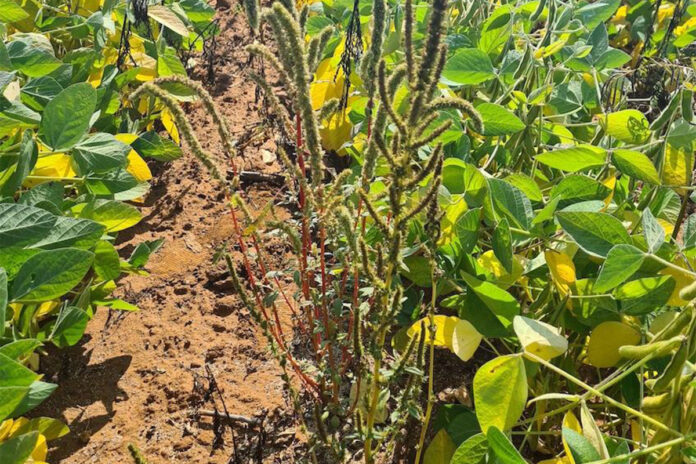
He also identifies Amaranthus species as an important challenge. According to Meiring, some Amaranthus species can still be controlled with appropriate herbicide applications. However, A. palmeri presents a more difficult challenge because some populations have developed resistance to certain herbicides.
“A. palmeri is what they call a superweed. So if you don’t control that pre-emergence, it’s very difficult to control it post-emergence because they’ve got resistance to certain herbicides,” he says.
The example illustrates the importance of early identification. A weed that is relatively straightforward to manage at an early stage can become considerably more difficult once it is established or has reached a growth stage at which herbicide control is less effective.
Farmers should therefore monitor fields before planting and identify problem weeds rather than waiting until the crop is established.
The regulatory status of specific herbicide products and active ingredients can change, and Meiring cautions that farmers should confirm current registrations and restrictions before relying on particular products. This is particularly important where products previously used for a specific weed are no longer registered.
Timing applications correctly
One of the most common mistakes Meiring sees is farmers waiting too long before applying herbicides.
“Labels are very clear on what size the weeds should be. You should rather determine when the weeds are correct to spray instead of waiting until the plant is bigger,” he says.
Once weeds become too large, achieving effective control can become more difficult. Farmers should therefore use the product label as the starting point for determining the appropriate application timing. This includes the target weed, weed growth stage, crop stage, application rate, and other requirements specified on the label.
Application quality is just as important
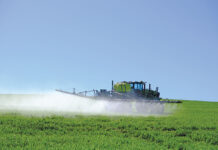
Meiring says farmers sometimes focus too heavily on how many hectares they can cover rather than whether the product is being applied correctly. “Reduce the speed, give more water, and apply correctly. Don’t chase hectares. A proper application is one of the most important things,” he says.
With soil-applied pre-emergence herbicides, achieving adequate coverage is particularly important because the target is the soil surface.
“If you miss a spot, you’re not going to control that spot,” he says.
Poor coverage can leave untreated areas where weeds emerge and compete with the crop. This means that choosing an effective herbicide is only one part of successful weed management. The application itself must also be accurate.
Seedbed preparation matters
The condition of the seedbed can influence how effectively a pre-emergence herbicide is distributed.
“If your seedbed is not properly prepared, and you’ve got a lot of clods in the field, obviously that has a negative effect on your coverage,” says Meiring.
A rough or uneven seedbed can make it more difficult to achieve consistent soil coverage. This can create areas where weeds escape control.
Residue levels also need to be considered. “If you have a lot of material on the field, your chemical is not hitting the target. The target is always the soil,” he says.
However, this does not mean farmers should simply remove all residue. Soil protection remains an important consideration, particularly in areas prone to strong winds.
This again reinforces the need for farmers to consider their entire production system rather than treating weed control as a stand-alone operation. Field preparation, residue management, erosion protection, pest management, and weed control all interact.

Soil and weather can change the outcome
Even where the correct product has been selected and applied at the right time, environmental conditions can affect its performance.
Meiring says soil conditions, including pH, need to be considered when planning herbicide applications. He also refers to the effects of repeated tillage, which can result in a hardened layer below the soil surface. Such conditions can influence water movement and chemical behaviour in the soil.
Weather after application is another consideration. “If you apply something and you get a lot of rain, the product is going to leach, or effectively just wash away. So that will also have a negative effect,” he says.
This means farmers should consider conditions at the time of application as well as what is likely to happen afterwards. The objective is to ensure that the herbicide remains where it is intended to work and that the application is not compromised by unsuitable conditions.
Resistance demands a different approach
Herbicide resistance has made weed management increasingly complicated in some production systems. Where a farmer has a field with a known resistance problem, simply applying more of the same herbicide is unlikely to provide a sustainable solution.
“You have to change practices,” says Meiring. The first step is understanding which weed is present and which herbicides it is resistant to. Once that is established, farmers can adjust their management programme.
Meiring says this could include changing herbicide groups, incorporating mechanical control, or changing the crop grown in a particular field. “Maybe change the crop that you use, because then you apply different chemicals again because different crops have got different classes of chemicals that you have to use,” he says.
Crop rotation can therefore form part of a broader resistance-management strategy by changing the selection pressures placed on weed populations and allowing different control methods to be used.
Meiring also advises farmers to pay close attention to the herbicide group indicated on the product label. “You have to change the groups. You can’t just keep using exactly the same herbicide,” he says.
The principle is straightforward: repeated use of the same herbicide group can increase selection pressure for weeds that survive the treatment.
Where appropriate, farmers can use combinations or rotations involving different modes of action. However, the correct strategy depends on the weed, crop, herbicide, and resistance profile of the field.
Farmers dealing with suspected resistance should therefore seek advice and use the relevant product labels and resistance-management recommendations.
Integrated weed management
While herbicides are an important tool, they are not the only method available to farmers. Meiring says chemical control can be combined with mechanical and cultural methods. “You can always use a combination,” he says.
Mechanical weed control can form part of field preparation, while chemical control can be used before or after crop establishment according to the production system and product requirements. Cultural practices can also influence weed populations by changing the conditions under which weeds establish and reproduce.
For farmers managing resistant populations, integrating different control methods becomes particularly important because it reduces dependence on a single herbicide-based approach.
There is no single formula that will work for every farm. Weed species, soil type, climate, cropping system, equipment, and field history all influence the most appropriate strategy. The starting point, however, remains the same: identify the problem early and prevent weeds from becoming established.
Avoid the rescue mentality
For Meiring, one of the biggest mistakes farmers can make is to rely on a rescue treatment after weeds have already emerged. “Don’t just say, ‘I’ll sort this out with glyphosate later.’ It’s not the right way to do it,” he says.
The problem with this approach is that the crop may already have experienced competition by the time the farmer applies the follow-up treatment. There is also a risk associated with trying to control large weeds with stronger or additional herbicide applications.
“It’s not a weed killer; it’s a plant killer,” says Meiring.
His point is that herbicides are biologically active products and must be applied according to their labels and within the crop’s tolerance. A treatment capable of controlling a weed can also cause crop injury if it is used incorrectly.
The best weed-management programme is therefore one that reduces the need for emergency intervention. “It’s always easier to keep a clean field clean,” he says.
Check whether the programme worked
Successful application should not be assumed. Farmers need to scout fields after treatment and assess whether weeds are being controlled.
Meiring says farmers can often determine within a week or two whether an application has worked, although this depends on the specific weed and product.
“If you start with a clean field and you apply a very good pre-emergence herbicide, nothing should come up except the maize or the soybeans. So if something else comes up, then there’s a problem,” he says.
An unexpected weed emergence does not necessarily mean that the herbicide itself was ineffective. Farmers should consider several possibilities, including whether the correct product was selected, whether the application was made correctly, whether coverage was adequate, and whether environmental conditions affected performance.
The cause should be established before deciding on a follow-up treatment. This is particularly important when herbicide resistance is suspected. Repeatedly applying another treatment without understanding why the first one failed could increase costs while contributing further to resistance.
Three priorities for the summer season
As farmers prepare for the summer cropping season, Meiring’s advice can be distilled into three broad priorities: start early, apply correctly, and avoid relying on rescue treatments.
“Practise early weed control,” he says.
The second priority is application quality. Farmers should follow label instructions carefully, use the appropriate water volume, and ensure that spraying conditions and equipment allow the product to reach its target.
The third is to maintain the programme rather than allowing weeds to become established and then attempting to catch up.
A strong pre-emergence programme can give the crop a cleaner start and make subsequent weed management more manageable.
“If a pre-emergence herbicide has been applied, then it’s easy. You just follow that up with your second spray. It’s going to be much easier to keep it weed-free,” he says.
The principle extends beyond maize. Whether the crop is maize, soya beans, sunflower, or another summer crop, the early establishment period deserves particular attention because competition during this stage can influence the crop’s eventual performance.
For farmers, effective weed control therefore starts long before weeds become a visible problem. It begins with understanding the field’s weed history, assessing conditions after harvest, preparing the seedbed, selecting an appropriate control programme, and applying products correctly.
It also means understanding that weed management is not a single spray. It is a season-long strategy that combines prevention, monitoring, and timely intervention.
The reward is not simply a field that looks clean. It is a crop that has been given the best possible opportunity to establish without unnecessary competition during the period when its yield potential is being determined.