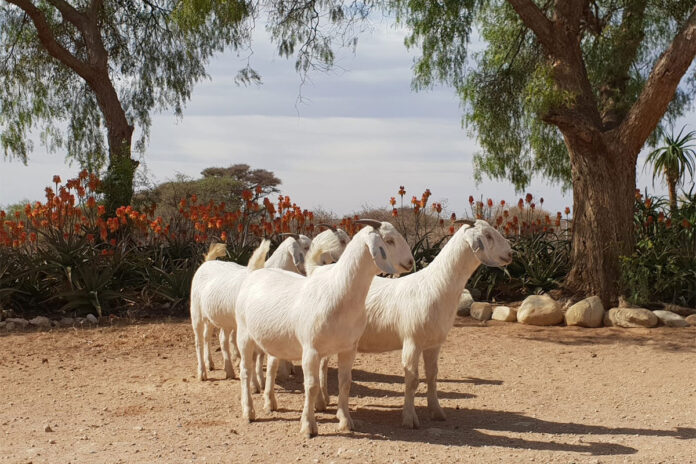
Buckle bought the farm Vaalpan, in the Griekwastad district, in 2015. It was there that he first saw white goats, without knowing much about them. He approached Joe Scholtz, chairman of the SA Savanna Club, who explained the breed and its advantages. What drew Buckle to the Savanna were the traits that suited the way he farms.
He values its hardiness, adaptability and mothering ability under an extensive production system.
“We are a family of four who believe the best things in life are done together: dreaming together, working together, laughing together, and when the goats decide to change our plans, making a plan together,” he says.
The farm lies on the Ghaapse berg, on hard veld that carries fynbos, olienhout, karee, and some swarthaak. Buckle rates the browse there as good feed for goats throughout the year, and the environment suited the stud he was starting to build.
In 2018, he attended a national show in Griekwastad and saw how well the animals could be presented.
Two weeks later, he bought his first ewes and a ram and registered the Safi Savanna stud the same year.
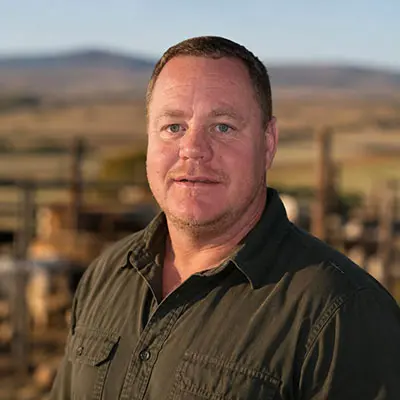
He started with one ram and 39 ewes. Buckle explains that Safi means ‘pure’ in Swahili and reflects values such as honesty and integrity.
The stud today is around 200 recorded ewes, a figure that varies between roughly 150 and 250 depending on weaning and culling throughout the year.
Three rams do most of the breeding work. Buckle lives and works in Postmasburg, while the farm is in the Griekwastad district, so the operation is run extensively and is not under his daily supervision.
He grew up with commercial goats, and that was the knowledge base he brought to the breed. Buckle says it was only after he started the stud and began showing that he understood the value of well-bred animals.
The shift from a commercial background to registered breeding still shapes the way he selects. He wants animals that earn their place through production, not appearance alone.
Buckle also credits Kobus Botma as an important mentor in developing his eye for Savanna genetics. As a student in 1987, Botma worked for Lubbe Cilliers outside Douglas, where the Savanna breed originated and was registered as a distinct breed. Drawing on Botma’s knowledge and insight, Buckle has been able to select the genetics best suited to his breeding goals.
A working Savanna
“If you ask 10 breeders what the perfect ewe or ram looks like, you will probably get 20 different answers,” he says. “I want to breed an animal that is adaptable and sustainable, but that can also hold its place in the show ring.”
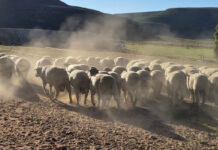
His ideal is a medium-framed, functional animal that can cover ground. Because he farms extensively, with most of his camps covering well over 100ha, the animal must be able to breed and kid in the veld without carrying so much weight that it loses adaptability under harsh conditions.
When he judges a ram, temperament catches his eye first.
“I like an alert ram with attitude. That is definitely one of the first things that catches my eye,” says Buckle.
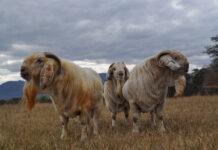
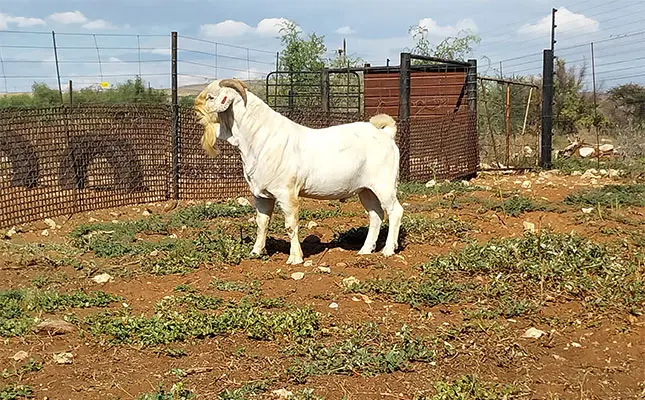
From there, he works through the structure: a strong, correct head, neck and chest connection, a broad stance behind, and a long broad croup over a straight back. The Savanna standard is strict on teats, pigmentation and conformation, including legs, hooves and mouth, and Buckle regards these requirements as non-negotiable for the breed’s survival.
He weighs a ram’s faults as carefully as its strengths. A breeding ram can pass on weaknesses as well as desirable traits, so Buckle wants to know what he stands to lose before using an animal.
“It doesn’t matter what an animal’s pedigree says or how attractive it is; if a ewe cannot raise a kid, she is an expense that cannot be afforded. The same applies to a ram that does not breed,” he says.
That thinking feeds into his main concern about the direction of the breed. There is a risk, he believes, that Savannas are bred too big, fed too heavily, and shaped too much for the show ring, while the traits that made the breed successful under extensive conditions receive less attention.
“Unfortunately, the show ring determines the trend or type the breed moves towards, regardless of whether the genotype suffers,” says Buckle.
He notes that these are also often the animals that achieve high prices at auction, even though they are not necessarily the best producers.
“There has to be a balance between genotype and phenotype that retains the good traits of the breed,” he explains.
The ewe’s mothering ability remains, in his view, the Savanna’s clearest advantage over other meat goat breeds.
Strict reproduction selection
Safi does not follow fixed breeding seasons. Buckle wants the maximum number of kids per year, so he runs a rolling mating system built around the ewe’s cycle.
A ram goes in with a group of ewes for 34 days, covering two 17-day cycles, and is pulled out for two weeks and is then replaced by a follow-up ram for another 34 days. Every ewe is exposed to two rams across four cycles.
There is no set ram-to-ewe ratio. One ram runs with the group, and the number of ewes he covers depends on how many come into heat in a given period and how active he is. Ram condition matters as much as ewe condition under this system, since a ram that is not fit will not get the work done.
The rolling system also acts as a fertility test. After kids are weaned at around 90 days old, at an average weight of 22kg depending on the ewe’s age and whether she raised multiple kids, the ewes are given time to regain condition before mating starts again. Ewes that do not kid when expected are easy to identify as the kidding groups move out of the big camp, which makes selection for fertility simpler than working from records alone.
Buckle selects according to age rather than weight. His aim is for an ewe to kid for the first time only after she has cut her two teeth, so that she is not losing condition while changing teeth and raising a first kid at the same time. Every animal must meet the minimum breed standard. Those that fall short are held until they are ready for a slaughter auction and sold there. Ewes that meet the standard are kept to 10 or 11 months old, when replacements are selected.
A young replacement ewe that does not conceive is given a second chance as a two-tooth. If she fails again, she is culled. Conception on its own is not enough. An ewe has to kid and raise that kid, and that is what decides her place in the herd.
From a first-kidding ewe, Buckle is satisfied with a single kid, provided she raises it well. By the second-kidding stage, he expects an ewe to have weaned around five kids in two years, which makes multiples important. He does, however, draw a line at excessive multiples.
“I would rather have a ewe that raises twins well than one that has quadruplets, loses two of them, and the other two amount to very little,” says Buckle.
Quadruplets tend to be born too small and struggle to develop properly, he explains, which does not suit an extensive production system.
His current figures are a 90% conception rate, a 160% kidding percentage, and a 95% weaning rate based on kids born. He also culls animals that performed well in the show ring but failed to reproduce adequately.
Managing off the veld
Because Safi farms in a dry area, disease pressure is limited. Ticks are the main problem, and Buckle treats the goats for ticks as the need arises during the rainy season rather than following a fixed treatment schedule. He treats sick animals rather than the whole herd and avoids over-medicating in a way that could work against the animals’ own resistance.
Feeding follows the same low-input approach. The goats produce mainly off natural veld. The only time ewes get extra feed is when they are pulled out of the veld just before kidding. Once they have kidded and the kids are strong enough to move with them and have been marked, they return to a separate camp where they receive their usual lick supplements, with molasses meal or maize meal added for energy.
Show and auction animals are the exception. Buckle moves them into a camp of about 1ha and gives them extra pellets and supplementary feed to bring them into condition over a period that depends on the season and the state of the veld.
Bought-in animals are kept separate and monitored before they join the herd, both to check for underlying problems and to guard against a rapid loss of condition after the move.
From the show ring to the market
Safi placed in several ram and ewe classes at the 2025 Savanna World Show. Because the stud is run extensively, Buckle says he cannot prepare animals to their full potential for a show ring, so the placings gave him an useful indication that animals selected for reproduction can still compete against those from intensive studs. Shows, for him, are mainly a way to measure his herd against others and check that he is moving in the right direction.
A Savanna ram fetched R2,05 million in April 2026, a new South African small-stock record. Buckle sees exceptional prices as positive for the breed because of the attention they generate, although he doubts whether prices at that level are sustainable. He is also concerned about the gap between elite prices and the broader market.
He believes the breed is increasingly serving two markets: breeders pursuing show-type animals and those looking for functional animals backed by strong production figures.
Safi’s biggest market is commercial farmers.
“Commercial farmers usually want a ram that can adapt immediately on their farm and start working among the ewes,” he says.
Many buyers are drawn to Savannas for their hardiness and mothering ability. There is export demand as well, with each market having its own requirements. Buyers in Kenya and Zimbabwe, for example, mainly seek Savanna rams for crossbreeding with indigenous goat breeds.
Protecting the Savanna’s strengths
Buckle does not see a pressing challenge facing the Savanna. New commercial and stud breeders keep entering the industry, and demand for young commercial ewes is strong, particularly among emerging farmers. Good stud genetics, he says, will always find buyers.
His concern is that breeders could begin pulling the Savanna in different directions, with show appearance and performance figures becoming competing objectives rather than parts of the same breeding goal.
With input and production costs rising, he believes the economics of keeping animals that do not produce will become increasingly difficult to justify.
Performance recording has an important role. Buckle regards information on an animal and its ancestry as valuable in helping a breeder select genetics to improve a herd. However, he stresses that it remains a tool and that its value depends on the integrity and accuracy of the information entered by breeders.
Ultimately, his aim is to retain the Savanna’s hardiness, adaptability, fertility, and maternal ability with breeding animals of competing at the highest level. He wwants to breed an animal that can perform at the top in both the show and genetic performance rings.
For more information, email Le Roux Buckle at [email protected].