
Since 1989, the Van Oene family has specialised in the production of flowers and ornamental plants. Over the years, they have invested in technology, processes, and people to deliver a high-standard product with durability and presentation.
Rancho Alegre Farm is where it all began. They started with the production of violets and Kalanchoe.
Joost van Oene backpacked across the globe from the Netherlands and ended up in Brazil, where he met his wife, whose Dutch family emigrated to South America years earlier. Joost maintained his Dutch citizenship, but due to that, he is not allowed to own an agricultural operation. His wife and children own the land and farm while he owns the business.
In 1999, they decided to focus on the production of Kalanchoe and removed the other flowers from their portfolio.
Joost was the driving force behind the flower Veiling Market in Brazil that operates as a co-operative with 450 members, and it’s based on flower auctions in the Netherlands. Veiling members are guaranteed payment and have access to a modern system for negotiating prices for the products. The system markets to some 1 000 clients through electronic auctions and digital systems on an online platform.

Ornamental horticulture represents only 0,57% of Brazil’s agribusiness GDP, but the sector is in a growth phase of 10% to 15% per year. Around 40% of the production concentrates in the state of São Paulo, mainly in Holambra.
Joost Kalanchoe sells around eight million pots annually around the world and commands about 60% of the Brazilian market.
Joost still visits Denmark and the Netherlands annually looking for new varieties to add to his range of Kalanchoe varieties.
Daughter directing sales and marketing
Simone, Joost’s daughter, is the director of sales and marketing of Joost Kalanchoe. She runs the business with her father and brother Ariel.
To expand her already vast knowledge in horticulture, when Simone was younger she applied for internships at Stefan Slijkerman and Dümmen Orange in the Netherlands, Beans and Greens in the US, and Holambra in Brazil. ‘The experienced and knowledge I obtained during my tenure at these global businesses prepared me for where I am today – helping to run a family business on sustainability pillars,” she says.
Simone is passionate about eco-friendly farming. The greenhouse spans 11ha, employs around 100 people, and integrates water recycling and renewable energy to reduce environmental impact.
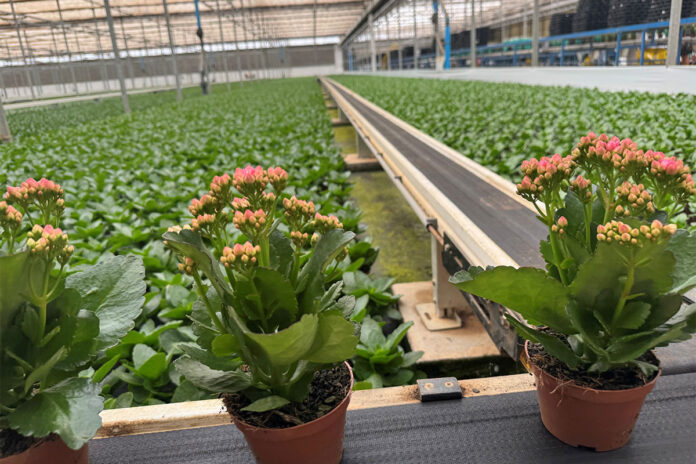
The modern air-conditioned greenhouse enables them to produce flowers around the clock. Kalanchoe flowers require short days for growing. Therefore, the production team constantly monitors and regulate heat, water and sunlight. To keep the temperature in the greenhouse constant, fans and ventilators are located on both sides to lower the temperature when needed and increase humidity. Shading screens keep warm air out and blackout curtains decrease the sunlight.
The climate is monitored and controlled via sensors.
“Temperature and humidity control is carried out through Padfan fan systems, which adjust the temperature as well as the relative humidity of the air, performing up to 35 air changes per hour,” says Simone.
“We focus on the environment and are moving towards a totally sustainable production system. All water used in production comes from rainwater harvesting. Rainwater is captured through water reservoirs and contour lines. For every square metre of greenhouse, we have 700ℓ of stored water.”
Optimising processes in the greenhouses
Simone explains that the irrigation system uses ebb and flood floors and drip irrigation. “Technology has enabled us to save 50% of our water and 70% of our fertiliser consumption. In addition, the ebb and flood systems contribute to a closed-loop system, recycling and reusing all the irrigation water.”
The water used for fertigation is treated and reused, eliminating soil contamination. “The disposal of phytosanitary product packaging is also done in accordance with regulations, and all waste produced is also separated and sent for recycling,” Simone explains.
She adds that conveyor belt systems have enabled them to optimise the processes in the greenhouses. “The 13km of SmartFlo conveyors have brought more efficiency, increased the quality of the plants and improved the working conditions of our employees.”
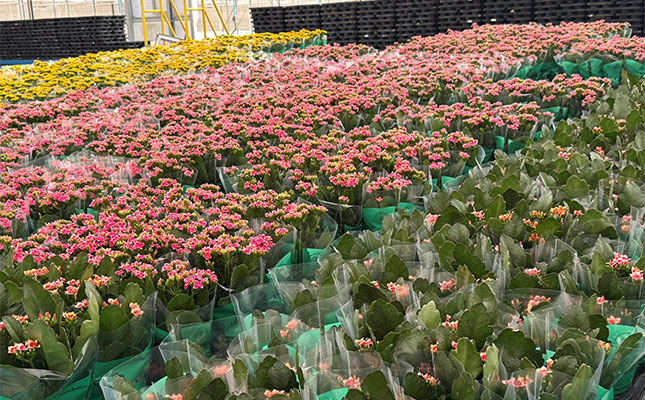
One of the greatest future challenges facing humanity is waste management. The creation of circular solutions, and the correct disposal and use of recyclable materials are essential. On the company’s properties, selective garbage collection is carried out. In addition, they have reliable suppliers who have the same business vision as them. For example, their packaging and jars are sourced and recycled material.
Discarded plants, whether due to malformation, disease, or any other reason, are composted and reused as fertiliser for other crops on the site.
“We follow an integrated pest management programme, allowing us to reduce phytosanitary products by 70%. Migrating to using more biological products also contributed positively to the quality of our products,”says Simone.
They employ 100 people, with 40 working in the three greenhouses while the rest are involved in preparing pots for shipping.
The family strictly follows Brazil’s environmental laws and also dedicate 20% of the property to conservation of natural forests.