Amid the scrum that forms in the walkway between the two main exhibition halls at Bredasdorp Park–the BKB and adjoining Voermol halls–a visitor would probably not spot the visual wordplay they were walking through: abalone shells and rainbow-coloured flowers, ending on the floor in an ornamental pot filled with gold.
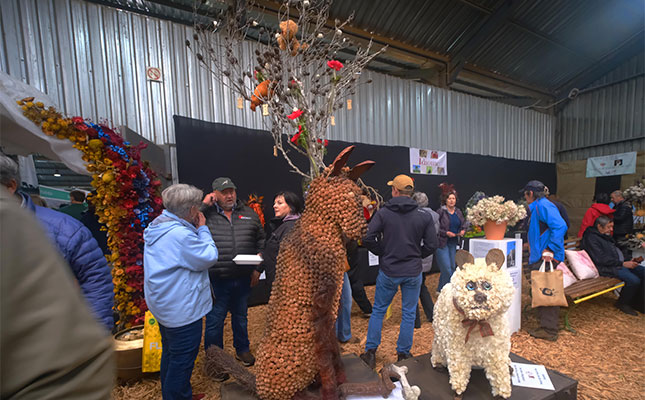
A visitor’s eye would perhaps first have been drawn to the brown, man-sized dog made of dried conebush flower bulbs, glaring down at a child-sized one made of white everlastings. Two dogs fighting over a bone, but on the floor, a third, tiny sausage dog made of beads gets the bone.
“One woman came past here, looked the brown dog in the face, turned to her husband and said, ‘You look exactly like this dog,” Malan laughed as she showed Farmer’s Weekly around her creations.

The conebush dog represented a number of cheeky Afrikaans sayings, like ‘being over the dog’s tail’ (the worst is over), and a cloud of branches above its head showing ‘getting dog’s thoughts’ (becoming suspicious).
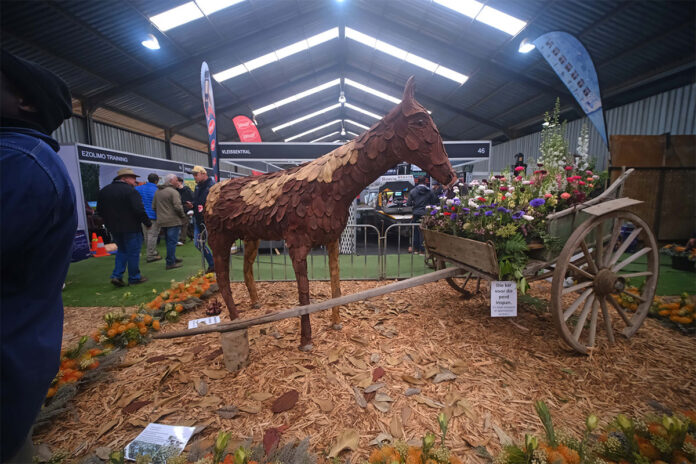
If the human traffic had pushed a visitor to the right-hand side of the hall’s entrance, they would have been confronted by a horse standing 17 hands tall, with a body of leaves, standing behind a cart. It was Malan life partner’s idea to put the cart before the horse. He was also extremely proud of the figs he put on the floor behind the horse’s tail because ‘horse turds are no figs’.
Once through the passageway, it would have been impossible to miss this year’s centrepiece, a small dam topped off with exactly 1 050 origami cranes flitting gently in the breeze, below a cloud with a silver lining.
“I started with a little dam, because the people at Nampo are our dam’s geese, or our kind of people,” Malan said.
As a member of the South African Flower Union, she has travelled widely to show her work at international events, and when in Japan, she was particularly taken with the origami crane at the Hiroshima memorial–a nod to a little girl who had survived the atomic blast and folded 1 000 origami cranes. Red-crowned crane (tsuru in Japanese) is the ultimate symbol of longevity, good health, and good fortune.
“And then of course, the blue crane is our national bird and typical of our region,” Malan said.