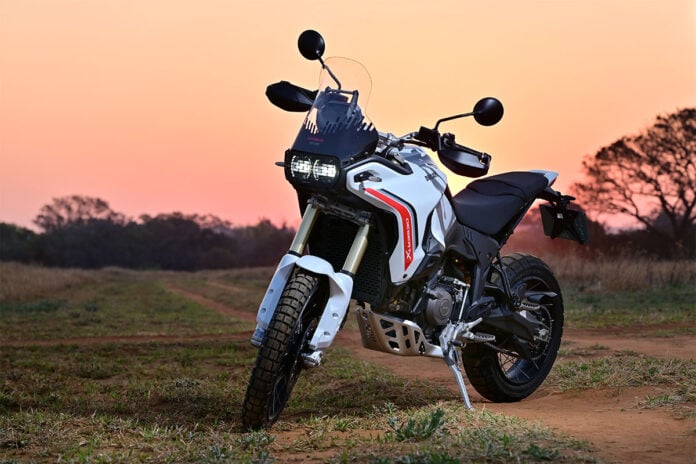
Southern Africa demands a rare, dual-purpose motorcycle. Between the vast travel distances of our agricultural heartlands and the punishing, rutted gravel roads that connect them, a bike cannot just look the part – it has to endure.
When Ducati first launched the original DesertX, it raised eyebrows by pairing traditional Italian asphalt aggression with a genuine Dakar-inspired silhouette. Yet, it was a heavy machine to handle when the terrain turned treacherous.
Enter the Ducati DesertX V2. This isn’t a subtle facelift or a marketing update. Ducati has executed a ground-up, clean-sheet redesign, retaining no parts in common with the outgoing model. It is rebuilt to conquer the dirt without losing an ounce of its high-speed highway composure.
Having recently pushed the extreme Rally variant to its limits through the punishing dust, rock, and technical trials of the Great African GS Challenge in Amersfoort, Mpumalanga, I can confidently say that Ducati’s engineering team has listened to real-world riders.
The new DesertX V2 brings that competition-bred DNA to the production line. It is an engineered solution to a distinctly African riding dilemma: how to cross thousands of kilometres of highway with ease, then drop into deep sand, mud, and shale with the agility of an oversized dirt bike.
Design and Ergonomics
The DesertX V2’s striking twin- headlight fairing is a nod to the iconic rally racers of the early 1990s. However, beneath the nostalgic bodywork lies an aggressive shift in geometry.
Ducati has abandoned trellis chassis, replacing it with a cast aluminium monocoque frame. This alters how the bike carries its weight.
The steel fuel tank has been swapped for a highly durable, slimmer 18ℓ polymer fuel tank. By changing the tank’s architecture, Ducati didn’t just shed weight, it pulled the fuel volume lower into the machine.
This lowers the centre of gravity. When you are picking your way through loose river stones or keeping the bike upright on a deeply rutted farm road, this lower balance point makes a machine that weighs 209kg (wet, without fuel) feel light and nimble between your knees.
The rider ergonomics have also been transformed. The footpegs have been moved backwards, while the seat and handlebars have been nudged forward. This shifts the rider’s bodyweight over the front wheel.
When you stand on the pegs to power through a corrugated section of gravel, you naturally pin the front end down, giving you confidence and front-tyre bite.
The bodywork is narrow, allowing you to move over the bike without your knees fighting wide fairings. For trail mishaps, Ducati integrated replaceable plastic crash covers over the fuel tank so a low-speed tip-over won’t ruin your day.
Torque Over Outright Speed
The biggest mechanical marvel is the heart of the beast. Ducati has ditched the older 937cc Testastretta engine for its new 890cc liquid- cooled 90° V2 engine featuring Intake Variable Timing.
This motor is the lightest four-valve twin-cylinder engine Ducati has ever engineered, tipping the scales at just 54,5kg.
On paper, it puts out a healthy 110,3 hp and 92 Nm of torque, but numbers alone don’t explain why this engine is an off-road masterpiece.
Rather, what makes it a favourite among reviewers is its delivery.
Thanks to the variable timing system, 70% of that maximum torque is available at a low 3 000 rpm.
For an adventure rider, this low-end grunt is everything; it means you don’t have to rev the engine hard to get out of trouble.
Instead, when you encounter thick sand or a steep incline, you simply twist the throttle, and the engine chugs forward with instantaneous, tractive power.
Ducati revised the six-speed gearbox for the DesertX, shortening the first four gear ratios. This allows you to crawl over technical, rocky inclines with clutch control, while a longer sixth gear ensures smooth, fuel-efficient cruising when eating up highway kilometres.
Suspension and Handling
If the engine is the heart of the DesertX V2, the suspension is its backbone. To handle off-road obstacles, Ducati fitted a heavy-duty, fully adjustable 46mm KYB upside-down front fork, paired with a fully adjustable KYB rear monoshock operating on a progressive full-floater linkage.
The numbers tell a story of its capability: you get a generous 230mm of wheel travel at the front and 220mm at the rear, contributing to 250mm of of ground clearance.
What sets this apart is its dual-rate composure. Independent damping adjustments on both fork legs mean the suspension can be fine-tuned to be plush over minor gravel corrugations, while retaining enough progressive bottoming resistance to swallow washouts or unexpected erosion ditches without jarring your wrists.
This suspension handles the classic off-road wheel blueprint: a 21” wire-spoke front wheel and an 18” rear wheel shod with tubeless Pirelli Scorpion Rally STR tyres. The massive 21” front wheel rolls over rocks, logs, and washouts with stability.
Bringing this package to a halt is a braking system with dual 305mm front discs clamped by radially mounted Brembo monobloc calipers.
They deliver precise, single-finger stopping power on tarmac, but offer enough progressive feel for controlled braking on loose dirt.
Digital Guardian Angel
Ducati has loaded the DesertX V2 with an advanced electronic brain powered by a six-axis Inertial Measurement Unit (IMU).
The IMU continuously monitors the bike’s pitch, roll, and lean angle, helping adjust the Cornering ABS, Traction Control, Wheelie Control, and Engine Brake Control for safety.
Riders select their experience via six distinct riding modes: Sport, Touring, Urban, Wet, Enduro, and Rally.
While the four road modes are designed for everyday touring, the off-road modes are where the bike shines:
- The Enduro mode scales the engine power back to 75 hp while keeping traction control and ABS active.
- This is ideal for less experienced riders or when navigating greasy, wet farm mud where you want the electronics to prevent the rear wheel from sliding out.
- The Rally mode unleashes the full 110 hp with minimal electronic intervention. It disables the rear- wheel ABS, allows you to deliberately break traction to steer the bike with the throttle, and optimises the engine’s responsiveness.
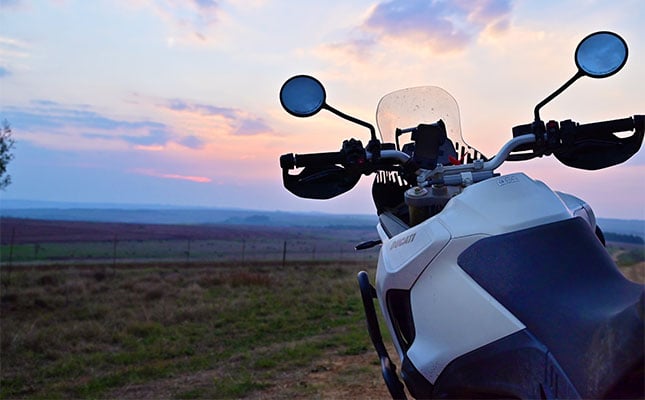
Everything is managed via a beautiful, vertically oriented 5” colour TFT display.
Ducati chose a vertical layout specifically because it mirrors modern rally navigation towers. When you are standing on the footpegs, a traditional horizontal screen can be obscured by your body position.
This vertical screen remains perfectly visible, and when toggled into ‘Rally Mode’, the graphics transform into a dedicated tripmaster display. This actually makes you feel like you’re hunting waypoints in a desert race.
Built for adventure
Having witnessed what the platform can do during the gruelling stages of the Great African GS Challenge, it is clear that the production DesertX V2 is a significant evolution. Ducati did not just build a fast street bike dressed up in rugged plastic; it has built an authentic,
high-clearance enduro machine that also offers incredible road manners.
By lowering the centre of gravity; deploying a lightweight and torquey V2 engine; utilising industry-standard KYB suspension; and anchoring it all with highly customisable electronics, Ducati has created a motorcycle that empowers the rider.
Whether you are an agricultural professional looking to cross vast distances across South Africa’s most remote backcountry or an enthusiast seeking to conquer the next off-road rally, the DesertX V2 stands out as an appealing favourite.
It is a machine that is born unbound, perfectly tuned for the beautiful, unpredictable terrain of Southern Africa.
Bike specifications
SpecificationDucati DesertX V2
Engine type890cc liquid-cooled 90° V2 (IVT)
Maximum power110,3 hp @ 9 000 rpm
Maximum torque92 Nm @ 7 000 rpm
(70% available at 3 000 rpm)
Wet weight (no fuel)209kg
Wheels (front/rear)21”/18”wire-spoked, tubeless
Suspension travel230mm front/220mm rear (fully adjustable)
Ground clearance250mm