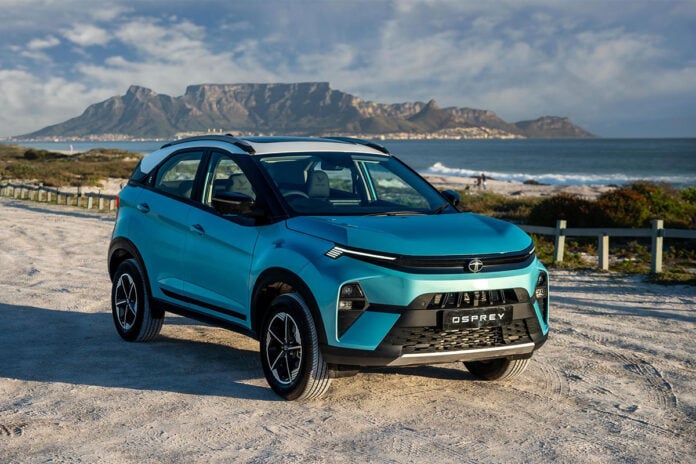
Comfortably Tata’s top-seller of 2025 in its domestic market, the surprise decision to rename it from Nexon to Osprey for South Africa was said to be a “carefully curated and engineered” decision drawing from the bird of prey’s ability to thrive no matter its location.
Officially launched in September and priced from an enticing R249 900, we sampled the flagship Creative+ derivative, priced at R329 900.
Styled to resemble the Curvv that sits above it, the Osprey looks stylish and funky, without any hints of approaching 10 years old.
The top-of-the-range model features 16” alloy wheels, LED head- and taillights, and imitation skidplates below the front and rear bumpers.
Deceptive interior
Conforming to India’s sub-4m regulations means the Osprey appears bigger than it actually is, as the restrictions require brands to ‘build up’ instead of lengthening the vehicle to obtain the desired interior space.
Again derived from the Curvv, the interior has decent finishing, but flatters to deceive. With the plastics and piano-key black digital climate control panel, the textured trim on the dashboard looks low-rent, and the combination of black and grey finishes is anything but inviting.
Finished in black cloth, the seats are tight, and while comfort is okay, the front chairs don’t drop all the way to the floor.
Not short on tech
The Osprey’s 10,25” infotainment system is one of the interior’s bright spots. The freestanding display is relatively easy to use and is aided by wireless Apple CarPlay and Android Auto.
The quality of the 360° surround-view camera impressed, as did the fairly easy to decipher, easy-to-read 7” digital instrument cluster, the quality of the six-speaker sound system, and the physical buttons and toggle switches on the wheel.
The connectivity trade-off comes at the price of basic ergonomics, as the slimline centre console has no cupholders, and front occupants only have access to bottle holders in the doors.
Decent boot space, keyless entry and push-button start
The Creative+ is well equipped with rain-sensing wipers, push-button start, keyless entry, and a cooled glovebox.
Safety equipment includes six airbags, cruise control, a tyre pressure monitor, and front and rear parking sensors. Also included is blind spot monitoring, and electronic stability control.
Opening the boot reveals even better news. Despite its size, the boot offers a claimed 382ℓ beneath the parcel shelf with the rear seats upright.
Unconvincing powertrain
It is on the move where the Osprey’s wings are clipped the most. Powering the compact crossover is the same 1,2ℓ Revotron turbo-petrol engine as in the Curvv, with outputs of 88kW of power and 170Nm of torque. The twist goes to the front wheels via a seven-speed dual-clutch automatic transmission.
A par-for-the-course segment selection, the final execution is more reminiscent of some Chinese vehicles, with a poorly calibrated throttle and a gearbox that hesitates when shifting up, and judders when shifting down or at slow speeds. Once up to speed, the engine is much more agreeable and comes with decent shove.
Dynamically, the Osprey’s steering is good for a vehicle in this segment, and the ride is well managed considering its structure and 208mm of ground clearance that shames bigger, more expensive SUVs.
What’s the verdict?
Competing in a fiercely competitive segment of the SUV market, the flagship Tata Osprey is simply outgunned in most departments, despite its list of features and price tag.
Brushing aside being cheap and appealing, the Osprey’s lack of substance and final execution conspire to make it a tough sell.
Tata Osprey 1.2T Creative+
Price: R329 900
Engine: 1,2ℓ turbo petrol
Transmission: 7-speed dual-clutch auto
Power: 88kW
Torque: 170Nm
Fuel consumption (tested): 6.9ℓ/100km
Licensing mass: 1 292kg
Payload: 410kg
Towing capacity: Not specified