
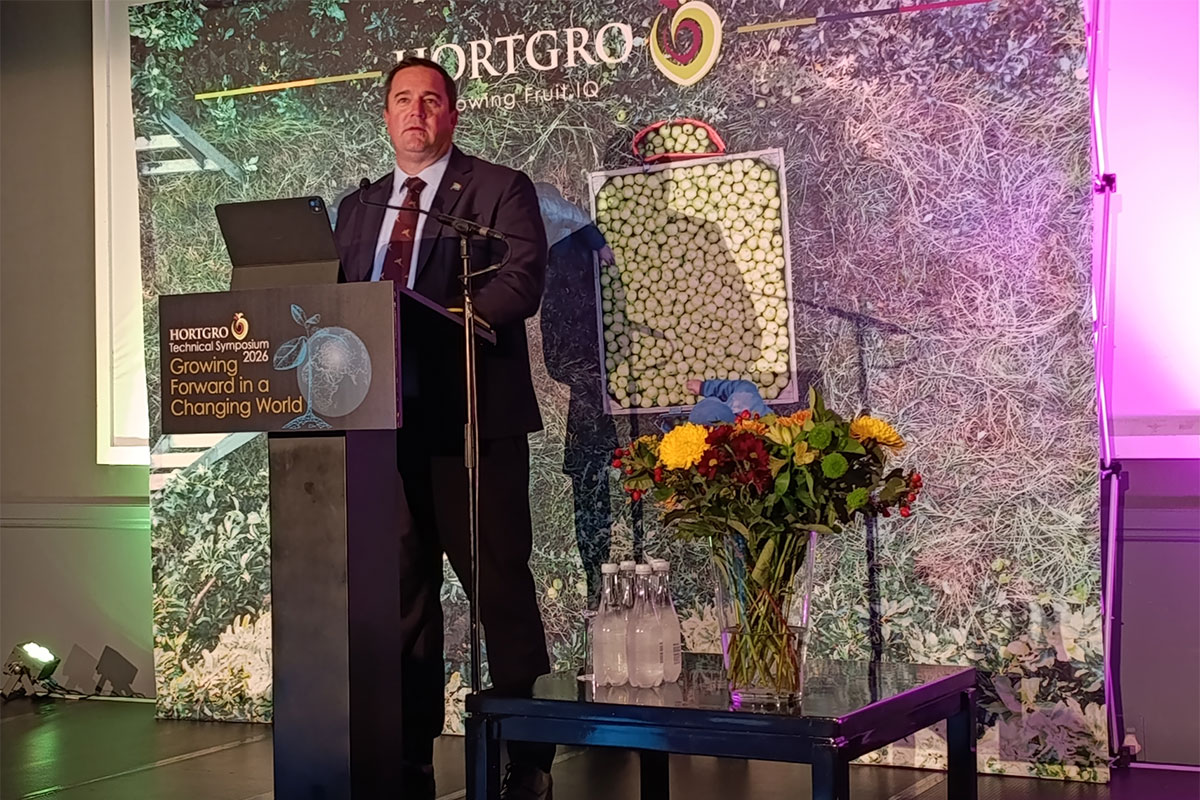
Opening the symposium, Hortgro Chairperson Nicholas Dicey said the event’s theme, ‘Growing Forward in a Challenging World’, reflected the reality facing producers who are grappling with severe weather damage, geopolitical instability, and increasingly complex global markets.
Reflecting on recent storms and flooding across the Western and Eastern Cape, Dicey said producers suffered a severe setback: “From the Eastern and Western Cape all the way to the north, we have been badly battered; there is no other word than that. The challenges we face are immense.”
Minister of Agriculture John Steenhuisen said the deciduous fruit industry understands better than most what it means to operate in a changing world, as it continues to face climate shocks, logistics constraints, and rising global competition.
Despite these pressures, he described the industry as one of South African agriculture’s most resilient, underpinned by strong export performance and rural economic contribution.
“These farmers are not simply producing world-class fruit. They’re building globally competitive value chains that sustain livelihoods, generate foreign exchange earnings, and position South Africa as a serious agricultural exporter on the international stage,” Steenhuisen said.
From storms to logistic challenges
Steenhuisen said recent storm damage in the Western and Eastern Cape highlighted the urgency of climate resilience and infrastructure investment, after orchards, roads, and electricity systems were damaged and cold storage operations disrupted during the export season.
“Climate change is no longer a future challenge for agriculture. It is already reshaping production realities today,” he said.
Steenhuisen noted that stronger biosecurity systems, continued investment in science and innovation, and urgent improvements to logistics and port efficiencies are essential for safeguarding export growth.
“It is great to wake up to the news that agricultural exports have grown 11% year-on-year, but one must ask how much better it could have been if our ports were operating at maximum efficiency.
“For high-value, perishable export industries like this one, logistics efficiency is existential,” he added, warning that delays translate directly into lost value and jobs, as well as weakened market confidence.
Shifting EU policy priorities
Christine Wieck, professor of agricultural and food policy at the University of Hohenheim in Germany, said the EU remains a critical destination for South African agricultural exports, particularly fruit and nuts, which account for about 72% of EU agricultural imports from South Africa.
Speaking during a session on trade and policy, she said geopolitical instability, including the Russia–Ukraine war and the conflict in the Middle East, has shifted Europe’s focus from sustainability-led policymaking towards food security, resilience, and competitiveness.
She added that the European Green Deal agenda has effectively been scaled back following farmer protests and post-COVID-19 economic pressures, compounded by supply chain disruptions linked to global conflict.
“The Green Deal policy as a strategic framework is no longer in any of [European Commission President] Ursula von der Leyen’s speeches,” Wieck said.
She added that the EU is now placing greater emphasis on strategic trade partnerships and regulatory simplification through the new ‘Omnibus Regulation’, designed to streamline sustainability reporting and corporate due diligence requirements across supply chains.
While this shift may reduce administrative burdens, Wieck said sustainability and biosecurity standards remain firmly embedded in EU market access requirements for exporters.
Regulation, trade access, and crop protection tools
Rod Bell, CEO of CropLife South Africa, said regulation is often dismissed as a technical or ‘boring’ subject but is, in fact, central to the competitiveness and survival of the agriculture sector, particularly in plant protection and international trade.
He said regulation provides “protection, peace of mind, and the right to operate” across the entire value chain, from registration holders to farmers, ensuring products are safe for consumers, workers, and the environment and acceptable in export markets.
“Regulations provide our industry with the right to operate, and that right to operate goes through the entire value chain,” Bell said, stressing that compliance is “non-negotiable” for long-term sustainability and market access.
Bell warned that increasing regulatory pressure, including the global phase-out of highly hazardous pesticides and tighter domestic controls, is steadily reducing the crop protection toolbox available to farmers.
“We are losing many, many valuable tools from the toolbox,” he said, cautioning that delays in registering new products risk undermining productivity and export competitiveness.
Bell added that international regulatory shifts, particularly in the EU, are increasingly shaping South African compliance standards.
“Compliance should be seen like insurance; it is not cheap, but it is necessary.”
He noted that the EU’s move from the Green Deal framework towards the omnibus approach reflects a broader policy rebalancing rather than a retreat from sustainability.
According to him, the omnibus reforms aim to streamline overlapping environmental and corporate reporting rules, improving clarity and reducing administrative complexity for businesses and exporters.
At the same time, he highlighted a clear shift towards more science- and risk-based regulation, including faster approval pathways for innovation, digital tools, and alternative crop protection methods such as biopesticides.
However, Bell cautioned that new policy directions in Europe, including debates on aligning domestic pesticide bans with import standards and tightening residue thresholds, could create additional pressure for exporters.
“If we don’t have adequate solutions to manage pest pressures and meet residue requirements, we will struggle to maintain access to those markets,” he explained.
Bell added that while the omnibus may reduce bureaucracy within the EU, it will not necessarily simplify compliance for exporters, instead increasing the need for faster innovation, stronger plant health systems, and closer regulatory alignment.
Science communication
Prof Marina Joubert, a lecturer in science communication and public engagement at the Centre for Research on Evaluation, Science and Technology at Stellenbosch University, said science communication has become essential in an environment shaped by misinformation, fragmented media, and declining institutional trust.
She warned that facts alone are insufficient to change public opinion, as people interpret information through values, identity, and lived experience.
“People do not come into a lecture with empty heads. They already have world views and experiences that shape how they respond,” she explained.
Joubert said trust is built through relationships, transparency, and credible messengers, and that it can be easily eroded by overly technical or one-directional communication.
“Effective science communication requires trust,” she said, adding that emotional connection and storytelling are as important as evidence in engaging audiences.
She cautioned that misinformation, disinformation, and conspiracy theories are increasingly amplified by social media platforms that reward sensational content.
Joubert concluded that scientists and industry experts cannot afford to withdraw from public debate on contentious issues such as pesticides, climate change, and food systems.
“If scientists are quiet, others will fill the space, and not always with accurate information,” she said.