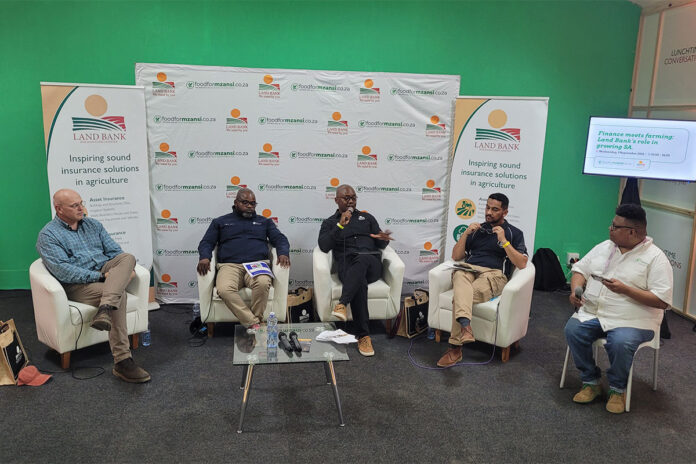
Government’s limited budget allocation to agricultural development showed that the sector was not being treated as a serious national priority, agricultural leaders warned during a recent panel discussion at Nampo Cape in Bredasdorp, Western Cape.
Speaking during the session on the Land Bank’s role in financing agriculture, Johann Kotzé, CEO of Agri SA, questioned how meaningful farmer development could take place when only R325 million in development capital was available through the Land Bank.
“We have a vision to introduce new farmers to agriculture, but I don’t see how we can achieve that with this budget. Development finance is at the core of developing agriculture, yet we are not honest enough about how much money is actually needed to establish new farmers,” he said.
Kotzé said the size of the allocation suggested that agricultural development was not receiving the priority it required.
“We expect people to enter agriculture and build profitable businesses, but development capital is expensive and new farmers need appropriate finance to succeed. If we really regarded this as important, we would be putting far more money into it.”
Dr Mogale Sebopetsa, head of the Western Cape Department of Agriculture, agreed that government spending reflected the priority given to agriculture.
“The limited budget government allocates to agriculture tells you how important the sector is considered to be. We need to tell the story of agriculture better so that it is placed on the agenda where it belongs.”
Kotzé also cautioned that development policy could not focus exclusively on small-scale farmers while neglecting those trying to progress to the next level.
“We need to grow agriculture in its entirety. If we focus only on small farmers, the middle can fall away. Middle-scale farmers also need development capital if they are going to grow.”
Money alone will not build viable farmers
Jabu Mphambo, acting CEO of the Land Bank, acknowledged that agricultural funding structures needed to change. He noted that stronger partnerships were required to create more funding opportunities.
However, finance was only one part of the problem. Sebopetsa identified insecure land tenure as a major obstacle to land reform, saying 30-year leases were unattractive to financiers.
Developing farmers also needed credible production and sales records to qualify for credit, and the Western Cape government therefore had programmes to help farmers improve record-keeping.
Dr Keith du Plessis, CEO of Casidra, said the wider support system was equally important because developing farmers had little capacity to absorb setbacks.
“There are many new farmers entering the market, but they are struggling to survive. The margin for error in farming is incredibly small, and developing farmers often have very little ability to recover when something goes wrong. The entire ecosystem needs to be geared towards helping them succeed.”