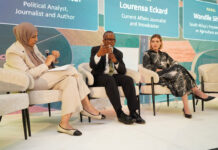

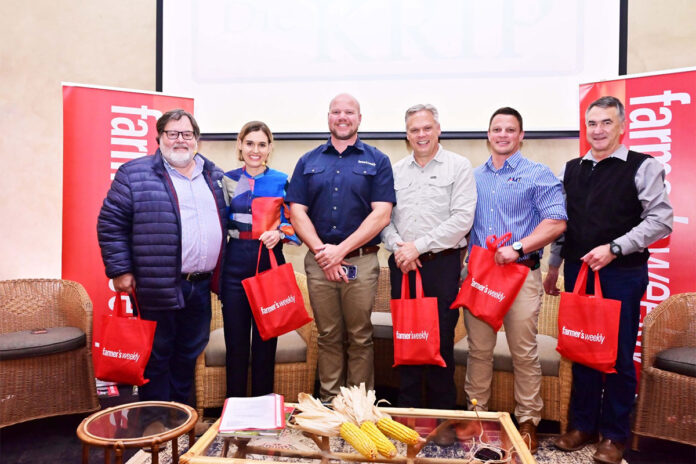
Factual journalism has become increasingly important to farmers, who must make decisions amid a constant stream of information and strong opinions on social media, Farmer’s Weekly General Manager Gary Wium said during a panel discussion on the first day of Die Krip Agricultural Festival, held on 4 and 5 September near Magaliesburg.
The discussion brought together Minister of Agriculture Willie Aucamp, political analyst Prof Theo Venter, agricultural economist Dr Johnny van der Merwe, and agricultural commentator and political analyst Roland Henwood. Reporter and TV presenter Lourensa Eckard was the facilitator.
“There is reliable and unreliable media. When you use information to make decisions, you need to know who the source is and where the information comes from,” Wium told festivalgoers.
He warned that forceful opinions were often presented as facts on social media. “If you don’t use reliable media, you may make the wrong decision at the wrong time.”
Wium said it was Farmer’s Weekly’s responsibility as a media brand and platform to tell farmers’ stories and share their knowledge with a wider audience.
Communities cannot remain on the sidelines
Aucamp opened the forum by urging agricultural communities to resist apathy and become more involved in the institutions and initiatives around them.
He said school governing body elections, church events, and community projects too often relied on the same small group of people, adding that festivals like Die Krip showed that communities could mobilise around agriculture and build resilience.
“Positivity is contagious; unfortunately, negativity is, too. When we mobilise one another positively as a community, we are far more resilient in the face of the challenges confronting us,” Aucamp said.
He acknowledged that while farmers had legitimate reasons for concern, including dry conditions and the developing El Niño, optimism needed to be rooted in realism, service, and continued community involvement.
From political analysis to participation
Venter used his move from political analyst to DA mayoral candidate for the JB Marks Local Municipality as an example of the need to become involved rather than criticise from the sidelines.
After 40 years of teaching people to think critically, he decided that his age and experience gave him an opportunity to help directly. Entering politics had also shown him that processes studied from outside felt very different when experienced from within.
Venter said a crisis usually moved through four stages: blame, investigation, accountability, and visible institutional change. Public confidence would not return if nobody accepted responsibility or if an organisation continued operating as before.
He said farmers affected by FMD were not interested in speeches or political explanations. Instead, they wanted to know what they could do and what government would do to resolve the crisis.
“It was clear to me that the [Department of Agriculture] had to act faster and more practically. Minister Aucamp was part of the answer to that,” Venter said.
Private capacity changes the FMD response
Regarding the FMD outbreak itself, Aucamp said private-sector involvement had given the national FMD response momentum that the state could not achieve on its own.
By the end of June 2026, about 13,5 million vaccine doses had entered South Africa over the previous 18 months, followed by roughly 10 million more during July and August, according to the figures available to the minister. This brought the total to around 23,5 million doses for a national herd he put at 15,2 million cattle.
He added that more than 95% of these vaccines had been financed by the state. With every head of cattle requiring two doses, vaccinating the national herd would require approximately 30,4 million doses.
Aucamp said he had convened the Department of Agriculture’s senior team on 8 July and insisted that the department and Onderstepoort Biological Products relinquish any exclusive claim to vaccine imports and distribution.
A parallel channel was then opened to allow the private sector to import and distribute vaccines at scale under the prescribed controls and cold chain requirements.
“We reached a settlement and a workable way forward within a short period. It would not have been possible without frank discussions, the private sector’s willingness [to engage], and experts who were prepared to help,” he said.
Aucamp explained that the cost was about R45 per dose delivered to a farm. Therefore, a first round for 1 000 head of cattle would amount to roughly R45 000.
He urged farmers to register, order vaccines, and work with private veterinarians instead of waiting for the state to vaccinate every animal.
“Be proactive and have your animals vaccinated. If we do nothing, we could again see heavy losses by December,” he said.
The scale of those losses was evident on farms. Aucamp said he had visited a nearby dairy producer who had lost 380 cows in about a week and a half. Milk production and income had plummeted, but the farmer’s employees rallied around the business and offered to work overtime without additional pay.
The response demonstrated the importance of solidarity among farmers, their employees, communities, agricultural organisations, and the private sector, the minister said.
Livestock market has not returned to normal
Van der Merwe cautioned that it was still too early to say whether the livestock industry had made it through the worst of the FMD crisis.
He explained that while farmers had continued producing despite the initial shock, and the market had begun to adapt, conditions had not yet normalised, and market distortion and uncertainty remained.
“Nevertheless, there are signs that the market is beginning to absorb the crisis and confidence is slowly returning,” Van der Merwe said.
He added that FMD data, market movements, and producer expectations had to be considered together before firm conclusions could be drawn.
Weather forecasts require caution
Seasonal forecasts presented a similar information challenge. Van der Merwe said the probability, timing, and expected strength of the El Niño phenomenon could change as new data became available, while international models did not always agree.
Thus, he said producers should follow updated forecasts, compare several sources, and avoid basing their decisions on a single long-term prediction.
Weather risk also had to be assessed alongside international stocks, export demand, exchange rates, and geopolitical uncertainty. Van der Merwe explained that these factors could reinforce or offset one another in agricultural markets.
Aucamp added that heat- and drought-tolerant seed, technology, and early-warning systems placed producers in a better position than a decade ago. Government and industry nevertheless had to help farmers translate information into practical decisions.
Geopolitical choices carry an economic price
Henwood said the international environment had become fragmented by military conflict, political power struggles, trade pressure, and shifting alliances.
He said that countries like South Africa that were dependent on international markets, energy supplies, and logistics routes were particularly exposed to these disruptions.
South Africa’s foreign policy choices had practical consequences for trade, investment, and diplomatic flexibility, he said. Political symbolism could ultimately carry an economic cost, while uncertainty around the US, Russia, Iran, and other strategic powers was unlikely to disappear soon.
Agriculture, therefore, had to prepare for rapid changes in market access, input costs, transport, currency movements, and demand. Henwood said South Africa should keep its options open and carefully manage relationships across different markets.
Export markets are not a luxury
Aucamp said this changing global environment made the protection and expansion of agricultural market access more urgent.
South Africa remained part of the African Growth and Opportunity Act, but the agriculture sector could not assume that current trade arrangements would continue unchanged. The cost of political decisions on trade and foreign policy frequently fell on farmers and rural economies, he said.
The minister added that government was engaging China on several agricultural protocols, including cherries, as well as the regionalisation or compartmentalisation of areas affected by animal disease. Progress had also been made on citrus export regulations.
Negotiations with Egypt on South African red meat exports had advanced, and the veterinary health certificate was ready for final signature, Aucamp said.
“We cannot drop the ball now; we have to get it across the line. Our red meat industry needs this market.”
Controlling FMD could allow livestock and meat supply to recover faster than local demand. Without export outlets, this could place renewed pressure on weaner prices and producer margins.
“When FMD is brought under control, a surplus of meat could again arise in the local market. If we don’t have export markets, the weaner price falls and producers suffer,” Aucamp said.
He argued that market access was not a luxury but a requirement for agricultural growth and profitability, adding that increased production had little value if producers had no destination for the additional product.
Government must enable farmers
Aucamp said the broader lesson from the FMD response and the work on expanding South Africa’s market access was that government had to draw on expertise beyond the state and remove obstacles to practical action.
“The Department of Agriculture must be a tool in your hand, not a millstone around your neck,” he told farmers.
“The state must enable you to do what you do best.”