
Wheat production is no longer economically viable for many South African growers, forcing them to expand their canola hectares over the past five seasons.
To prevent further shrinkage in wheat plantings, Grain SA has called for several interventions aimed at improving growers’ profitability. One such intervention is the inclusion of white wheat in the national basket of approved cultivars, which would strengthen diversification and yield stability, the Grain SA Chairperson Richard Krige, said in a media statement last year.
According to Driecus Lesch, wheat breeding project lead at Syngenta, white wheat is an attractive option for dryland wheat farmers because it is believed to produce higher yields than the hard red cultivars around which the South African wheat industry and cultivar standards have developed.
White wheat could also benefit processors, as it is generally associated with higher flour yields than hard red cultivars. However, Lesch said that local breeding has improved the flour yields of red wheats so effectively that they now compare well with, and can even exceed, those of white wheats without compromising flour colour.
While white wheat may offer a yield advantage, this is not a given.
“The theory goes that you will generally get higher yields with white wheat because it is more widely planted worldwide, and those cultivars are therefore better researched than the hard red bread wheat cultivars planted locally,” Dr André du Toit, research and development director at SA Seed Development (SA Seed), said.
However, white wheat does have some characteristics that must be considered under South African conditions. These cultivars tend to have a lower protein content than hard red wheat, which can make the flour less suited to the bread-making characteristics on which local cultivar release standards were formulated. Some cultivars are also prone to sprouting before harvesting, Lesch explained.
He said that, historically, South Africa’s cultivar release standards have stuck with hard red cultivars because they can be used to bake both white and brown bread, and the country’s relatively limited wheat storage capacity meant there was insufficient storage for both white and red, which must be stored separately.
“This poses a challenge for silo operators. But in recent years, things have changed: there are silo bags and other temporary storage facilities available, so it’s no longer impossible for grain handlers to separate the two wheat types.”
But this does not mean the grain-handling industry will immediately be able to handle and store equal quantities of red and white cultivars.
“It’s something the sector can grow into. It will still be a challenge, but much less so than 20 years ago,” Du Toit said.
Same production requirements
Lesch added that there is no difference in the production requirements for the two wheat types, but the question remains whether the quality and yield of white wheat will live up to expectations.
“There is also the question of whether there will be a buyer for white wheat,” he said. This is because the milling and baking industry typically combines the high-protein flour ground from hard red wheat grown locally with the lower-protein flour ground from imported white wheat.
According to Du Toit, whether or not local millers and bakers would buy white wheat would ultimately depend on the quality, which is why local seed suppliers and breeding companies cannot simply abandon the stringent quality standards set for South African wheat.
“Seed-breeding companies spend vast sums on breeding new cultivars that are suited to local conditions. Breeding wheat of subpar quality would be a waste of money, because it would result in lower returns for growers, hence there would be no market for it,” he added.
Smashing preconceptions
Andries Theron, a grain farmer and chairperson of the Grain SA Winter Cereals Trust’s Wheat Technical Committee, has been motivating for the acceptance of white wheat for many years.
“For me, as a grower, it is another tool and another opportunity for us to produce something that may give us a higher yield without completely sacrificing quality,” he explained.
“Another advantage of white wheat is that you don’t have to remove the bran during processing, because it won’t colour the flour. The only challenge that remains is that you cannot use the white wheat flour for brown bread, but for that you can just add bran.”
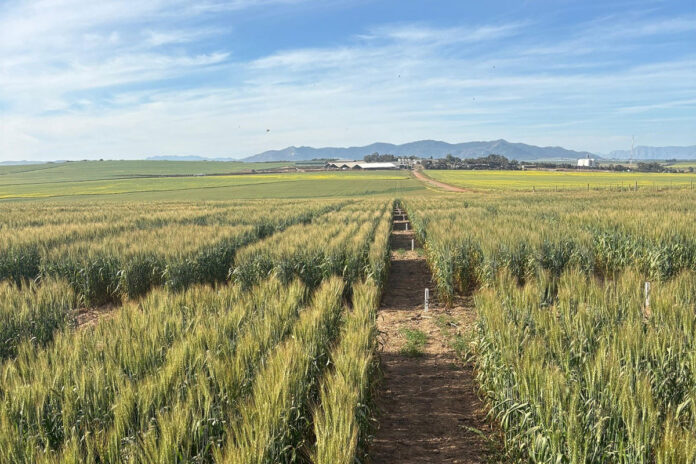
A number of white wheat trials for candidate cultivars from multinational suppliers have been planted on Theron’s farm over the past two seasons, and he said that what he has seen has dispelled the commonly held myth that white wheat is inferior to hard red wheat in terms of quality.
“These trials have proven to me that this is not biscuit wheat; it’s a hard, white wheat. You can use it to bake bread, and it also offers an opportunity for local growers to take back the pasta market. Currently, most of the pasta used in South Africa emanates from Namibia, which imports the wheat, mills it, manufactures the pasta, and then exports it to South Africa tariff-free.
“Should the local wheat industry go the distance with white wheat, it means we can also comfortably provide for our own pasta market.”
Theron said he was “very excited” by what he saw during the trials on his farm.
“I’m always very careful to make yield predictions, but you can see the Australians have done an immense amount of genetic improvement on white wheat. We had our first batch of test cultivars tested at the Southern African Grain Laboratories, and I was pleasantly surprised by the quality.”
One outstanding matter is that the current grading regulations explicitly apply to hard red wheat, so these need to be changed to include hard white wheat, he added.
Theron said that, provided the current trials are finalised and the cultivars perform as required, the first commercial white wheat cultivars could be planted commercially in 2028 under irrigation and on dryland the year after.
Local wheat cultivars loading
Lesch and Du Toit indicated that both Syngenta and SA Seed are currently actively breeding white wheat cultivars for the local market, but it is unlikely that such cultivars will be released before 2030.
Lesch explained that wheat breeding is a lengthy process, as initial lines of two cultivars yield widely varying descendants, each of which has to be separately evaluated for optimal traits to find those the market requires.
“You can go from crossing lines to a perfectly adapted line in six to seven years, but if we use all the techniques at our disposal, we can shorten that period to two or three years to arrive at a new, adapted, and purified line. After that, we still need a minimum of three years of quality trials for dryland growing, so if you start today, you’ll need six to seven years before you can market that cultivar.”
Lesch indicated that Syngenta was continuing work on selected lines that showed promise. He said the company already has white wheat lines that are agronomically adapted to local conditions; these now have to undergo quality testing.
During the breeding process, cultivars are proactively selected for genes that provide resistance to evolving pathogens and resilience to climate change. In contrast, directly introduced white cultivars are mainly evaluated and released based on their seasonal performance.
“So perhaps in three or four years, that line will be ready, and then we’ll need another three years of quality and yield data. We won’t get a named seed line before 2030, and after that we will still have to multiply the seed to commercial quantities, and that will take us to 2033 before it will be commercially available, if all breeding steps are successful,” Lesch explained.
Du Toit said SA Seed is also actively testing new cultivars.
“We had a few promising white wheat lines a few years ago, but these weren’t released commercially because they didn’t meet the quality norms.
“Subsequently, the quality norms have been lowered, so we have now once again included these lines for evaluation. This process only started this year, so it is unlikely to be finalised before 2030,” he said.