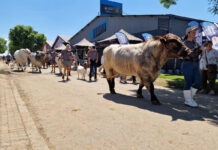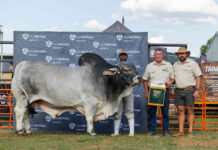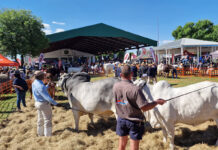

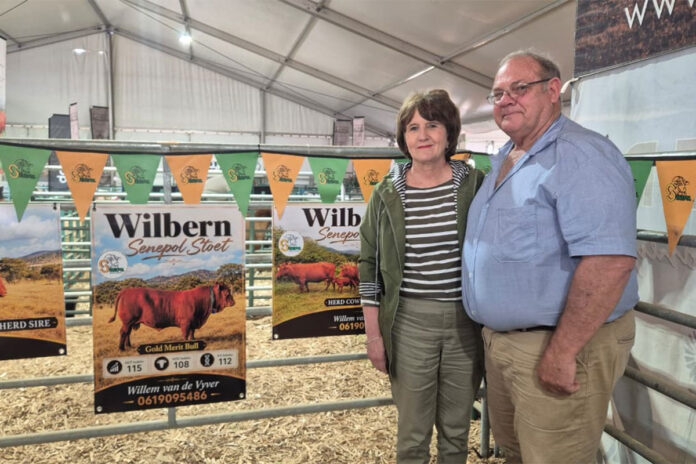
A ban on live cattle due to the threat of foot-and-mouth disease means that Willem van de Vyver, a stud farmer from Queenstown, Eastern Cape, could not bring his prize Senepol bull to his first Nampo Cape, but he is determined to convince everyone passing his stand of the promise the breed holds for the Western Cape red meat industry.
“The Western Cape has traditionally been oriented more towards the British-type breeds with larger frames, but I believe the Senepol has a place here because of its excellent meat quality, its adaptability on the land and its very efficient feed conversion,” he told Farmer’s Weekly in an interview during Nampo Cape 2026.
Van de Vyver started the Wilbern Senepol stud in 2014 and keeps his animals on rented land in the Queenstown district.
He believes that with lower rainfall and higher temperatures becoming more prevalent in the Western Cape, there is value to a breed with a smaller frame that adapts readily to changing and difficult conditions.
“Your large, heavy breeds are more inclined to lose weight during drought conditions, which in turn leads to lower reproductive efficiency,” he says.
The Senepol’s short, shiny coat also makes it exceptionally tolerant to high summer temperatures and more resistant to tick bites, he says.

A passion by chance
Despite all these admirable traits, Van de Vyver’s love for the breed came about by chance.
“After I sold my Bonsmara stud, I was at Nampo Bothaville the one year and spotted a few Senepol cattle in a pen. Among them was a very fat cow with her calf. When I got into the pen with them, she didn’t even get up. At that moment, I realised that if a total stranger could get into a pen with a cow and calf and get such a calm reaction, I, as an older man, could farm these animals. They have a beautiful temperament, and are tame and easy to handle,” he says.
He started his stud with two cows and one bull calf, and has since built it into a herd of more than 100 head, marketing mainly to the Free State. He adds that he selects for his herd based on genetic testing and conformation.
“Genetics is a long-term business. When I started, you could buy cows for R8 000 to R10 000, but now you’re looking at R30 00 to R35 000 for a cow. Cattle have a place in a diversified farming set-up. In the wool and mohair business you get massive fluctuations between seasons, but cattle bring consistency to your business.”
He says that Senepol cattle attract a very particular kind of breeder: someone who thinks beyond the obvious and does not shy away from new things.
“All my fellow breeders are people with vision, who are looking beyond the conventional routes to improve their animals.”
For more information, phone Wilbern Senepol on 061 909 5486.