
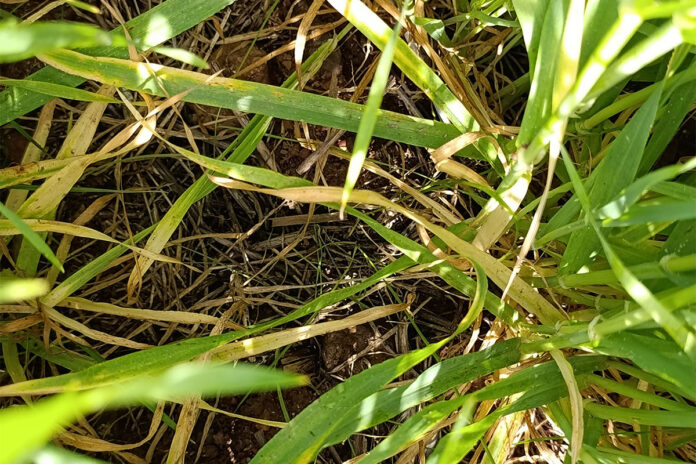
This was according to Prof Johann Strauss, senior scientist at the Western Cape Department of Agriculture, who spoke during a Farmer’s Weekly-hosted panel discussion at Nampo Cape in Bredasdorp on El Niño and managing drought and heat stress.
“You can’t farm according to a recipe like your fathers did. You must be adaptable,” Strauss said.
For him, this meant responding to what was actually happening in the field and adjusting production decisions as the season unfolded.
Strauss used nitrogen top dressing as an example. Rather than automatically applying a second top dressing because it formed part of the usual programme, rainfall could be used as a trigger for the decision.
He explained that, in the system he referred to, the first top dressing would be applied, but a follow-up dressing would be withheld if 100mm of rain did not fall by the end of July.
The same thinking applied to crop protection.
Rather than automatically spraying because a particular treatment would normally be applied at that stage of the season, farmers should first scout their lands and establish whether the disease was actually present or posed a risk.
Following this method, they avoid spending money on an intervention that is unnecessary.
The margin is what matters
Strauss said the benefits of conservation farming practices could be seen in what farmers were now able to produce under difficult climatic conditions.
Where poor rainfall might once have resulted in little or no crop, improved management and the ability to conserve moisture from earlier rainfall could give farmers a chance of still bringing in a harvest.
That was an important achievement, but Strauss cautioned that agronomic resilience did not automatically translate into profitability.
He referred to the prospect of harvesting around 2t/ha under difficult conditions as “brilliant”, but added that this “unfortunately was not enough to pay the bills”.
The challenge was therefore not only to keep the crop going, but also to ensure that the money spent on it remained justified by the yield that could realistically still be achieved.
“The margin determines the decision,” Strauss said.
As yield potential declined, farmers had to become increasingly selective about additional inputs and interventions. The aim was not to chase yield at any cost, but to protect the margin and keep the farming business viable through a difficult season.
Don’t change everything at once
Farmers also did not necessarily have to introduce completely new crops or enterprises to become more resilient.
Strauss said some producers had strengthened their businesses by making better use of the crops and livestock already suited to their farms, and by changing how these were combined in rotation.
“Some farmers who had adapted their systems in this way had remained financially strong through drought years, with a few even able to buy farms at a time when others were being forced to sell,” he said.
Look overseas, but test at home
While farmers could often improve resilience by adapting existing systems, Strauss said there was also value in looking elsewhere for new ideas.
“South African farmers can learn from countries such as Australia, where dryland producers faced similar drought and margin pressures. However, the solutions still have to be tested under local conditions as everything is not translatable,” he said.
One option being explored, for instance, was lentils and faba beans, which could give Western Cape cash-crop farmers another pulse crop in their rotations.
Research before taking the risk
Strauss highlighted the broader value of agricultural research, including that done by the Western Cape Department of Agriculture, in an increasingly uncertain production environment.
“Research allows new crops, products and practices to be tested before farmers commit to them across large areas of their farms,” he explained.
This was particularly important because the consequences of an intervention might not always become apparent during the season in which it was used.
Strauss referred to cases where a product appeared to perform well on one crop, only for problems to emerge when canola was planted on the same land the following year.
Long-term trials therefore allow researchers to look beyond the immediate response and see how a practice performs over several seasons and within a wider cropping system.
Strauss said these trials were even more valuable when different disciplines worked together, drawing on expertise in areas such as agronomy, soil science and breeding, as well as partnerships with universities and other research organisations.
“We can’t be islands,” he said.
Know your own farm
A separate challenge was that a practice that worked on one farm could not simply be copied onto another and expected to give the same result. Differences in soils, rainfall and production conditions meant that even farms in the same region could respond differently.
Strauss also cautioned farmers against becoming too dependent on consultants and company representatives for production decisions.
While outside expertise remained valuable, farmers still needed to take responsibility for understanding what was happening in their own fields.
He said every field was different, and knowing the farm well helped farmers judge whether the advice they received made sense for their particular circumstances.
For Strauss, this was ultimately what resilience came down to: using research and expert advice as a guide, but knowing the farm well enough to decide what suited its conditions, and knowing when management needed to change.