
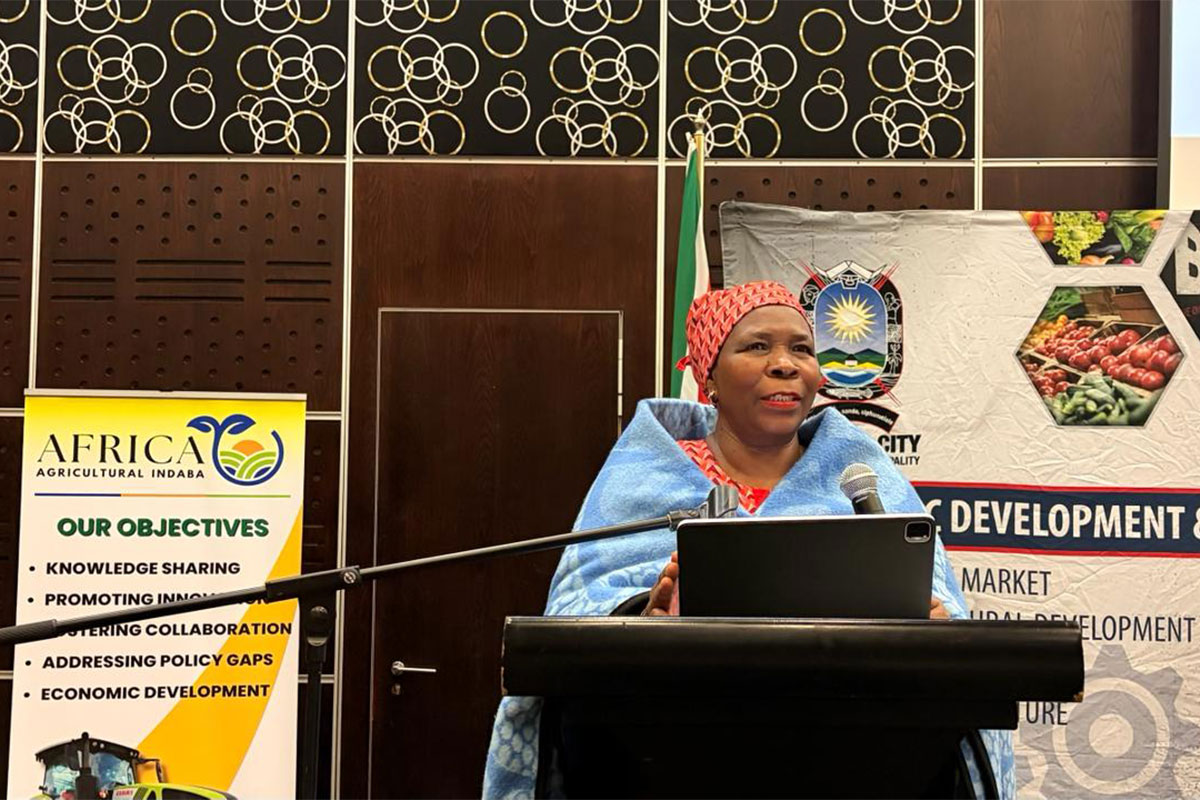
The three-day indaba, currently under way at the East London International Convention Centre in Quigney, has brought together farmers, agribusinesses, researchers, government leaders, and industry stakeholders to discuss the future of agriculture in the province and across South Africa.
Speaking during the opening session, Mabuyane said the province has significant agricultural potential but continues to lose economic value because products are processed elsewhere.
“For too long we have remained exporters of raw materials while importing unemployment, poverty, and even food that we are fully capable of producing ourselves,” he said.
Mabuyane noted that the provincial government is making major infrastructure investments to support agricultural growth, including upgrades to roads linked to farming regions and irrigation schemes.
He described agriculture, forestry, and fisheries as among the province’s most important economic sectors, contributing significantly to employment and agro-processing opportunities.
According to him, the province’s future growth will depend not only on primary production but also on strengthening processing, packaging, logistics, and export industries.
Push for local procurement
Mabuyane also said government institutions will increasingly be expected to procure food from local farmers as part of a broader localisation strategy.
“A hospital in Mthatha must procure from local farmers. Schools and prisons must support local agriculture. This is how we keep money circulating within rural economies,” he said.
According to him, government is seeking to localise an estimated R2,6 billion currently spent outside the province on food procurement.
He also highlighted opportunities in high-value industries such as citrus, livestock, dairy, hemp, cannabis, aquaculture, and wool production, while calling for stronger agro-processing capacity within the province.
“The future belongs to regions that can produce competitively, process innovatively, and export strategically. That future must include the Eastern Cape,” he said.
Indaba must deliver practical outcomes
Speaking to Farmer’s Weekly, Kontsiwe said the indaba needs to move beyond discussion and deliver practical outcomes for the agriculture sector.
“This indaba is not a ceremonial gathering. It is a working platform that must produce direction, partnerships, and measurable outcomes for the agriculture sector in this province,” she said.
Kontsiwe described agriculture as a key driver of economic growth, employment creation, and food security in the province.
“As we engage, we must interrogate the constraints facing the sector, agree on practical solutions, and take collective responsibility for implementation.”
She noted that global geopolitical tensions, changing trade conditions, climate variability, and supply chain disruptions are increasing pressure on food systems around the world, making local agricultural production increasingly important.
According to Kontsiwe, the department’s long-term strategy includes transitioning communal and smallholder farmers to commercial production through structured support and improved market access.
She also addressed the ongoing foot-and-mouth disease outbreak in South Africa, saying the Eastern Cape has once again mobilised veterinary officials and animal health technicians to prevent further spread.
“The province managed to contain outbreaks in Kouga and Kou-Kamma during [the 2024 outbreak] and remains confident that current interventions will also succeed,” she said.
Youth participation in agriculture also formed part of discussions at the indaba, with Kontsiwe saying people are central to the province’s commercialisation plans.
“We have invested significantly in young people, who form a core part of our implementation strategy for the commercialisation of 100 farms.
“What we do here must translate into action beyond this platform. Let this Indaba mark a shift from fragmented efforts to coordinated action, and from plans to implementation,” she said.