
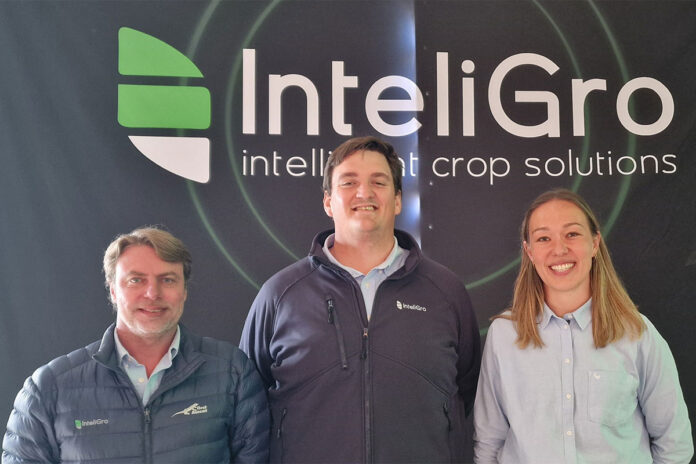
This was one of the key messages from InteliGro’s Farmers’ Day at the 92nd Swartland Show in Moorreesburg.
Soil scientist Jan van Zyl challenged producers to look beyond average soil test results after researchers encountered fields where crops showed magnesium and potassium deficiencies despite analyses indicating adequate nutrient levels.
Presenting findings on chemical stratification in long-term minimum-tillage systems, Van Zyl explained that the research was prompted by situations where crops displayed magnesium and potassium deficiencies despite analyses indicating adequate nutrient levels.
When soil tests don’t tell the full story
To better understand the phenomenon, soil samples were collected in layers down to 30cm on fields that had been under minimum tillage for many years.
“What we found was a significant accumulation of calcium, potassium and phosphorus in the top 2,5cm of the soil profile,” Van Zyl said.
The sampling revealed that nutrients and soil amendments had become concentrated near the soil surface rather than being distributed throughout the active root zone.
“This indicates that stratification is occurring. Nutrients and soil amendments are concentrated near the soil surface and are therefore not always available where the majority of plant roots are active,” he said.
According to Van Zyl, the problem becomes more apparent as the topsoil dries out.
“As soils dry out, crops may experience nutrient deficiencies earlier than expected because much of the available nutrition remains concentrated in the uppermost soil layers.”
Van Zyl also referenced Western Cape research that found soil stratification affects about 30% of Swartland soils.
“Where significant stratification exists, one possible solution is strategic tillage to redistribute nutrients and amendments through the soil profile and create a rooting environment that plants can use more efficiently,” noted Van Zyl.
Profitability over maximum yield
Karen Truter, technical marketing specialist at InteliGro, said data and technology are becoming increasingly important tools for helping producers understand variability on their farms and make better decisions.
“Variation at farm level is significant. If we can use data and technology to understand that variability, it becomes much easier to manage,” she said.
Truter encouraged farmers to make greater use of focused on-farm trials while also drawing on information already generated within their production regions.
“The idea is to equip farmers to conduct their own trials, while also helping them make use of trial information that already exists in their production areas. Ultimately, this helps them make better-informed decisions on their own farms,” said Truter.
One of the key lessons emerging from Data-Intensive Farm Management projects is, “farmers should always evaluate trial results from the perspective of economic yield rather than simply agronomic yield.”
“The objective is not necessarily to achieve the highest possible yield, but rather the most profitable yield. Farmers need to understand where their input spend delivers the greatest return,” advised Truter.
Local trials reinforce the lesson
The importance of local, site-specific information was reinforced by InteliGro agronomist Reinhardt Wessels, who presented results from the company’s 2025 Intelekt Solutions wheat trials conducted in and around Moorreesburg during last year’s wetter season.
“Trials from the past give us the data and lessons that we can apply in the future,” Wessels said.
The trials compared five wheat cultivars under different disease-management programmes and evaluated responses to Septoria and brown rust pressure.
“Not all cultivars had the same reaction to the treatments,” he said.
Wessels noted that cultivars such as Ancia and IS Tordo delivered some of the strongest results in untreated plots, partly because of their natural disease resistance.
However, he cautioned against assuming that the same results would necessarily be repeated in different regions or seasons.
“In other areas and trials, it looked different,” noted Wessels.