
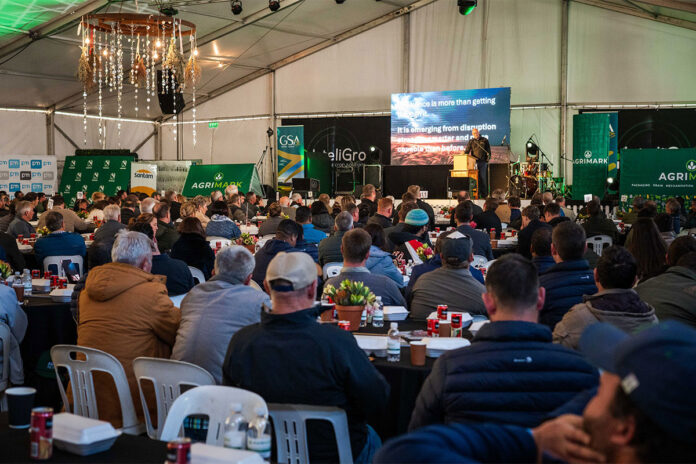
Dr Dirk Strydom, managing director of NAMPO (Pty) Ltd, opened the agricultural seminar at the 92nd Swartland Show by outlining several Grain SA priorities.
He said about 10 cultivars had been approved for release within one to two years, some of which could lift yields by more than 10%. Strydom also referred to Grain SA’s engagement with banks over Prudential Authority rules on distressed debt restructuring.
“You can have the best business, you can have the best farm, but if the rain doesn’t come, there is nothing you can do about it,” he said, arguing that agriculture faced risks that distinguished it from other sectors.
South Africa’s long-term food security depends on the whole food value chain remaining economically viable, Tiger Brands CEO Tjaart Kruger said.
Kruger said participants in the chain had to earn a sufficient return on capital to remain in business. He pointed to Tiger Brands’ disposal of its Randfontein milling operations, which included maize milling, as an example.
A competitive value chain
Local manufacturers did not compete only with one another, Kruger said, but also with retailer private-label products and imports, meaning the domestic chain had to remain internationally competitive.
Tiger Brands has expanded support for local small white bean producers after low 2024 yields forced it to import a portion for the first time. The company says it procures about 19 000 tons of small white beans a year from local farmers, while 70% of its agricultural procurement spend in 2025 went to local producers.
What farmers can control
Willemse’s main message was that producers should plan deliberately and concentrate on what they could manage. He asked how many farmers had a three- or five-year plan and urged them to plan beyond current conditions.
His advice included budgeting for machinery replacement, understanding future cash needs before approaching a bank and building reserves during stronger years to provide a buffer when conditions turned. He also pointed to diversification and cost control as part of a longer-term plan.
Adapting to uncertainty
Mark Watt, a partner at consulting firm Heidrick & Struggles, said businesses could no longer plan around a single expected outcome.
“You have to deliver today what you plan for tomorrow,” he said, arguing that leaders had to consider several possible scenarios at once.
Watt said organisations that navigated cycles best combined foresight, adaptability, learning and resilience. Foresight meant weighing different time horizons and working backwards, while adaptability required continually asking what should be done differently as circumstances changed.
He said South African organisations had developed unusual resilience because of the difficult environment in which they operated, and closed by stressing the value of collaboration.
“None of you are alone, but together we have a much better opportunity of getting through it,” he said.