


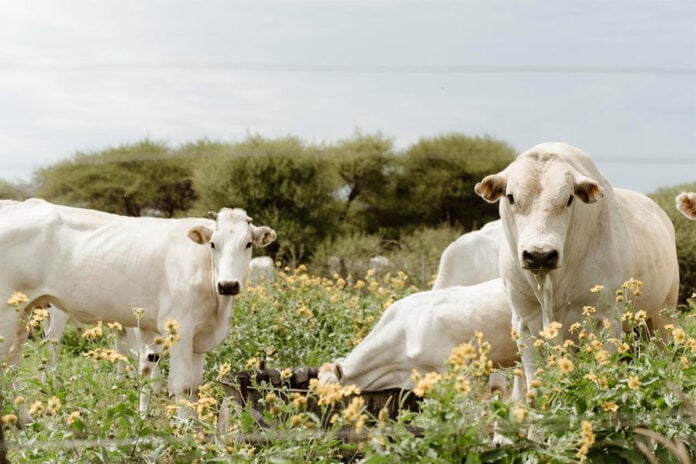
Asked by Farmer’s Weekly how the breed can contribute to increasing red meat yields per hectare, he says: “Production per hectare is not determined by breed alone. Stocking rate, fertility, grazing management, feed costs, market prices, and the number of calves weaned all influence profitability. For the commercial producer, the question is not simply how large a calf can grow, but how efficiently the whole system converts available resources into saleable beef.”
Chianinas for commercial cattle producers
According to Van Heerden, the commercial producer is extremely important to the long-term future of the Chianina breed. He emphasises the fact that stud breeders cannot operate in isolation from the industry it is ultimately intended to serve. This forms the basis of Van Heerden’s philosophy to breed cattle that are both genetically sound and commercially useful. The Grance Bovini goal is to improve the herd consistently rather than chase a particular look or a single performance figure.
“Our responsibility is to breed animals that offer practical value to commercial farmers. This means paying attention to the characteristics that influence profitability. We believe Chianina genetics can be particularly valuable in crossbreeding programmes where the producer wants to improve specific traits in an existing herd. The right mating can potentially add value, but the choice of bull must always be appropriate for the cows and the production environment. We want commercial farmers to see Grande Bovini as a source of highly effective genetics, backed by honest information and a clear understanding of their farming objectives,” he says.
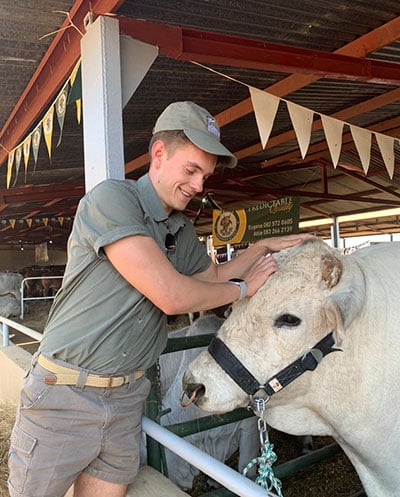
However, Van Heerden makes it clear that crossbreeding is not simply a matter of putting a large bull to any cow and expecting an impressive result. The choice of bull, the characteristics of the female herd, and the production environment matter. The objective of crossbreeding should be to produce a calf that performs well within a commercial producer’s production system. This includes calving ease, growth, fertility, adaptability, and the market for the eventual offspring.
Chianinas’ value to crossbreeding concerns
“We see the commercial producer as an important part of the future of the breed. Our goal is to supply genetics that can make a contribution to commercial herds, rather than breeding animals purely for appearance. I have had the experience of very successfully crossbreeding my Chianinas with a number of breeds, including Simbra, Brahman, and Nguni’s, achieving astonishing results. A client of ours used a Grande Bovini bull on Nguni females and recorded a 30kg increase in the previous season’s weaner weights,” says Van Heerden.
Functional and commercially relevant
Grande Bovini was established in 2011 by Van Heerden’s father, Willem van Heerden. The idea behind the stud was to build a breeding operation focused on producing purebred quality, Chianina cattle that are not only impressive to look at but also functional and commercially relevant. He joined the farming operation as a young boy in 2018 and took over the farming operation after the passing of his father in 2020.
Van Heerden currently runs a herd of approximately 80 stud animals on 300ha.
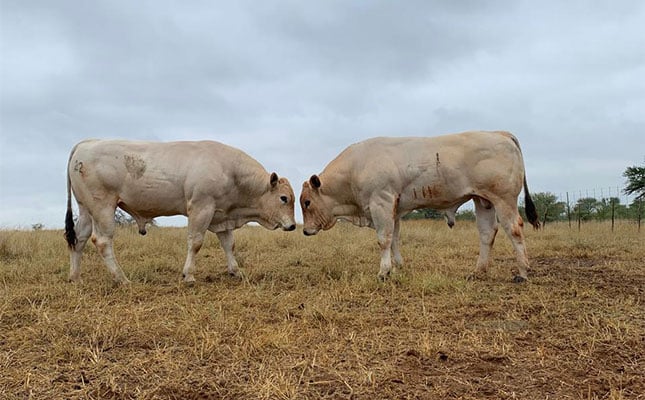
“What attracted us to the Chianina was its combination of size, growth potential, muscle development, and overall presence. It is a breed that stands out, but what interests me most is the potential to translate those characteristics into commercial value,” he points out.
Fertility, sound feet and legs, good body capacity, and the ability to thrive under often challenging conditions are important considerations. Van Heerden pays particular attention to growth, muscle and an animal’s overall balance. He strictly keeps to the breeding standards of the Chianina as established in Italy, over the years backdating the breed’s existence in South Africa.
“Ultimately, although size is one of the breed’s distinguishing characteristics, we do not believe it should be pursued at the expense of functionality. The ideal Grande Bovini animal must combine the breed’s natural characteristics with the practical requirements of the environment they are farmed with,” he says.
Contribution over a lifetime
A Grande Bovini bull should have a masculine appearance, good length, a strong topline, sound legs and feet, and a well-developed hindquarter. The cow should be feminine, structurally sound, and capacious, with the body capacity needed to maintain herself and her calf even under extensive conditions such as drought and heat. For Van Heerden, the ultimate measure of a good breeding animal is what it contributes to the herd over its productive lifetime.
The matter of replacement heifers is managed very carefully by Van Heerden; decisions made at this stage influence their future performance in the herd. Heifers are selected on growth, structure, pedigree, and temperament and are introduced to bulls at approximately 24 to 36 months, provided they have reached the appropriate weight and level of development. A heifer must be sufficiently developed to cope with pregnancy and calving while still continuing to grow herself.
At the moment, approximately 15% to 20% of the Grande Bovini herd is artificially inseminated. The objective is to introduce new genetics that would otherwise be difficult or expensive to acquire.
Ease of calving and an even temperament
Calving ease is one of the most important considerations in any beef cattle operation, and it is something that is taken seriously at Grande Bovini.
“Although the Chianina is a tall, large-framed breed, we do not believe that birth weight or mature size should be considered in isolation. Calving ease is influenced by factors such as calf birth weight, calf shape, the cow’s pelvic capacity, and the management of the breed. We pay particular attention to the suitability of bulls used on heifers and believe in selecting breeding animals according to the females they will be mating with. Calving ease is the norm in our stud, with little to no issues. We would rather make careful mating decisions than create unnecessary calving problems in pursuit of size,” says Van Heerden.
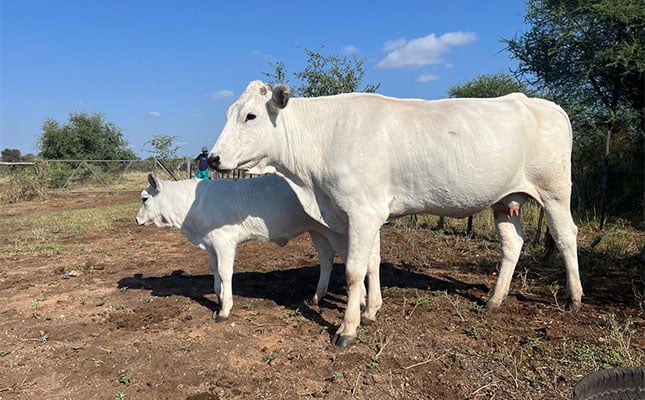
Temperament is vitally important in the Grande Bovini herd. As Van Heerden puts it, “Good temperament makes handling safer and significantly adds to ease of management. In our stud we strive to reduce unnecessary stress to make routine management considerably easier. One of the best moments in my life is walking among my ‘gentle giants,’ coffee in hand, in the early morning,” he says.
The Van Heerden farming concern is primarily focussed on the Chianina stud but also includes vegetable production. The Grande Bovini herd is kept mainly on natural sweetveld grazing complimented by additional feeding. The adaptability of the breed is underscored by its ability to comfortably manage the extreme temperatures interspaced by regular droughts that occur in the area.
“We believe that a breed’s suitability must be judged by how it performs under the conditions in which it is farmed. An animal must maintain its condition, reproduce, calf, and remain structurally sound over the duration of the year, even in times of want,” says Van Heerden.