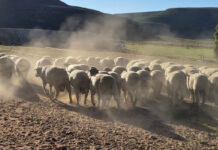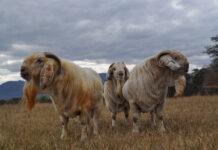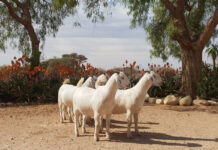

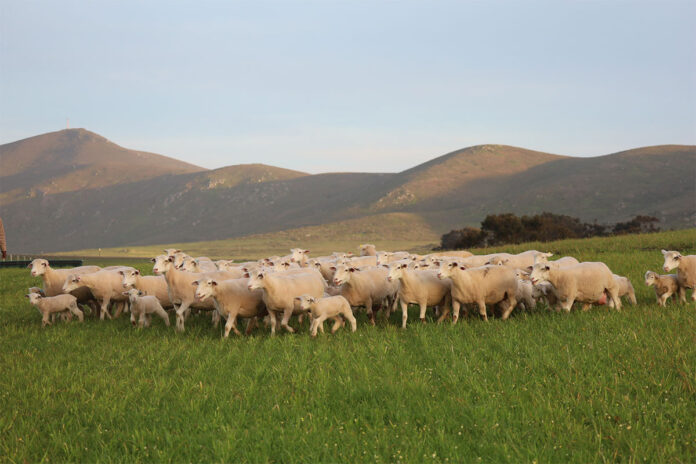
Johnny Forbes runs his Vredesig Dormer stud, comprising 250 ewes. The fact that quality always trumps quantity forms the cornerstone of his flock.
The stud, registered in 2021 and farmed under semi-intensive conditions, is fully geared towards the production of animals that are suited to all farming conditions in the country because of the breed’s outstanding adaptability.
Forbes manages the stud alongside his wife, Mala, and the studmaster, Dewald Linde.
Outstanding fertility coupled with rapid growth
“The medium-framed Dormer is a first-rate choice as far as the production of lamb and mutton is concerned. The breed is highly fertile and known for rapid growth, meaning weaned lambs are ready for market at a younger age.
Ewes are able to produce a lamb every eight months, a trait that adds significantly to the productivity of any flock, markedly increasing production per hectare, and, obviously, income p/ha. The fact that the Dormer performs excellently in terms of crossbreeding also adds to the breed’s outstanding value in terms of lamb and mutton production,” says Forbes.

The stud, registered in 2021, was initially founded on proven genetics from the Renosterbosrug Dormers, originating in Malmesbury, Western Cape, Johanri Dormers in Lindley in the Free State, 2Broers Dormers near Barkly East in the Eastern Cape, and Droërivier Dormers, close to Burgersdorp in the Eastern Cape. Since then, Forbes has put his own stamp on the flock, strictly selecting highly productive sheep that make economic sense.
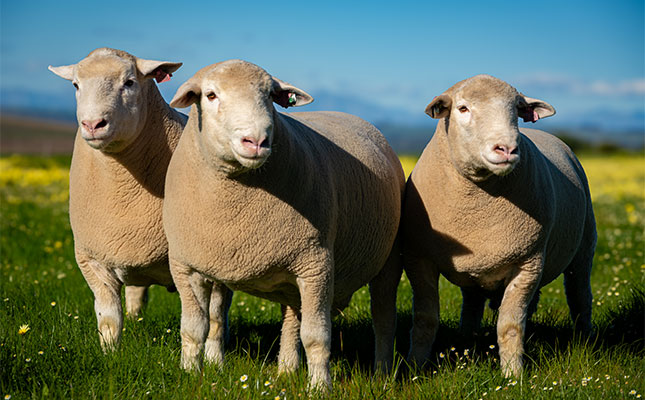
The ideal Vredesig ewe is expected to drop and wean at least one lamb annually. The ewes must be feminine, carrying adequate meat. Rams are well-muscled with excellent carcasses. Top walking ability is high on the selection list for both ewes and rams.
Viticulture, cattle and commercial sheep
Forbes’ farming business also includes a commercial cattle and sheep component, as well as the production of crops such as lupines, barley, and oats. He also runs a viticulture component consisting of grape cultivars such as Cinsault, Grenache, and Chenin Blanc.
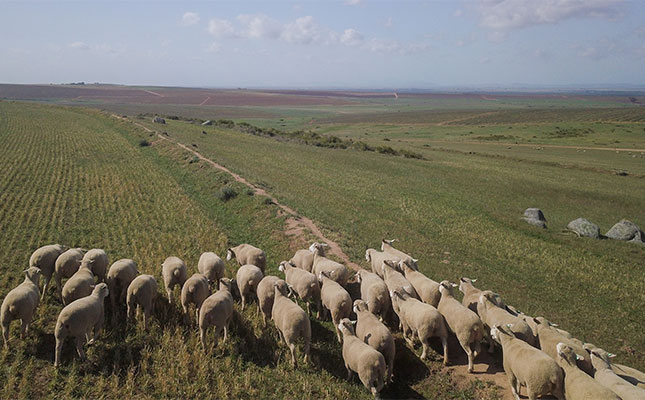
The Forbes’ sheep production concern is run semi-intensively. The flocks graze on crop stover and dryland-planted pastures through the year, but the ewes that lamb are kept in lambing pens.
The mothers and lambs are kept in the pens for 10 days after the births before being moved to the crop fields and pastures. Moving the ewes and lambs out relatively early means early adaptation to the grazing conditions. The pastures consist of a seed mixture that includes, among others, rye, oats, vetch, and fodder radish.
Lambing pens and biosecurity
Keeping the ewes and lambs in the lambing pens creates a strong bond between them that markedly adds to increased weaning percentages. However, keeping the animals in confinement calls for very strict biosecurity measures to prevent the outbreak of disease. Forbes is unwavering as far as biosecurity is concerned.
He says: “The outbreak of disease in the close confinement of a lambing shed could, in an instant, wipe out an entire lamb harvest and seriously affect the breeding ewes as the bedrock of the flock.
“The Dormer is on top of the list of terminal breeds for crossbreeding. This is underscored by the high demand for Dormer rams in South Africa. Dormer cross lambs present exceptional slaughtering percentages, and feedlotters are often prepared to pay a premium for these lambs.
“Dormer and Dormer crosses fare exceptionally well in carcass competitions because of the superb meat quality, top carcass quality, and slaughtering percentages of between 48% and 52%,” adds Forbes.
Animal recording and performance testing are of utmost importance in the Vredesig stud. According to Forbes, the data gained in this way makes it possible for him to identify poor performers timeously. This adds markedly to the overall performance of the stud and is invaluable for, among others, the maintenance of high average daily gains and top reproduction.
Birth weights, weaning weights and average daily gain
Forbes maintains two breeding seasons. One group of ewes is inseminated by laparoscopy in March and the rest in September. Two weeks after the procedure, rams are introduced for 10 days. The ewes giving birth in February and March have access to grazing in the vlei areas of the farm, while the ewes lambing in August and September have access to the crop stover. Because of the prevalent weather conditions in the Renosterveld area, lambing in winter is not possible.
“We maintain an average birthweight of between 3,5kg and 4,4kg, while our average weaning weight at 90 days is between 38kg and 45kg. The average lambing percentage is between 160% and 170%. The average inter-lambing period stands at 375 days. The stud maintains an average daily gain of between 380g and 450g,” says Forbes.
Vredesig Dormers are mainly marketed at production sales, with the annual National Dormer Sale being the primary event. The very best rams and ewes are earmarked for this sale. The stud also participates in the Bakgat (Bloemfontein), and Vastrap (Parys) sales.
Best and worst decisions
Asked what the biggest mistake was he made in terms of stud breeding, he says: “My biggest mistake was to believe that quantity supersedes quality. I can never emphasise enough that quality always trumps quantity enough.
“Two hundred top-performing ewes are infinitely more valuable than 400 average ewes. On the other hand, the best decision I took was to put young ewes to the rams at the age of 12 months, instead of 18 months. This decision accelerated the genetic improvement of the stud significantly.
For more information, contact Johnny Forbes at [email protected].