
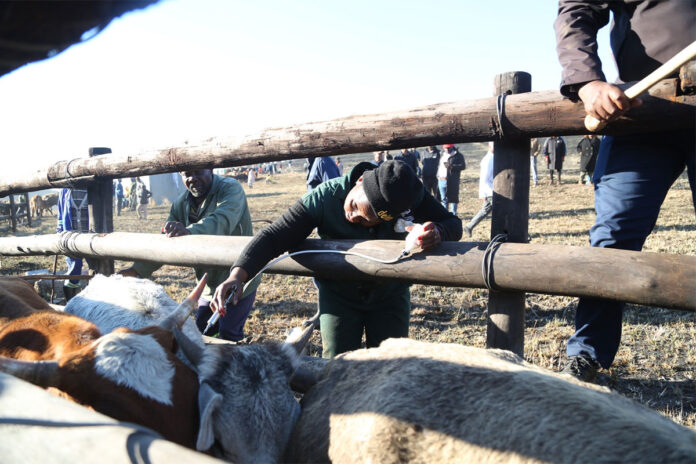
Speaking to Farmer’s Weekly during an FMD vaccination and rabies awareness campaign in Mtontsasa, Ingquza Hill Local Municipality, Eastern Cape, this week, Capa said government had deliberately prioritised areas with the highest livestock concentrations and the greatest economic risk when the outbreak escalated.
“It is important to understand that the department did not discriminate against rural communities during our emergency response.
“We initially concentrated our efforts where livestock numbers were highest and where the economic impact would have been greatest. We had to protect the dairy industry because, had we not started there, South Africa could have faced serious shortages of dairy products. We also had to focus on areas producing beef for export and other livestock products.
“That meant some rural communities were reached later, but we are now ensuring that these communities also receive the necessary support,” she explained.
During the campaign, officials vaccinated more than 500 cattle at one dipping tank before moving to another rural area to vaccinate dogs and cats against rabies.
“We also provided cleaning equipment, including forks and spades, to ensure the dipping facility can be properly maintained and to improve hygiene around the site,” Capa said.
The visit formed part of the department’s Nelson Mandela Month outreach programme and also included the handover of livestock ownership certificates, gardening implements, and seedlings to community members.
Capa said ownership certificates are an important tool in combating livestock theft.
“If livestock are stolen, the police require proof of ownership. An identity document alone is not sufficient; the ownership certificate links the animals to their rightful owner,” she said.
She added that the department aims to provide multiple services during a single visit rather than requiring communities to wait for separate interventions.
“Our approach is that when we visit a community, we should deliver as many services as possible instead of returning repeatedly.”
Addressing biosecurity, Capa said livestock theft and inadequate rural infrastructure remain significant concerns.
“Many dipping tanks have no toilets, storage facilities, or shelters where equipment can be kept or meetings can be held,” she explained.
According to her, veterinary officials are also using the vaccination campaign to educate farmers on disease prevention and biosecurity.
“All the district animal health officials are here, together with veterinary professionals who provide advice and answer farmers’ questions. Even after the formal meetings end, farmers gather around these officials to ask practical questions about animal health.”
Capa noted that the department wants to strengthen partnerships with traditional leaders and municipalities to improve infrastructure supporting animal health.
“When we return, we will discuss these proposals with Minister [of Agriculture] Willie Aucamp. We want to work with traditional leaders and municipalities to improve roads leading to animal health facilities and dipping tanks, and gradually improve the infrastructure available at these sites.”
She also encouraged farmers to better manage their grazing to reduce overgrazing and soil erosion, saying several producers have already proposed establishing fenced grazing reserves for winter.
“The response from the community has been extremely positive. More and more people are arriving, even though the programme has already exceeded its planned duration,” Capa concluded.