
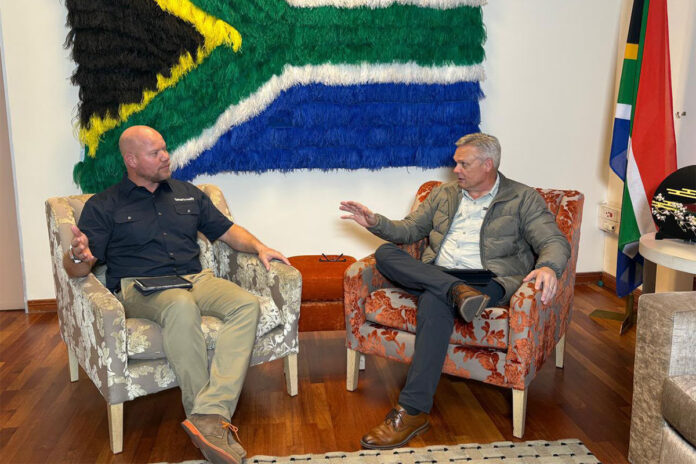
Willie Aucamp has served as minister of agriculture for little more than a month but has already identified several areas of the sector that he believes need attention.
Speaking to Farmer’s Weekly, he said many of the problems facing agriculture can be addressed, but acknowledged that government must improve the way it operates and work more closely with the sector.
Aucamp pointed to outdated departmental systems, lengthy administrative processes, insufficient use of technology, and communication failures between government and the agriculture sector.
He also accepted that government cannot solve these problems on its own, saying: “We need to work together. We are one team in agriculture.”
Aucamp repeatedly emphasised the need for greater engagement with farmers and agricultural organisations, saying government needed to understand the sector’s frustrations and respond to them.
FMD remains the immediate priority
Aucamp’s first priority is the foot-and-mouth disease (FMD) crisis. He described FMD as the most pressing issue he encountered when entering office, adding that the crisis had exposed government’s limitations in trying to manage a national agricultural emergency on its own.
The minister said the Department of Agriculture (the department) needed to address its own deficiencies and strengthen its partnership with the private sector.
He believes the increased involvement of private veterinarians, farmers, and agricultural organisations in the vaccination campaign can help overcome some of the capacity constraints that have slowed the rollout.
A key change involves allowing farmers who register as authorised persons to vaccinate their own livestock. Aucamp said he saw the measure as a way to address one of the bottlenecks in the vaccination campaign: the shortage of veterinarians and veterinary technicians.
“That will really speed up this whole process,” he added.
He also acknowledged that a vaccination campaign could not succeed if some farmers were left behind.
Aucamp noted that farmers who could afford vaccines and had the necessary facilities could protect their own herds, but farmers who lacked the financial means or capacity to vaccinate could undermine the broader effort.
“This is a collective effort,” he said.The minister added that the approach gives farmers a greater role in administering the vaccination campaign, and that its effectiveness will depend on vaccine availability, farmer participation, reporting, and the department’s ability to monitor implementation.
The minister added that the approach gives farmers a greater role in administering the vaccination campaign, and that its effectiveness will depend on vaccine availability, farmer participation, reporting, and the department’s ability to monitor implementation.
‘We need to get the basics right’
Aucamp’s concerns extend beyond FMD.
He identified the department’s administrative systems as an area requiring attention, particularly the delays in applications processed under the Fertilizers, Farm Feeds, Agricultural Remedies and Stock Remedies Act (No. 36 of 1947).
The minister said the current administrative delays were unacceptable.
“We cannot have people waiting for months, and in some instances years, to present products [such as animal feed] to the market that can benefit agriculture.”
Aucamp also wants to modernise the department’s internal systems. He described a department where some submissions still move through the system in hard copy, slowing decisions and making an already bureaucratic process more cumbersome.
“We need to see that we really get things done in a quicker way,” he said.
Aucamp believes officials need better systems and technology to enable them to work more efficiently.
He also identified the need for a cultural shift within the department, saying officials should view serving farmers as a responsibility rather than just a job.
“They must have the attitude of: ‘I want to go to work today because I want to be of service to the farmers of this country.’”
Aucamp did not give a firm timeline for resolving the administrative delays, noting that some changes, particularly those requiring legislative reform, would take time.
More engagement with industry
Aucamp has met with major agricultural organisations and said the discussions had revealed considerable overlap in their concerns.
His approach is to start with what he calls the basics. “If you’ve got the basics right, you will have sorted out a lot of the problems that most of these organisations have got.”
The minister said he wants more engagement between the department, organised agriculture, the private sector, and other role players on a regular basis.
Government, he argued, could not simply design regulations and expect the industry to implement them, adding that the agriculture sector needed to be part of the process.
He pointed to the ministerial task team on FMD and the Industry Coordination Council as examples of structures through which government and industry could work together.
Aucamp said workable solutions can only be found through consensus and ongoing dialogue.
“You hear me speak a lot about collective decision-making and taking everybody on board. Without that, it will not succeed,” he said.
Rural safety: talk must become action
Rural safety was another issue Aucamp identified as requiring greater cooperation between government departments.
He believes farm attacks, murders, and stock theft require a coordinated response involving the police, agriculture, and other government departments.
He was also straightforward about the need to move from discussion to implementation.
“We can talk and talk and talk about this, but we must now start implementing measures that can be measured on the ground.”
Aucamp said he intends to raise the issue with President Cyril Ramaphosa and wants rural safety to receive greater attention and resources.
He mentioned better preventative measures, improved investigations, and potentially specialised courts as measures that could form part of a stronger response.
At the same time, Aucamp said farmers had a role to play in protecting themselves and their communities through measures such as farm watches and safety networks.
His proposals require cooperation from departments outside agriculture, meaning implementation will depend on support beyond his own portfolio.
Aucamp also pointed to infrastructure as part of the rural safety challenge, saying rural roads in poor condition make it difficult for police to reach farms quickly.
He said addressing seemingly small infrastructure problems was necessary to improve the broader rural safety picture.
Looking beyond the crisis
Aucamp also identified infrastructure, electricity, transport, ports, and cold chain logistics as interconnected parts of the export value chain.
He used table grapes as an example, saying farmers can produce a high-quality product but face challenges involving roads, electricity, cold chain infrastructure, and port bottlenecks.
Aucamp said he has engaged with Minister of Transport Barbara Creecy on these issues.
Market access is another priority.
Aucamp said South Africa needed to protect existing markets while pursuing new ones.
He pointed to his planned visit to China in September to sign a protocol relating to cherry exports and said agricultural attachés stationed in various countries could help South Africa develop markets proactively. He added that more markets provide greater pricing options for local producers.
Opening new markets will depend on successful protocol negotiations and South Africa’s ability to meet the relevant animal health and market requirements.
FMD makes this particularly urgent for the beef industry.
Aucamp is concerned that restrictions on beef exports could result in an oversupply on the domestic market and place downward pressure on producer prices.
He linked farm profitability directly to food security. “If farmers are not profitable, they cannot produce, and if they can’t produce, we won’t have food to eat.”
Change will take time
Aucamp acknowledged that some of the changes he wants to make will take time.
He pointed to legislation dating back to 1947, arguing that the regulatory environment needs to reflect the technology and production systems used in modern agriculture.
“We’ve got to make sure that legislation speaks to the times that we are living in now,” he said.
Aucamp added that the department would continue working towards these changes despite the time required.
“We will not lie down until they are achieved,” he said.
He sees agriculture as one interconnected value chain, stretching from the farmer to the consumer, but also incorporating everything that happens before production begins, including seed, finance, and other inputs.
He warned that failure to manage these interconnected elements could eventually threaten both food security and rural economies.
What happens next?
Aucamp said farmers can expect better communication between the department and agricultural organisations, greater collaboration, clearer priorities, and a stronger focus on service.
“I can promise you that my department and I [will work] steadily to change things around and to really serve agriculture in this country,” he said.
His closing message to Farmer’s Weekly was that government, industry, and farmers need to take responsibility together.
“For as long as I am in this seat, I will work day and night, really hard, to the benefit of our farmers,” he concluded.
To watch the full video click here.