Morphew, who was among the recipients of an apology requested by Steenhuisen, said the incident raised important questions about government’s willingness to work with producers and industry stakeholders in combating South Africa’s worsening foot-and-mouth disease (FMD) outbreak.
“That partnership is not a courtesy. It is the only thing that will bring this disease under control,” he said.
The controversy erupted after a screenshot of an internal email dated 3 June 2026 began circulating on social media. In the email, Le Roux forwarded correspondence to Department of Agriculture Director-General Ramasodi Mooketsa and Deputy Director-General Dipepeneng Serage with the comment: “Attached just received for some amusement.”
The attached correspondence was not a complaint against the minister or his department. It was a detailed request for engagement from FMD Response SA, a collective of farmers, veterinarians and industry stakeholders seeking to support government’s efforts to contain the country’s worsening FMD outbreak.
Writing on behalf of the group, Morphew requested engagement on two key issues: aligning South Africa’s vaccination strategy more closely with the biology of the disease and ensuring sufficient vaccine access for the private sector to accelerate vaccination coverage.
In the letter, FMD Response SA acknowledged Steenhuisen and his department for securing vaccine supplies under challenging circumstances and stressed that government and industry shared the same objective: achieving widespread immunity, controlling transmission and restoring South Africa’s export market access.
The group further endorsed Steenhuisen’s commitment to a public-private biosecurity model and requested direct engagement with the minister and senior officials to discuss practical measures to improve the effectiveness of the national vaccination campaign.
Minister distances himself from email
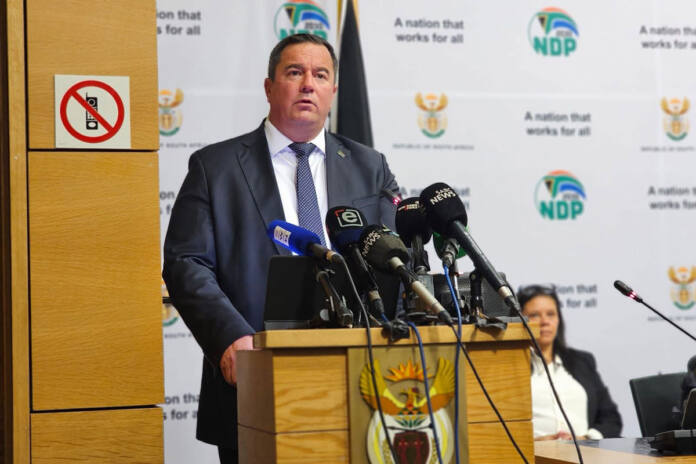
Responding to growing criticism, Steenhuisen publicly condemned the email.
“The email was in bad taste and I have requested the person concerned to apologise to the respective parties,” he said.
“We must continue to show mutual respect and always act in good faith because only through collaboration can we overcome major obstacles in the sector.”
The minister’s statement sought to contain the fallout from an incident that has reignited debate over government’s relationship with the agricultural sector and the role of private industry in combating FMD.
Morphew: ‘We remain willing to engage’
Morphew confirmed the authenticity of the email but said FMD Response SA remained focused on controlling the disease rather than taking offence.
“We do not have time to be offended. There is a disease to beat, and that is where our attention is,” he said.
Morphew said international examples from countries such as Brazil and Argentina demonstrated the importance of public-private partnerships in disease control and reiterated the group’s call for private-sector access to vaccines and greater involvement by veterinarians and producers.
He maintained that government had a central role to play in leading the national response and funding vaccines, but warned that no country had successfully defeated a major FMD outbreak without substantial private-sector participation.
“We are asking to help solve the problem. We remain willing to engage,” he said.
Industry leaders express concern
The leaked email triggered strong reactions from agricultural commentators and industry leaders.
Former DA MP Renaldo Gouws criticised the incident, noting that Morphew’s correspondence was intended to support government efforts rather than attack the department. According to Gouws, the letter sought practical solutions to strengthen vaccine rollout and assist government in combating FMD.
Agricultural commentator Paul Hattingh described the exchange as deeply troubling at a time when livestock farmers were grappling with movement restrictions, financial losses and mounting uncertainty caused by recurring outbreaks.
Dr Ernst Roets, executive director of the Pioneer Initiative, questioned whether the incident reflected a broader tendency within government to dismiss concerns raised by producers and agricultural stakeholders.
South African Agricultural Initiative (SAAI) CEO Francois Rossouw was among the most outspoken critics. He argued that the leaked email reflected a dismissive attitude towards private-sector participation and suggested it exemplified how industry proposals were often treated by officials.
“It reflects a broader attitude of arrogance, where public servants act as though they are to be served rather than serving the farmers who are in crisis,” Rossouw said.
Rossouw further criticised government’s decision to retain exclusive control over vaccine distribution while refusing offers from private-sector groups willing to assist with logistics and administration.
He argued that industry organisations had repeatedly offered to help accelerate vaccine deployment and improve coverage, but had been prevented from doing so by government policy.
Farmers demand a seat at the table
The controversy extends far beyond an ill-judged email.
At its heart lies a growing debate over how South Africa should tackle foot-and-mouth disease, how quickly vaccines can be deployed, and what role organised agriculture, veterinarians and private producers should play in the national response.
The correspondence that triggered the dispute was not a criticism of government. Instead, it was a request from farmers and industry stakeholders to participate more actively in the fight against the disease and to help accelerate vaccination efforts. That reality has made the contents of the leaked email particularly troubling for many producers.
For livestock farmers already grappling with movement restrictions, financial losses and uncertainty, the incident has become emblematic of a broader concern: whether government genuinely views the private sector as a partner in controlling foot-and-mouth disease.
Prof. Bismark Tyobeka, rector and vice-chancellor of North-West University, argues that South Africa’s struggle to contain foot-and-mouth disease exposes a deeper problem than the outbreak itself.
According to Tyobeka, the state’s response remains firmly government-driven, but the capacity to implement that response effectively is increasingly under strain. He believes a significant part of the problem stems from government’s reluctance to involve farmers more directly in decision-making and disease management processes.
“Farmers are not passive stakeholders in this crisis. They are the first line of detection, the custodians of livestock movements and the practical implementers of containment measures,” he said.
Tyobeka warned that excluding producers from meaningful participation risks slowing response times and weakening enforcement where it matters most.
His comments echo concerns raised by FMD Response SA and other industry organisations, which have repeatedly called for greater private-sector involvement in vaccine distribution, vaccination campaigns and disease surveillance.
Drawing on international examples such as Argentina and Brazil, Tyobeka argues that successful disease control depends on collaboration rather than centralised control. Following severe foot-and-mouth disease outbreaks in the early 2000s, Argentina adopted a hybrid model that combined government oversight with strong farmer participation, coordinated vaccination campaigns and regional disease management structures.
He believes South Africa should follow a similar path.
“The current system has been tested to its limits and has fallen short,” Tyobeka said.
Delays in vaccine distribution, movement permits and administrative processes have exposed structural weaknesses in the country’s disease-control framework. The challenge, he argues, is no longer simply about containing a virus, but about aligning capacity with responsibility.
The leaked email has reignited a debate that extends far beyond questions of professionalism or courtesy. It has highlighted growing frustration among producers who believe bureaucracy is slowing efforts to contain a disease that continues to threaten livestock production, rural livelihoods and export markets.
“Foot-and-mouth disease spreads rapidly. Bureaucracy does not,” Tyobeka cautioned.
With South Africa having lost its foot-and-mouth disease-free status in 2019 and continuing to battle recurring outbreaks, farmers are demanding more than apologies. They want meaningful engagement, faster decision-making and a genuine public-private partnership capable of responding to the crisis with the urgency it requires.