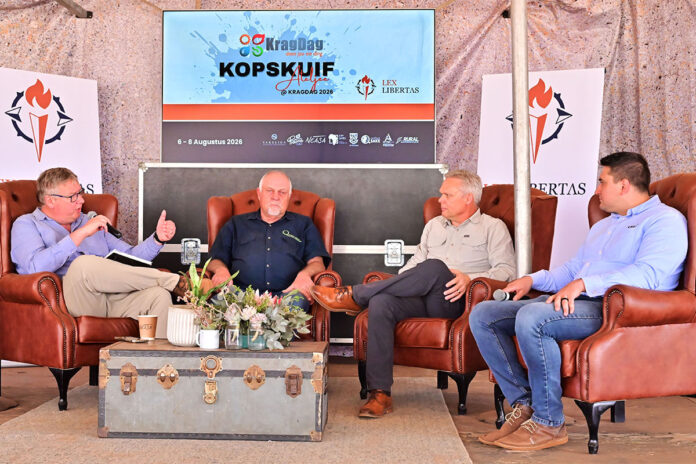
The panel comprised Minister of Agriculture Willie Aucamp, Free State Agriculture President Francois Wilken, and Southern African Agri Initiative CEO Francois Rossouw. James Kemp, station manager at Pretoria FM, moderated the discussion.
According to Aucamp, his signing in July of the latest foot-and-mouth disease (FMD) control measures, issued under Section 9 of the Animal Diseases Act (No. 35 of 1984), marked a complete overhaul of the measures governing FMD control in South Africa and established a new framework for regulating the livestock industry.
“There is now certainty on this matter, and anyone who remains unsure can consult Section 9 and implement its provisions,” he said.
Aucamp added that the immediate priority was ensuring that sufficient vaccine doses, including a booster shot for each animal, were available and distributed as quickly as possible.
Vaccine pricing and distribution
The panel also discussed vaccine pricing and the increased cost associated with Onderstepoort Biological Products’ (OBP) role in distribution. Aucamp attributed the high cost to poor logistical management. He explained that manufacturers could deliver the vaccines anywhere in the country at approximately R45 per dose, but that the bottleneck at OBP drove up the price because the facility then had to redistribute the vaccine.
The minister said that a total of 17 million vaccine doses had been brought into the country to date. Under the new framework, which allows the private sector to import and administer FMD vaccines, the first batch of one million doses had been supplied directly to the market through the private sector.
He added that a further four million doses from Dunevax were en route. Of those doses, only one million would be allocated to the state, while the balance would be distributed through the private sector. In addition, another four million doses being brought into the country by Red Meat Industry Services would soon arrive.
Aucamp said the entire national dairy cattle herd had already been vaccinated once, with some animals having received a second dose. He assured dairy farmers that they remained a national priority and would all soon receive second-dose vaccines.
He also emphasised that while the Section 9 document was not set in stone, it was sufficiently flexible to evolve with the industry’s changing needs.
Emphasis on vaccine availability, distribution
Wilken agreed that the immediate focus should be on vaccine availability.
“We need as many vaccines as possible, and they must be distributed as quickly as possible. We have to meet the requirements of the World Organisation for Animal Health [WOAH] to regain [South Africa’s] FMD-free status,” he said.
The panel discussed the industry’s move towards a single, integrated national system designed to facilitate safe agricultural trade while scientifically managing and containing outbreaks.
Aucamp appealed to farmers to use the digital vaccination registration platform developed by Buffalo Analytics and Dunevax Biotech.
“Farmers must use the straightforward application process and register as authorised agents. The documents are widely available through agricultural organisations and on the Department [of Agriculture’s] website,” he said.
Farmers are required to give five days’ notice of their intention to vaccinate. “The information gathered on the digital platform helps us provide evidence to the WOAH in order to restore our disease-free status,” Aucamp confirmed.
He added that the platform aimed to provide government with real-time vaccination data, strengthen traceability, and automate compliance checks. He called on all agricultural organisations to encourage their members to register, adding that electronically captured vaccination records would also enable suppliers to gauge demand more accurately and plan vaccine supplies accordingly.
Working together
“We’ve learnt many important lessons about better biosecurity preparedness, better policing through roadblocks to regulate movement, and better communication and collaboration across the industry.
“Another looming crisis we need to address is the loss of local vaccine manufacturing capacity,” Aucamp said.
Referring to the biosecurity measures implemented during the COVID-19 pandemic, which were relaxed once the disease had been brought under control, he added: “Farmers should remain vigilant in maintaining their own biosecurity.”
Aucamp stressed that biosecurity should be maintained throughout districts and ultimately extended across all provinces, adding that it was not solely the responsibility of farmers, but also of government, which had failed farmers in this regard.
He questioned whether protective cordons were being adequately maintained. “When last did anyone see an FMD roadblock?” he asked, acknowledging the need for improved policing and movement control.
Positive momentum
Wilken expressed optimism about the first vaccine doses to be distributed directly to farmers through the private sector. “We wanted to see action, and now we are finally beginning to see it,” he said.
He said farmers were hopeful that the spread of FMD could be contained, but he cautioned that the process would not be a short-term project and could take years. He also stressed that farmers must be included at every stage when planning the way forward.
Wilken emphasised the importance of traceability and proof of vaccination, adding that the immediate objective should be to vaccinate the required 90% of animals.
“Only once they have been vaccinated again six weeks later will the industry be able to breathe easier,” he added.
Wilken said he remained concerned about how the mass vaccination programme would be implemented in a controlled manner. Once vaccination has taken place, the Department of Agriculture and its veterinarians would be responsible for conducting the testing and monitoring required by WOAH.
“The latest control measures, farmers’ ability to market and transport their animals under certain conditions, and the creation of an electronic system linking all relevant government departments make us feel that progress is now being made and that we are on the right track,” he said.
The discussion highlighted Aucamp’s intention to decentralise processes so that the agriculture sector can play a greater role in controlling FMD in future. He assured the panel that he was doing everything in his power to change attitudes among officials and ensure that political considerations did not derail or inhibit the necessary processes.