
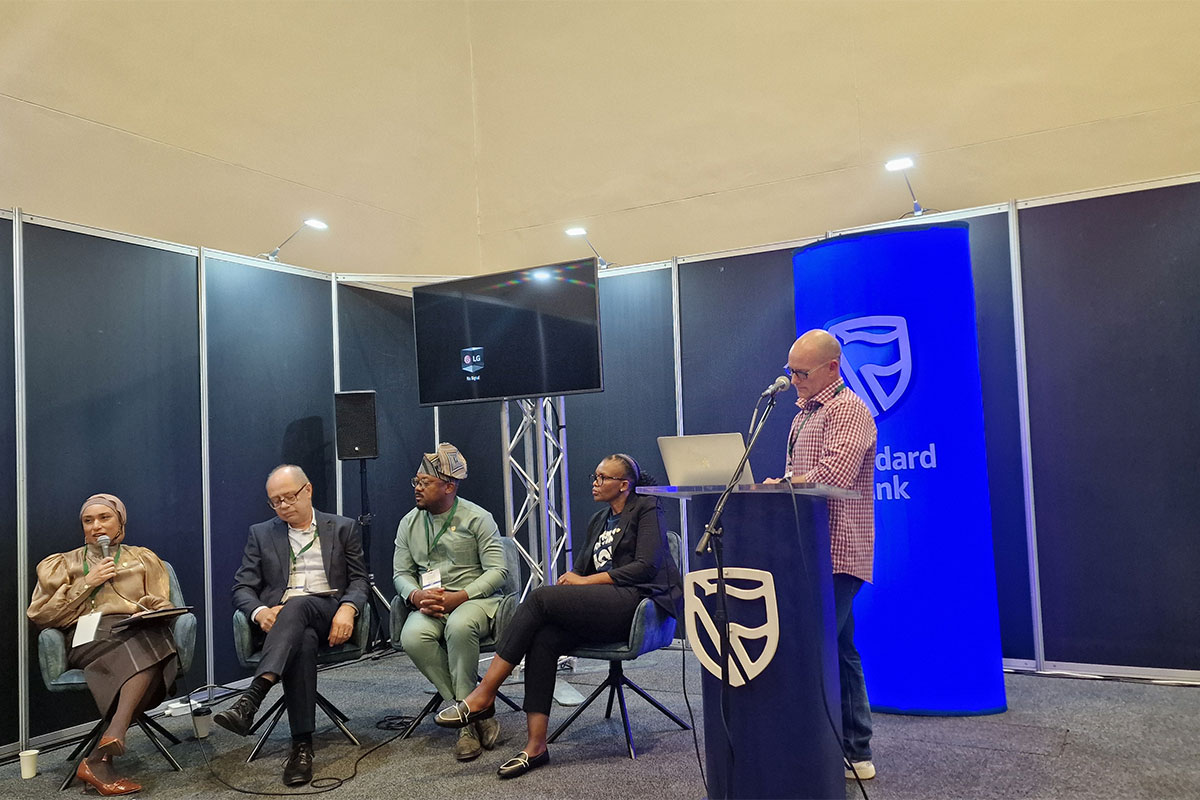
This and other advice came from a panel of Standard Bank senior managers at the 2026 Organic & Natural Products Expo Africa, held at the Cape Town International Convention Centre from 17 to 19 April. Warren Hickinbotham, co-founder of the expo, moderated the panel discussion.
The panel said farmers and small, micro, and medium enterprises (SMMEs) in the organic and natural products space have opportunities to expand and diversify.
Panellist Glenn Pratt, head of insights and sustainability for Business and Commercial Banking at Standard Bank, said the organic and natural products industry is growing.
“For smaller businesses, we see a lot of scope and opportunity in this industry. Also for Africa as a whole, and that’s why we’re here,” he said.
“We must leverage the innovation we see in this industry; that’s where African solutions will come from. There are a lot of opportunities in Africa’s natural resources, and we must look at how we can benefit from this, but not in the traditional extractive way.”
Qaanitah Dollie, Western Cape head of the enterprise banking portfolio, agreed: “Africa has rich land, biodiversity, and holds 65% of the world’s remaining arable land. This presents a huge opportunity for us in the Southern Hemisphere to grow, while those in the Northern Hemisphere can’t. From a farming perspective, farmers must diversify and plant drought-resistant crops.”
Expanding African trade
With exhibitors and visitors from several African countries, including Kenya, Namibia, Lesotho, and the Democratic Republic of the Congo, Hickinbotham asked the panel how Standard Bank helps African businesses grow beyond their borders.
Siduduzo Ntshangase, head of enterprise banking in the Client Propositions Enterprise Banking, Africa Regions division at Standard Bank, said the bank partners with many organisations to invest in African entrepreneurs.
“Africa is our home, and we must invest in growth that does not hamper the future. At Standard Bank, we have a holistic conversation and approach to business,” he said.
“In Africa, we go deeper and understand customers’ pain points. We link markets in Africa and China, and we work with governments on how to leverage digital platforms to increase trade. We invited a business from Kenya to the expo that wants to trade here in South Africa. We encourage our businesses to understand the information, take ownership, and know where demand is and take advantage of it.”
Nokhanyo Ntshingila, senior manager of enterprise and supplier development at Standard Bank, told the audience that the bank goes beyond expectations to help SMMEs.
“We do this through partnerships like this expo. We have 12 businesses that we want to see real opportunities for,” she explained.
“We’ve also taken businesses to other markets. Last year, we took them to Kenya to learn from and even partner [with other businesses]. We also took them to China to matchmake and have conversations at those business hubs.”
The panel discussed other ways to unlock opportunities for businesses in the organic and natural products space, many of which are SMMEs.
“When you have a small business, the biggest challenge is unlocking market access. Small businesses need opportunities like this at the expo to reach customers. Funding and training come next,” Ntshingila said.
“As a business, Standard Bank, along with government, must give them opportunities to grow not just locally but also beyond South Africa. Market access is key.”
Hickinbotham then asked how the bank practically helps SMMEs, to which Ntshingila responded:
“We run capacity programmes and identify businesses we can introduce into our own value chain. They become service providers to the bank. This needs to be very intentional.”
Ntshangase added: “We provide trade finance and help mitigate risk. If an SMME needs a product, we can look at introducing them to a bigger supplier that can help.
“Due to trust in our brand, we’re able to facilitate meetings by introducing our clients in different markets to each other. This makes it possible for them to expand in Africa.”
Do not confuse organic with sustainable
Pratt said many people confuse organic with sustainability.
“Organic is not the same as sustainable. The terms are often combined. In business practice, we look at whether something is sustainable today and into the future. We look at the economic, social, and health aspects. Enterprises in the organic industry need to ask whether they are sustainable in a number of areas.”
He said further questions need to centre on mitigation and adaptation, especially in relation to the impact of climate change.
“We see more frequent and severe natural disasters. How will you address this? On mitigation, how are you going to show clients that you’re reducing emissions?
“[Standard Bank was] the first business in South Africa with a Sustainability Academy. We train businesses on many environmental aspects for free on our website. It is open to everyone, not just Standard Bank clients.”
Digital payments key to SMME growth
Hickinbotham asked the panel about payment platforms, a key challenge for many SMMEs.
Dollie said she had also discussed the issue with exhibitors.
“Digital payment solutions are critical for clients who don’t have time or money to employ more people. [Standard Bank’s] card payment machine is an all-in-one platform. It doesn’t just do card payments; you can also build an online platform that’s free,” she said.
The panellists’ closing advice to the audience and African SMMEs centred on building and growing trusted brands: “Focus on building African businesses that don’t just survive locally or across the continent but also expand globally.”