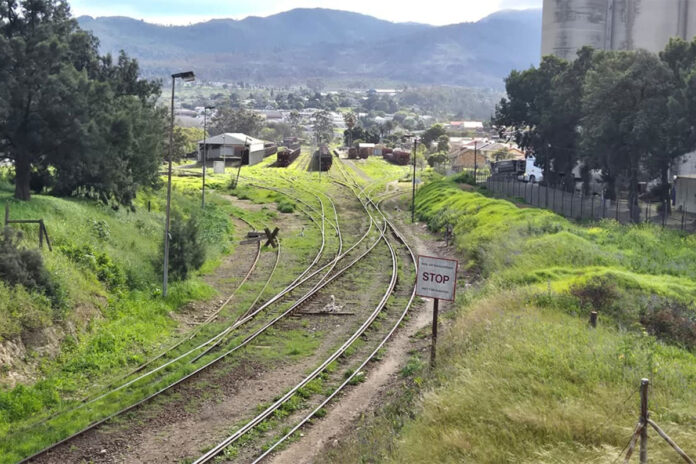
Government’s request for information (RFI) for South Africa’s B-Network railway lines, a process managed by the Transnet Rail Infrastructure Manager (TRIM), opened earlier this month and seeks to gather as much information as possible on the country’s low-traffic regional railway lines.
The aim of the RFI is to assess private- and public-sector interest in refurbishing, financing, operating, maintaining, and possible concessioning of some 9 000km of low-density feeder and branch railway lines.
The ultimate goal is for some of these lines to be managed by TRIM, which was unbundled from Transnet for the specific purpose of managing the rail infrastructure, while the management of other lines may be contracted to private rail companies. In addition, various private rail companies could operate trains on the lines to transport goods.
Dr Charl van der Merwe, general manager of Agbiz Grain, explained that this process was of particular interest to the grain industry, as a large proportion of South Africa’s older and still-operational grain silos were located next to such railway lines.
“The goal of the Agriculture and Agro-processing Master Plan is to move 30% of South Africa’s grain transport back to rail. Currently, less than 5% of grain is being transported by rail, but our members have indicated that about 20% of deliveries could be moved back to rail, depending on the crop size,” he told Farmer’s Weekly.
Building an optimal logistics network, however, involves more than just rebuilding these long-neglected regional lines.
Van der Merwe pointed out that it would be prohibitively expensive to repair the entire B-line network. In many instances, the railway lines have been broken, lifted, or otherwise blocked or rendered inoperable.
In addition, the grain freight landscape has altered significantly since the 1990s.
“The overall process of rail freight reform involves significant complexity, because transport requirements have changed over time.
“At the time the grain marketing boards were disbanded [in the late 1990s], most of the country’s milling capacity was located at Randfontein and in the coastal areas. Today, there is a lot of milling capacity within the production areas as well. Milling capacity has been established in places like Wesselsbron [in the Free State], Leeudoringstad [in North West], and Christiana [in North West], and large mills have also been established in Mpumalanga,” Van der Merwe explained.
“As a result, the inland flow of grain from producer to silo to mill no longer completely aligns with the traditional rail network. This means we must consider an intermodal transport model, where you may collect a product via road from a smaller or remote silo and transport it to a collection point, a larger hub, or silo, and from there it can be moved by rail over longer distances.”
He noted that an opportunity lies in the fact that the agricultural logistics industry is no longer simply a user; it is now also part of the overall planning process and could potentially also participate in the final operation of a decentralised, privatised rail freight network.
Farmer’s Weekly reported in August 2025 that the South African Cereals and Oilseeds Trade Association previously proposed the forming of a consortium between traders, network operators, and grain handlers to operate specific routes for large volumes of grains.
Many moving parts
Sinovuyo Moabalobelo, head of strategic projects at Agbiz, explained that a number of parallel processes needed to be considered during the investigation into the viability and practicality of reviving disused B-lines and continuing operations along existing B-lines. These included the public consultation for the Draft National Rail Master Plan, which closed on 31 July, and the Network Statement consultation process that is currently under consideration.
She added that inputs from these two processes would influence how the final rail network looked.
“I believe that all the processes are supplementary to each other. The Department of Transport is planning and budgeting for the national rail infrastructure, and the inputs received from these processes will support the department and TRIM’s railway line recommissioning.
“The RFI and RFP [request for proposals] processes will ultimately inform all of these planning processes for the future,” Moabalobelo said.
Van der Merwe noted that B-lines cannot be seen in isolation: “Most of the commodities transported on the B-lines will eventually end up somewhere on the country’s A-lines, so it was interesting to me that the inputs on both the National Rail Master Plan and the A-lines RFI closed before the B-lines RFI, because information gathered on the B-lines may influence how the A-lines are ultimately handled.”
Not only for grain
While grain has traditionally been among the most important agricultural commodities serviced by rail, it is not the only commodity group that could benefit from rail transport.
Wolfe Braude, manager of Agbiz Fruit, told Farmer’s Weekly that, thus far, the citrus and deciduous fruit industries have shown the greatest interest in moving some of their freight from road to rail.
He noted that the citrus industry had shipped significant amounts of fruit by rail prior to Transnet’s decline, and there was significant interest in the refitting of trains.
“It can, however, only work if there is uninterrupted power and the cold chain is maintained, so appropriate electric or diesel train sets must be available,” Braude said.
He added that while no concrete plan had yet been formulated, there was interest from the
citrus and deciduous fruit industries in using rail services back to back, so that where locally applicable, the deciduous fruit industry could take over the same trains and some of the same lines for its export season once the citrus season was complete.
“That would make it more viable for a train operator, whether it’s Transnet or a third-party operator, to provide such a service,” Braude said.
Process timeline
Van der Merwe said it was very difficult to put a timeline on when the reform process would eventually translate into the movement of significant amounts of agricultural commodities from road to rail.
“The RFI process must now first run its course, and then from that, Transnet will have to see from the information gathered whether some lines have potential. Then there will need to be an RFP, and that is where the important detail and the real number-crunching will be done.”
He said there were investors who were interested in the process, but whether it would be viable to invest in the maintenance and operation of a particular B-line would depend on the cost of repair and maintenance.
“A lot must still happen, and there’s no guarantee which lines will be operated, but it is important for the industry to take part, as the information gathered in this process will play a role in the reform process going forward,” Van der Merwe said.
Moabalobelo added that anyone wishing to provide input on the viability, condition, or use case of particular B-lines for agricultural logistics can email her at [email protected].