

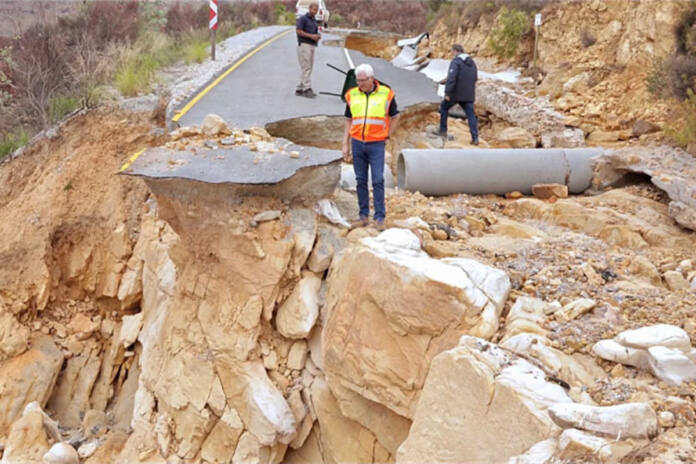
Initial damage assessments across the province point to a growing disaster bill exceeding R9,1 billion, with agriculture among the hardest-hit sectors, Winde and members of his Cabinet said at a media briefing on 18 June.
According to Western Cape Minister of Agriculture, Economic Development and Tourism Dr Ivan Meyer, about 680 farmers have already reported damage of more than R8,5 billion, including approximately R2 billion in crop losses, R6,4 billion in damaged infrastructure, and R50 million in livestock losses.
Winde acknowledged the scale of the challenge facing his government, infrastructure agencies, and the agriculture sector. He described the May storms and flooding as among the most severe he has seen in his more than three decades in government.
The storms also claimed lives. Eleven fatalities were initially reported, while the body of a missing person was recently found.
“The damage extended from the West Coast and Cape Winelands through to the Garden Route and Karoo, affecting both urban and rural areas. Bridges were washed away, roads collapsed, and key transport routes were cut off for extended periods. Pumps, farm infrastructure, and farmers’ housing were damaged, too,” Winde said.
Electricity infrastructure was also severely affected, with pylons collapsing and large areas left without power for weeks after the storms. Winde said he chairs daily meetings with Eskom to ensure restoration efforts continue, as some farms are still experiencing power disruptions due to damaged networks and difficulties in accessing affected areas.
Agriculture under pressure
Agriculture was one of the sectors most heavily impacted by the storms. The Cape Winelands District recorded the highest losses at almost R800 million, followed by the Garden Route District at more than R762 million in damages.
Meyer said assessments indicate widespread damage to vineyards, orchards, irrigation systems, and farm infrastructure, as well as losses of crops and topsoil.
Farmers also reported significant disruption to operations due to power outages, damaged access roads, and water infrastructure failures.
Officials warned that the full extent of the damage is still being determined, as some areas remain inaccessible and new data are still being submitted.
“The consequences are expected to extend beyond the immediate damage, with reduced output, higher input costs, squeezed margins, and pressure on farm employment likely in the months ahead,” Meyer warned.
Disruptions to roads, bridges, and logistics routes have made it difficult to move produce, while power outages have placed additional strain on cold storage and packhouse operations, Winde added.
Emergency infrastructure recovery under way
Western Cape Minister of Infrastructure Tertuis Simmers joined the briefing with his team live from Oudtshoorn. They are conducting multiple site visits across affected parts of Uniondale as well as Meiringspoort Pass, which remains closed.
“The storm damage and flooding are the worst in 50 years. The scale of the damage we see on the ground is huge,” Simmers said.
Authorities reported that more than 230 roads were affected by the storms, with over 250 provincial roads closed at various stages. While around 70% of these routes have been reopened in some form, many repairs are temporary and full reconstruction is required.
Damage to transport infrastructure alone is estimated at around R2 billion.
Simmers said the provincial government has identified at least 19 priority emergency projects, with contractors already appointed in some areas to restore critical infrastructure and re-establish access.
However, officials cautioned that rebuilding key routes and bridges could take months or even years, depending on the extent of the damage.
The scale of the disaster has placed significant pressure on provincial finances. Western Cape Finance MEC Deidré Baartman said the cost of recovery far exceeds available reserves, meaning every department in the province will have to reprioritise budgets and rely on additional support from national government.
“You cannot turn R500 million into R9 billion,” she said, referring to the province’s existing disaster reserves.
Preliminary figures indicate that the cost of damage is roughly equivalent to the province’s annual infrastructure budget of R10 billion.
“As a result, some planned infrastructure projects may be delayed or postponed as funds are redirected toward urgent repairs and reconstruction,” Baartman said.
Provincial officials confirmed that requests for assistance have been submitted to national government, including to President Cyril Ramaphosa. Provincial departments are also in communication with their national counterparts regarding support for disaster recovery.
However, according to Winde, no clear timeline has been provided for when additional funding may be released. He also pointed out that the national disaster system is under strain due to the scale and number of disasters across the country.
“There is no guarantee on timelines; we are dealing with an unprecedented scale of damage. Funding processes are not designed for disasters of this magnitude,” he explained.
Baartman added that while the disaster funding process is “moving along”, it is “too slow given the current needs”.
“Our province will lobby national government to reform and speed up funding processes,” she said.
Beyond immediate repairs, rebuilding efforts will need to include improved planning and design standards that will cost up to three times more to reduce vulnerability to future extreme weather events, Winde noted.
“We must build back better so that we can mitigate the risk of the next massive flood,” he concluded.