
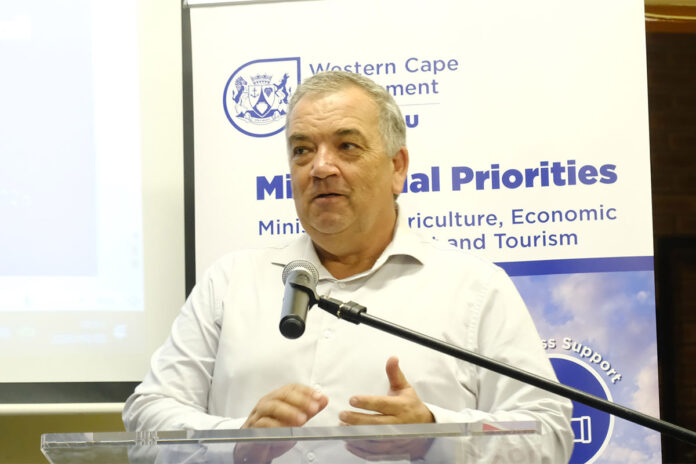
Reinard Geldenhuys, the Overberg District Municipality’s Manager of Protection Services, told a stakeholder meeting in Bredasdorp on 8 September, that the area had suffered a particularly tough 2025/26 fire season, with seven fires recorded in October and November 2025, affecting a total of 25 000ha along a fire line of 240km.
Geldenhuys said this included “extreme fire behaviour” that he had not seen before in 30 years of firefighting.
He said the district’s disaster management authorities were advised that the developing El Niño would “exacerbate what we have already experienced in the last three years”, leading to “more rapidly developing fires and water shortages in higher density areas over the peak holiday seasons”.
However, he said the risks were significantly mitigated by the Greater Overberg Fire Prevention Association (FPA), which facilitated landowner alignment and preparedness, training and integrated fire management. In addition, the provincial department of agriculture was also using the FPAs to channel the province’s Land Care projects.
“We are forging tactical partnerships with landowners through the Greater Overberg Fire Prevention Association. We know we are going to have many stubble land fires, and we know our farmers all have skid units [firefighting equipment] on their bakkies. Whenever there’s a farm burning, they’re all there, and in the past we’d all jump in and chase after them, because you can’t have a fire and not have the fire department there.”
Instead of this jostling for position, Geldenhuys told the audience that the district municipality would allow farmers to be the first responders with their 500ℓ skid units, and that they would follow with their 5 000ℓ trucks.
He added that while the strength of El Niño would not be linear in its effects, the Western Cape was expecting lower rainfall, increased air temperatures and, therefore, an increase in fire risk.

Risks affecting SA agriculture exports
Dr Ivan Meyer, Western Cape Minister of Agriculture, Economic Development and Tourism, who hosted the event at the provincial department of agriculture’s district office in Bredasdorp, told the audience that other than the El Niño , some of the biggest concerns for world agriculture were the ongoing conflicts in the Middle East and Ukraine.
He also expressed concern about the growing popularity of right-wing politics in important European countries such as Germany, as right-wing movements tended towards protectionism and increased non-tariff barriers.
Meyer also said that as 66% of South African agricultural exports go to African countries, his staff had approached CEOs of companies headquartered in the Western Cape that conduct business elsewhere in Africa on how the provincial government can assist them, particularly following the wave of anti-immigrant protests in June.
Meyer added that some of the most pressing concerns for local farmers included a lack of water, poor rural roads and infrastructure, poor rural safety, lack of title deeds and political instability.