
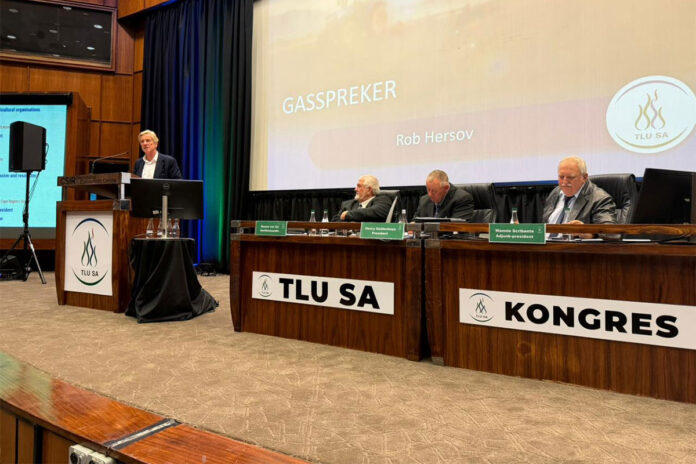
Under the theme ‘Agriculture: Grounded. Protected. Preserved’, the congress brought together TLU SA members and agricultural experts to examine the challenges facing commercial agriculture in South Africa and the organisation’s future.
Three panel discussions, facilitated by TV personality Mia Slabbert, explored the principles underpinning TLU SA, the protection of producers, and the resources on which future food production depends.
Although speakers approached South Africa’s challenges from different perspectives, a common message emerged: commercial agriculture cannot remain productive if farmers are expected to compensate indefinitely for failing public institutions, policy uncertainty, and deteriorating infrastructure.
A call for self-reliance
Opening the congress, TLU SA President Henry Geldenhuys argued that policy decisions should be evaluated against their practical consequences for production, investment, resilience, and food security.
He placed agricultural finance, grain price formation, market access, property and water rights, infrastructure, crime prevention, animal disease control, and soil conservation among the issues requiring sustained attention.
Geldenhuys’s central theme was that farmers and agricultural organisations need to become more deliberate, credible, and self-reliant. He suggested that food security depends not only on what happens on farms but also on whether the institutional environment enables producers to remain profitable, to invest, and to plan.
He added that TLU SA’s legal team was prepared to offer support as amicus curiae (friend of the court) in proposed litigation in which a network partner intends to challenge race-based legislation.
Cooperation between state and industry
Minister of Agriculture Willie Aucamp used his address to emphasise cooperation between government, the private sector, and organised agriculture.
As a farmer himself, the minister described agriculture as a calling, urging farmers to participate actively in representative organisations rather than remaining outside the structures where decisions are influenced.
Aucamp acknowledged the pressures confronting farming but argued that practical cooperation had already shown what could be achieved.
He referred to measures to preserve animal health and efforts to expand agricultural markets as areas where government and industry need to work together. Export growth requires persistent work to open and retain markets for products such as citrus and cherries, he added.
“The ‘we want land’ ideology does not plant maize,” Aucamp said, encouraging farmers to remain focused on the things they do well.
Farmers pay twice for state failure
Businessman Rob Hersov delivered a sharp critique of government policy. He argued that agriculture was burdened by political rhetoric, while profitability and sustainability received insufficient attention. He added that farmers operate in a world where physical and financial realities could not be avoided.
“You can’t irrigate with press releases. You can’t plant crops on the back of a policy document,” Hersov said.
He linked agriculture’s performance to the condition of roads, dams, electricity networks, ports, policing, and municipalities. When these services fail, farmers pay twice: first through taxes, and then by privately financing security, road maintenance, and other services that should have been supplied by the state.
He also argued that weak economic growth, corruption, and administrative failure had reduced confidence and investment. His call to farmers was to refuse to accept decline as inevitable, to become more politically engaged, and to use their influence constructively.
During a Q&A session, however, he cautioned against physical confrontation and civil unrest, saying these seldom produced a predictable or desirable outcome.
Questions put to Hersov also touched on the competition between agriculture and mining for scarce land and water resources. Delegates raised concerns about illegal mining, environmental damage, and the potential effect of mining activity on agricultural land and water resources.
The issue of fracking was also raised, revealing differing views about energy development, environmental safeguards, and the evidence needed to assess risk.
Faith, identity, and rural safety
The first panel discussion, comprising Prof Andries Raath, TLU SA’s regional manager for the Free State and emeritus professor of public law, and Dr Danie Langner, managing director of the FAK, focused on the connection between agriculture and faith, identity, responsibility, education, community institutions, and cultural continuity.
The discussion was explicitly linked to TLU SA’s Christian foundation. The panel considered how this foundation should continue to shape the organisation’s policy approach, its engagement with government and non-governmental institutions, and the transfer of its values and agricultural culture to the next generation.
The panel also spoke about how farming is more than an economic activity: it is embedded in families, schools, local organisations, and traditions that help communities remain resilient.

In the ‘Protected’ panel, Jannie Rossouw, professor of economics at Wits Business School, and MP Ian Cameron, chairperson of the Portfolio Committee on Police, focused on rural safety, political and economic stability, corruption, property rights, and the consequences of weak state capacity.
Policy uncertainty was identified as a direct constraint on long-term planning: the less predictable the policy environment, the shorter the period over which businesses were prepared to commit capital.
The discussion also highlighted the importance of effective local institutions, reliable information, community safety networks, and cooperation between communities.
Water security and the next farming generation
Water was the subject of the final panel, featuring Hanke du Toit, CEO of the Oranje Riet Water Users Association, and advocate Stefanie Fick, executive director of the Accountability Division at the Organisation Undoing Tax Abuse. The panel considered water availability, quality, infrastructure, legal accountability, and government’s responsibility for managing the resource effectively.
Municipal sewerage failures, industrial pollution, and mining-related contamination were identified as threats to agricultural water resources. For farmers, these failures affect the availability and usability of a critical production input; for communities, they affect daily access to suitable water.
The panel considered both efficient water use and the legal remedies available when municipalities, officials, or state institutions fail to fulfil their responsibilities.
Clemens Senekal, chairperson of TLU SA’s Young Farmers Committee, outlined a vision for a strong, professional, and organised young farmer structure. He identified knowledge-sharing, technology, and innovation as important tools for building sustainable and profitable farming businesses.
The committee aims to bring young farmers together to share knowledge, develop business opportunities, and find collective solutions to the broader challenges facing young farmers, while encouraging responsibility towards employees, communities, and the conservation of natural resources.
Taken together, the congress discussions reflected a sector demanding both government competence and greater producer agency. Delegates did not suggest that farmers could withdraw from public policy. Instead, the message was that they should organise, scrutinise decisions, defend their rights, cooperate where cooperation produced results, and strengthen the institutions within their own reach.
The clearest conclusion was that food security rests on more than production expertise. It also requires profitable farms, secure water and property rights, functioning infrastructure, stable policy, safe rural communities, and a relationship between government and industry grounded in measurable outcomes rather than promises.