
With El Niño strengthening and the province facing the prospect of a much hotter and drier summer, Winde urged farmers to prepare to face extreme heat, wildfires and increased pressure on water resources.
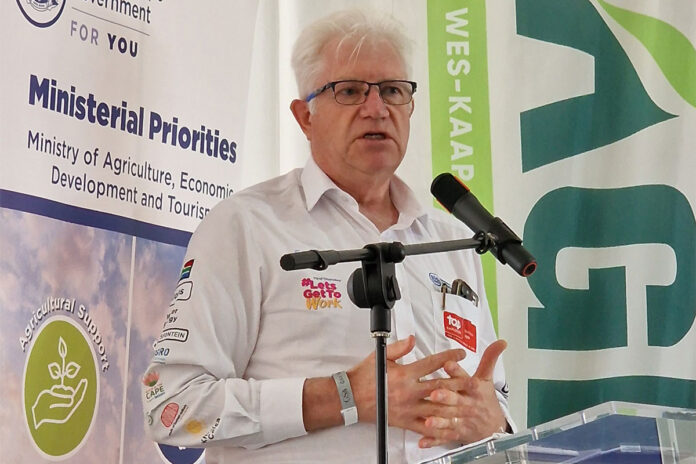
Speaking during an engagement session at the Agri Western Cape Hall at Nampo Cape in Bredasdorp, Winde said farmers should act now to protect crops, livestock, farmworkers and rural communities.
“I bring one message, and that is [that we have to be prepared] for what is coming our way,” Winde warned.
Europe provides a warning
Winde pointed to Europe’s recent experience to illustrate the severe human and agricultural consequences of extreme heat.
“We have seen more than 30 000 excess deaths in Europe, let alone the massive negative impact on agriculture because of droughts, low-flowing rivers and extreme heat. We must learn the lessons and make sure we are prepared,” Winde explained.
Turning to conditions closer to home, he warned that the developing El Niño weather pattern could increase the Western Cape’s exposure to extreme heat, wildfire being imperilled and pressure on water resources.
The provincial government said in August that El Niño was expected to strengthen over the following months. Although its most direct effects in South Africa are generally experienced in summer rainfall regions, it could still increase temperatures, fire danger and water pressure in the Western Cape.
Winde said the Provincial Disaster Management Centre had held a full-day preparedness exercise about three weeks ago, bringing together municipalities, agricultural representatives and provincial departments to examine the risks and required responses.
“Our disaster management is our superpower, but preparedness cannot only be government’s responsibility. Agriculture has always been an important partner in our disaster-management system,” Winde said.
Farms urged to act now
Wildfire readiness was among Winde’s chief concerns. He urged farmers to inspect and clear firebreaks before the peak summer fire season.
“Are we cutting firebreaks right now? We cannot have further risk to agriculture itself, to our towns and to our villages,” Winde said.
Livestock producers also need to ensure they have adequate water and shade available during periods of extreme heat.
“What is the plan for our animals when it is going to be that hot? We cannot have our livestock without sufficient water or shade. Are we thinking about it?”
Winde said farmworker safety would require similar planning, including the possibility of adjusting working hours during extreme heat.
“What about farmworkers in the middle of this hot season? Are we going to change hours? In Europe, they are starting to harvest at night because it is simply too hot to work during the day,” Winde noted.
Predictability needed on water
Jannie Strydom, CEO of Agri Western Cape, said the timing of water restrictions would be critical, particularly during the summer irrigation and harvesting period.
Strydom said the agriculture sector would prefer moderate restrictions to be implemented earlier rather than face far more severe curtailments when crops required water most.
Dr Ivan Meyer, Western Cape Minister of Agriculture, Economic Development and Tourism, said farmers needed sufficient water storage capacity on their farms and greater certainty about possible restrictions.
“Farmers do not want to wake up one morning and see level 4 or level 5 water restrictions. Farmers want predictability so that they can manage through that cycle,” Meyer said.
He added that farmers were not seeking additional water allocations, but sufficient storage capacity to manage water availability across their production cycles.
Anton Bredell, Western Cape Minister of Local Government, Environmental Affairs and Development Planning, supported the earlier introduction of moderate water saving measures. However, he stressed that farmers and other users also had a responsibility to comply with water and environmental legislation.
Winde said government, municipalities and agriculture needed to act and be well prepared before the province found itself responding to another crisis.
“We are going to have to respond differently to mitigate the risk of what, by all indications, is going to be a much drier and hotter summer,” Winde stressed.