
The Vaal River is South Africa’s ‘water workhorse’, according to an article on the Water Research Commission’s website. It is a vital economic lifeline, supplying water to the heavily industrialised Gauteng region, the Vaal Triangle, and numerous agricultural hubs.
For Jan du Toit, owner of Country Trax Off-Road Riding Academy, and a small group of fellow adventure motorcyclists, however, the Vaal represents dirt tracks and adventure.
Du Toit recalls riding alongside the river in the Potchefstroom area some time ago. The experience reminded him of a journey he and a group of riding friends undertook in 2007, following the course of the Zambezi River.
It also gave rise to the idea for his next expedition: a ride along the complete course of the Vaal River. He returned to the farm with the idea, and Du Toit and a few riding companions put their heads together. They ultimately decided to embark on the Vaal Expedition, following the river by motorcycle from its source in Mpumalanga, to its confluence with the Orange River, just west of Douglas in the Northern Cape.
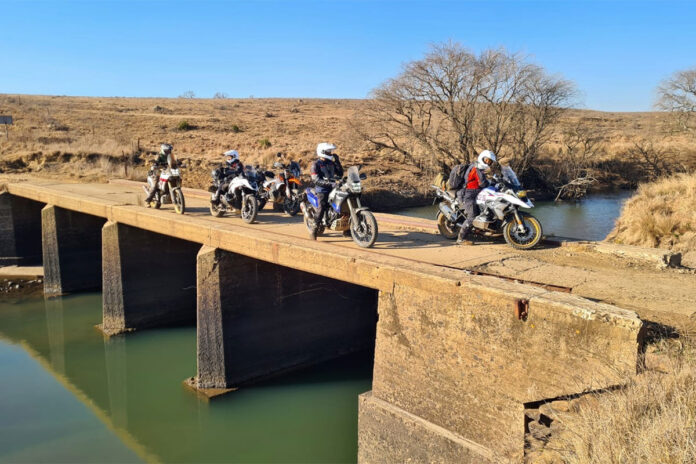
“The plan is to cross as many bridges and natural crossings spanning the river as possible,” explains Du Toit.
A wealth of information is available on the Vaal River, but a few facts from the Water Research Commission sum it up well. The Vaal is South Africa’s second- longest river, flowing for more than 1 120km across the heart of the country. Rising from the ground near Breyten in Mpumalanga, it winds through the Free State and forms natural boundaries with Gauteng and North West, before joining the Orange River on its journey to the Atlantic Ocean.
An expedition, not a tour
Du Toit deliberately calls the journey an ‘expedition’. “You see, going on a tour implies strict itineraries and comfort, which is absolutely not what we offer.
“On this expedition, all we knew was that we had to stop at 4pm because a member of the group had to return home to Gauteng,” he says.
Although he and his companions do not plan every detail in advance, some preparation is still essential.
Their chosen route was mapped out with considerable help from team member Ben Potgieter, a veterinary surgeon from Ermelo who knows almost every farmer along the way. Potgieter secured the necessary permission to enter farms along the route and is also familiar with most of the dirt roads they would travel.
The expedition could not be completed as one continuous journey, as all the riders have full-time jobs and families.
They therefore divided the route into shorter rides, making it possible for more friends to join them.
The first official leg of the expedition began at the river’s source and ended at the historic Begin der Lijn Bridge, also widely known as the Paul Kruger Bridge. It is located roughly midway between Ermelo and Amersfoort.
The Vaal rises near Breyten in Mpumalanga, to the east of Johannesburg. On the morning of 25 July, just after the worst of the frost had melted, the group set out to find the river’s source, drawing on Potgieter’s knowledge of the area.
They located the spring near the Sterkfontein beacon outside Breyten, near Ermelo. A palisade fence surrounds the spring to keep, among others, local children away from the open water and out of harm’s way.
“Local folklore tells of a huge snake, known as the Vaal Snake, living in the river. People are warned that it could drag them into the river and beneath the water, so we were very careful not to antagonise the Vaal Snake,” says Du Toit.
Riders of all ages
The team joining Du Toit on the first leg comprised Noeline Laubscher, owner of the Toyota dealership in Ermelo, riding a BMW R 1300 GS, Daniel Rossouw, a risk-management consultant at a private firm in Johannesburg, on a KTM 890 Adventure, the veterinarian Potgieter on his BMW R 1250 GS Adventure, and Gideon Buys, owner of a pumping service in Pretoria, on a Yamaha Ténéré 700.
“I want to emphasise that nobody is too old to start riding a motorcycle, and you do not need years of experience to enjoy a day or more on a dirt road. “A two-day training session with a reputable instructor should be enough to get you started,” says Du Toit.
To support his point, he recounts how Laubscher first climbed onto a motorcycle at the age of 53.
“About three years ago, Noeline phoned me. She felt she needed something interesting in her life and wanted me to teach her to ride a bike. Now she tackles every road we ride.”
Du Toit also recounts how Daniel’s hands almost froze on his ride from Johannesburg to Ermelo that morning.
“He left Johannesburg wearing only his summer gloves, and we had to thaw his hands in warm water.
“He solved the problem by putting on a pair of braai gloves over his summer gloves.”
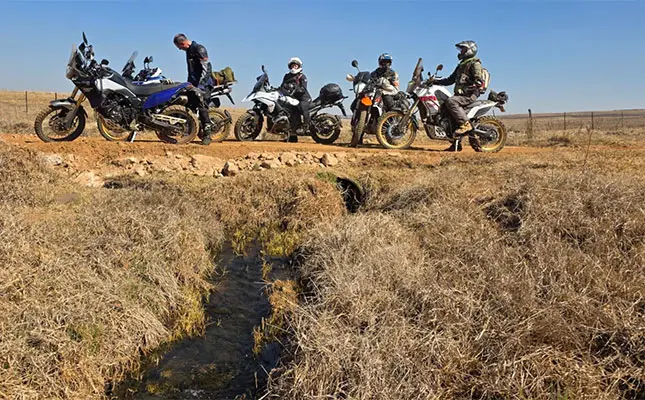
From the Vaal’s source, the riders followed the shortest routes between bridges and other crossings over the Vaal, which is little more than a stream in places. The river broadened as tributaries joined it along the way.
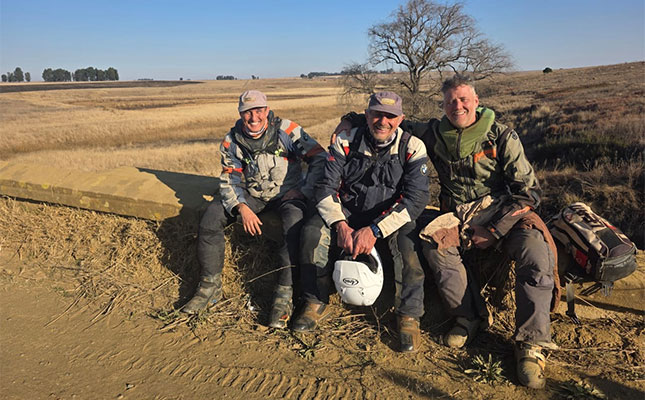
Their first ‘bridge’ was a natural crossing on Morné Engelbrecht’s farm, where the team decided to stop to rest and to take some photographs to preserve the memories.
Riding without rivalry
Asked what they packed for the journey, Du Toit laughs and says: “Only a tyre- repair kit, water and a rain suit.”
They encountered no problems on the trip, which Du Toit attributes to the riding philosophy and general attitude of the groups with whom he rides.
“We never turn a trip into a contest. Things can go pretty wrong when riders compete and try to outperform one another. We ride to enjoy the motorcycles and the scenery, and we are always willing to help each other in challenging situations.
“We don’t charge through pools of water at speed to soak everyone else because it’s winter and it’s cold. We take it slowly and steadily, and we do it together. We respect the environment, one another, and the motorcycles,” he says.
On these shorter rides, the only guaranteed meal is breakfast, which the group always enjoys at its morning meeting point.
“From there, we basically take things as they come and eat and sleep wherever we find a suitable place.
“When we reached the natural crossing on Engelbrecht’s farm, we realised we would not pass through another town where we could buy food that day. Fortunately, Noeline had come prepared and produced energy bars from the small daypack she carries.”
After completing the 320km first leg, Buys had to ride back to Gauteng.
The rest of the group returned to Amersfoort with Du Toit to recap the day’s events and enjoy a braai on his farm.
The next leg of the expedition will be a three-day journey, starting at the first bridge after the Begin der Lijn, or Paul Kruger Bridge, where the first leg ended.
The current plan is to cover approximately 300km a day.
Farmer’s Weekly will follow the progress of the Vaal Expedition and continue reporting on the riders’ adventures.