

This follows a tumultuous few weeks during which Alexey Likhachev, CEO of the Russian nuclear power parastatal Rosatom, announced to the Russian media that the Namibian Cabinet had granted approval for Headspring Investments, owned by Rosatom subsidiary Uranium Group One, to resume drilling activities in the underground basin, which forms part of the larger Stampriet Transboundary Aquifer System.
The uranium deposit occurs within the Stampriet system’s main drinking-water aquifer, which extends into Botswana and South Africa, where the same aquifer is pumped for drinking water.
These pronouncements led the Namibian government to break its months-long silence on the matter by releasing a technical report by the International Atomic Energy Agency (IAEA). The report echoed reservations that critics have been voicing for years about substantive shortcomings in Headspring’s environmental impact assessment (EIA), environmental management plan, and radiation management plan, which were submitted in support of its application for approval to begin pilot-plant test mining of the deposit.
The IAEA report outlined further studies that Headspring should undertake to improve these documents.
Early in November, Likhachev told Russian news agency Interfax that the uranium project had received permission to commence drilling. Reports were later rectified to indicate that permission had only been granted for research.
Wolfgang Teichert, chairperson of the Stampriet Aquifer Uranium Mining Association (SAUMA), which opposes the mining, told local radio station Kanaal 7 on 10 November that it was “outrageous that such information is divulged in such a way, from outside the country’s border, and [that] there was no reaction from our government until much later. The lack of transparency and the way it was announced leaves far more questions than answers”.
Teichert, a veteran of the mining industry, said the concern was that, in addition to uranium, the rock formations in the aquifer also contain other potentially more toxic heavy metals, which could seep into the rest of the aquifer and pollute potable and agricultural water.
Proposed mining method
Headspring announced in 2021 that it intended to mine for uranium by means of in-situ leaching (ISL), which involves pumping a leach solution containing weak sulphuric acid and strongly oxidising chemicals into the uranium ore in the water-bearing aquifer. This dissolves the uranium, after which the uranium-bearing solution is pumped back to the surface and the mineral extracted. The remaining water is then recharged and pumped back underground for further leaching.
Headspring touted ISL as a cleaner, safer, and less invasive extraction method than opencast and conventional underground mining.
Speaking to Farmer’s Weekly, Divan Opperman, who farms about 30km from Leonardville and is a founding member and former chairperson of SAUMA, said local farmers first became aware of Headspring’s uranium exploration permits around 2020, when company representatives began approaching farmers for permission to drill on private land.
“Back then, the Russians simply approached the farmers individually, so we quickly organised ourselves and founded SAUMA,” he said.
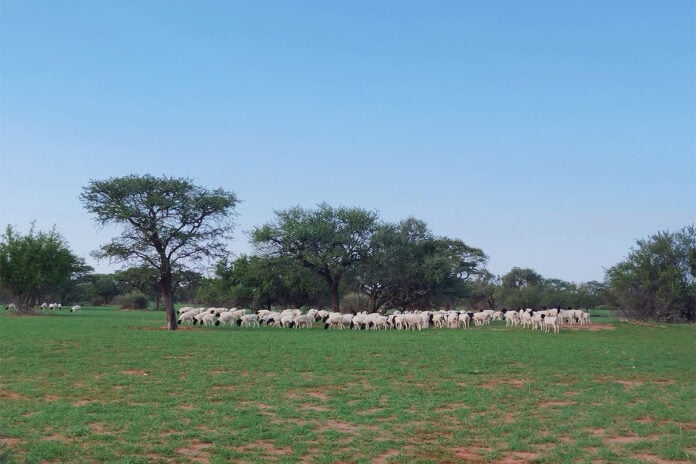
Since its establishment, SAUMA has pushed for transparency and accountability in the mining application process, particularly regarding water security, as the Stampriet Artesian Basin feeds the large-scale irrigation boreholes used in the production of much of Namibia’s fresh produce.
“This area has historically been a sheep, goat, and cattle farming area, but more recently, the Stampriet area has become an important irrigation area. We have import restrictions on fresh produce, and about 85% of Namibia’s fruit and vegetables are grown locally. A significant proportion of that fresh produce comes from the area where [Headspring] wants to mine uranium.
“It’s one thing if only one farm is affected, but the aquifer is the lifeblood of the farming community, and it creates direct employment for more than 13 000 people, while 80 000 people are estimated to live in the aquifer area.
“We aren’t against mining, but we also cannot risk the country’s water and food security,” Opperman said.
A chequered past
Two of Headspring’s initial exploration permits were revoked by the then Ministry of Agriculture, Water and Land Reform on 9 November 2021 for “gross violations and non-compliance of permit conditions,” according to an official letter sent to Headspring and recently shared with Farmer’s Weekly.
In the letter, Percy Masika, then executive director of the ministry, wrote that boreholes intended for hydrogeological studies “have actually been drilled in a specific pattern mimicking that of an in-situ leaching technique”.
He noted that several drilling activities had failed to comply with permit conditions, including exceeding the permitted number of boreholes by at least 77, a failure to seal off boreholes, and creating a risk of contamination.
The drilling contractors were not registered with the ministry and were unaware of “the special drilling specifications for the Stampriet Artesian aquifer system”, he added.
Geologist, hydrogeologist, and SAUMA member Dr Roy Miller told Farmer’s Weekly that there was no consensus on whether groundwater could recover to its previous state after ISL mining.
“Headspring says it will recover. We at SAUMA refer to various international publications that indicate that contaminating mine solutions can travel for kilometres and for years once they escape from the mine area,” he said.
Miller explained that the geology of the Stampriet basin was complex, and that rock layers preventing the artesian water from escaping upwards naturally had been breached in several places.
“There are numerous vertical fractures [faults] that cross all layers in the hard rock below the Kalahari sands. These zones of broken rock are zones where the mine solution can escape upwards. Mine solution can also escape up leaking boreholes.
“Many international publications on ISL warn about these geological problems, sandstone-sandstone contacts, faults, and leaking boreholes.”
He said pollution of boreholes supplying irrigation and drinking water was likely both inside and outside the mining area. This was because large-scale irrigation induces such a high rate of underground water flow that it can draw mine solution out of the mine area cause widespread contamination of the aquifer.
Miller said detailed studies on the underground water flow have not yet been conducted, “but such studies need to be designed by and done by a credible outside party where all results are made public”. He added that the costs should be borne by the exploration permit holder, as was the case in the US and Australia.
According to Teichert, SAUMA was concerned that Headspring would “do the investigations, the monitoring, and then send the results to the ministry”.
“How can you be your own prosecutor, your own judge, and also handle your own defence? For us, this is not transparent at all,” he added.
Teichert asked how Namibians could be expected to trust a company that had previously drilled many more boreholes than its permits allowed, many of which had never been rehabilitated.
Engaging the local community
In its report, the IAEA noted Headspring’s extensive efforts to gain support in the small community of Leonardville. These included funding a school kitchen and meals for the pupils of Naosanabis Primary School, school gardens, a fully-equipped computer lab, local healthcare services, and “scholarships for Namibian students pursuing studies related to the mining industry and […] vocational training for young people from Leonardville at the Namibian Institute of Mining and Technology”, covering tuition, accommodation, and meals.
The report also noted that Headspring held monthly meetings with community representatives in Leonardville.
“High expectations were generally observed within the Leonardville local community with regard to the project moving forward and ongoing investment and development in the area,” the report’s authors wrote.
Among its recommendations, the IAEA warned that Headspring’s “social programmes could be more clearly positioned as a distinct component of corporate responsibility, while the safety of pilot operations could be more effectively demonstrated through robust monitoring data, established control methodologies, and independent expert review. Maintaining this distinction supports transparency and contributes to mitigating reputational risks”.
“High expectations within the community need to be carefully managed by both the Namibian authorities and [Headspring] to ensure commitments are realistic and achievable. Clear, consistent, transparent communication is essential to align expectations and minimise the risk of dissatisfaction,” it added.
Clarifying the approval
On the eve of SAUMA’s annual general meeting on 4 November, a media report surfaced quoting Likhachev as telling the Russia–Africa Summit, held in Moscow from 28 to 29 October, that the uranium mining project had received permission to start drilling test wells.
“The method we use, so-called in-situ leaching for uranium, has been approved by the IAEA. An IAEA delegation visited Namibia, after which we received permission to commence these operations,” Likhachev was quoted as saying.
His remarks were first interpreted as meaning that Headspring had obtained permission to start drilling the ISL wells. This prompted the Namibian Ministry of Agriculture, Fisheries, Water and Land Reform (MAFWLR) to issue a statement clarifying that the government had permit limited drilling activity for research purposes in October.
“The licence relates to boreholes intended for hydrogeological monitoring and exploration control. Its issuance does not, on its own, authorise [Headspring] to commence drilling, nor does it constitute approval for pilot in-situ leaching operations or uranium mining. The protection of groundwater resources within the Stampriet Transboundary Aquifer System remains a central consideration in the ministry’s assessment of the proposed activities,” it said.
The statement also clarified the scope of the IAEA’s recommendations, describing the report as “an independent technical basis to assist the competent Namibian authorities in making informed decisions”, with its scope “limited to the proposed pilot operation”.
“[The IAEA review] does not extend to an assessment or approval of future full-scale mining. The review found that the environmental documentation provides a general framework for assessing environmental risks. However, significant technical uncertainties remain concerning groundwater protection,” it added.
An IAEA delegation had visited Namibia in February 2026 to perform a comprehensive review of Headspring’s plans, but the technical report it provided to the Namibian government was only made available to the public on request on 6 November.
This report echoes many of the concerns raised by SAUMA and other community stakeholders. These include a failure to account for the effect that groundwater extraction elsewhere in the basin could have on the movement of contaminants through the system, questions about rehabilitation after mining, and the use of regional-scale rather than site-specific data in the project’s EIA.
Teichert SAUMA was adamant that an independent specialist party should undertake the evaluations necessary to inform a decision on whether or not the project should proceed. He did not rule out the possibility of litigation to prevent drilling from going ahead without the necessary groundwork.
In its statement, the MAFWLR said the framework for further work comprised four phases:
- Characterising the aquifer and testing confinement of wells;
- Wellfield installation and hydraulic-control testing;
- Controlled pilot injection into wells; and
- Groundwater restoration and post-operational monitoring.
“Importantly, the introduction of lixiviant [leach solution] will only be considered once the preceding phases have demonstrated adequate aquifer protection and effective hydraulic containment. Progression between phases will not be automatic, as each phase will require a thorough technical assessment and a formal decision by the competent authorities to ensure that groundwater resources, public health, and the environment are adequately protected,” it said.