
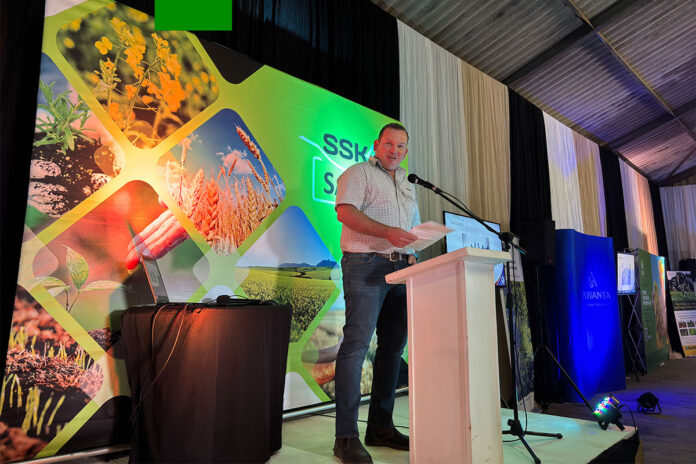
Keynote speaker Dr Miekie Human, science and policy manager at South African National Seed Organization (Sansor), discussed new seed technologies, regulation and plant breeders’ rights, and their implications for producers.
Human said advances in precision breeding were speeding up crop development, but regulation would play an important role in determining producers’ access to new technologies. She focused on the Plant Breeders’ Rights Act (No.12 of 2018), and regulations that came into force in 2025, which introduced defined farmer categories and conditions governing farm-saved seed from protected varieties.
She added that Sansor had obtained two legal opinions on the implications for commercial producers. According to this advice, commercial producers wishing to retain protected seed for replanting would require an agreement with the relevant rights holder, with licensing and remuneration arrangements agreed between the parties.
She also highlighted the importance of lawful seed conditioning, varietal traceability, and preventing unauthorised seed sales, or ‘brown-bagging’.
Beyond the regulatory changes highlighted by Human, SSK CEO Francois Swanepoel told Farmer’s Weekly ahead of Winter Grain Day that Western Cape grain producers were facing mounting profitability and production pressures.
One of the clearest shifts he pointed out was towards canola. “Producers are increasingly looking at net profitability rather than just yield,” Swanepoel said.
Canola had delivered better profits per hectare than wheat and barley over the past two years, driving an increase in hectares planted to the crop.
However, Swanepoel said the Southern Cape was likely approaching the maximum area that could be planted to canola within sustainable crop-rotation systems, while the Swartland still had considerable scope for expansion.
Wheat and barley profitability remained under pressure, with barley facing the additional challenge of limited availability of new cultivars and disease-control problems in some existing cultivars, which were affecting yields.
He added that seasonal conditions were also uneven across the province. Prospects in the Southern Cape and Overberg were favourable, with the potential for above-average yields, while Swartland had received very little rain over the preceding six to eight weeks.
Swanepoel advised farmers to manage financial and production risks over the long term and avoid cutting costs that directly affected yield. He said that financially stronger producers tend to build reserves during good seasons to buffer their businesses against weaker years.
“You should never sail so close to the wind that you cannot weather a year or two of setbacks,” he said.
Those broader production challenges were reflected in a trial programme focused on cultivar choice, crop establishment, and input management under local conditions.
Producers viewed wheat cultivar trials from Syngenta, Agricol, and Limagrain, while Lisa Smorenburg, scientific technician of agronomy at the Western Cape Department of Agriculture, presented yield results from the department’s wheat trial plots.
Canola plots featured material from Pioneer, Agricol, and Advanta, while the canola component also included planting-depth demonstrations presented by Piet Lombard, scientific technician of agronomy at the Western Cape Department of Agriculture.
Barley trials were presented by Anheuser-Busch InBev and the South African Barley Breeding Institute. The Microbial Biological Fertiliser Institute, Ecosoil, Revival, and RealIPM also showcased biological inputs for use in winter grain production.
The day highlighted how cultivar development, new technologies, and sound agronomic management are becoming increasingly important as Western Cape grain producers navigate tighter margins and changing production conditions. At the same time, evolving seed regulations are adding another layer to the decisions farmers will need to manage in the seasons ahead.