In response to a clarification request from Farmer’s Weekly, the Department of Agriculture said the act “will come into force after the finalisation of the regulations which are not yet approved”.
“The commencement date for the Act is determined by the President; therefore, the department may not make such a determination. However, it is envisaged that the Plant Health Act should come into force in the 2026/27 financial year,” the department said in an e-mailed response.
Once it comes into operation, this new law governing plant health gives relevant authorities more leverage to search any premises suspected of harbouring harmful plant pests or diseases.
Officials will be able to obtain warrants to enter and search premises, seize materials or documents deemed related to regulated or harmful plant pests or diseases, and question individuals about such objects or information under the new act.
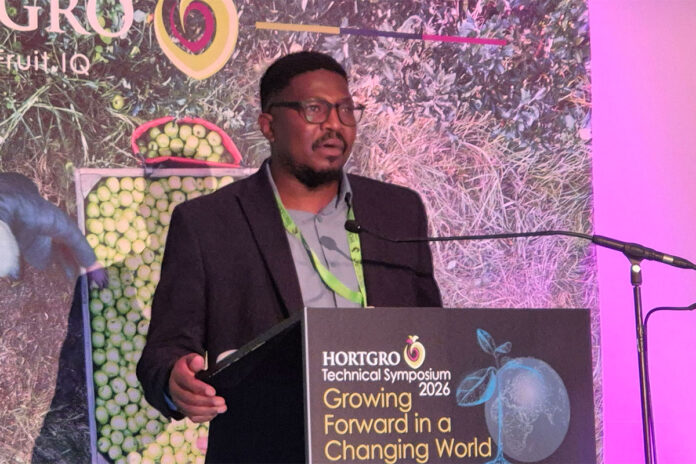
Dr Maanda Rambauli, deputy director of plant health at the Department of Agriculture, disclosed during a presentation at the Hortgro Technical Symposium in May that government officials experienced “difficulties to enter certain farms, even after they had notified farmers” that they wished to inspect farms.
“However, this act empowers (plant health) inspectors to conduct investigations; it even includes issues like (setting) up a trap (for pests) on a farm,” he said during a presentation on the provisions in the new act.
The powers of inspectors are wide-ranging. Subject to a warrant from a local magistrate, the act gives inspectors permission to access any part of a premises covered by the warrant, inspect any fields, buildings or vehicles, obtain access to any records and documents, physical or electronic, related to regulated articles, make copies of relevant documents, and question persons on the premises in connection with relevant entries.
The act states that they may also seize evidence, demarcate land and inspect whether a farming enterprise complies with control measures or orders and carries out pest surveillance.
In cases where officials are refused entry on the grounds that the material in question contains confidential information, the officials may “request a magistrate who has jurisdiction to seize or remove that article for safe custody until a court of law has made a ruling on the question on whether the information in question is confidential or not”.
Compulsory reporting and other new measures
Rambauli told attendees at the that the act also closes a number of gaps that could have contributed to new pests entering and spreading in the country before being detected. This is made possible by the fact that:
- It provides for the declaration of pest free areas, quarantine areas, and sites of agricultural production;
- It makes the notification of registered pests in pest-free areas compulsory;
- Any detection of a new pest may not be publicised before the national department of agriculture is notified. Once reported, the department will undertake phytosanitary measures to prevent the establishment and further spread of the pest;
- It provides for the establishment of areas of low pest prevalence;
- It provides for assistance from, and cooperation with, other government spheres to perform its duties. In his presentation, Rambauli also outlined provisions for national control of plant pests by prohibiting the movement of plant materials from infested areas to non-infested areas.
The act contains sections on export control, requiring consignments to comply with the import requirements of the importing country, as well as outlining import control measures that provide for regulated articles to be imported with a permit.
‘This is to prevent the introduction, establishment, and spreading of regulated pests into the Republic,” he said.
He explained that the act would provide for better assurances that products are pest and disease free, help South Africa to maintain existing export markets and also to access new export markets.
A stronger act
Lise Korsten, a professor of plant pathology at the University of Pretoria and co-director of the Department of Science, Technology and Innovation and the National Research Foundation’s Centre of Excellence in Food Security, told Farmer’s Weekly that the new act has been formulated to align with the import and export legislation of other countries, particularly South Africa’s trading partners.
“The new act grants the executive officer significantly more authority and provides for both the establishment and strengthening of the national plant protection organisation. It also improves coordination between government, industry, and academia. This will enable the government and industry to institute better plant protection measures when a pest is detected. This essentially means you can locate the pest faster, issue phytosanitary certificates more quickly, and, most importantly, conduct more effective pest risk analyses,” Korsten said.
While welcoming the strengthened measures to establish quarantine and pest-free areas, Korsten noted that the South African public must be educated on the importance of plant health.
She emphasised that citizens must take responsibility for not introducing foreign pests and diseases, which are often carried across borders via agricultural products or food. Every citizen must help protect the country’s crops and agricultural industry.
“Every high school learner should understand the importance of plant health, just as we advocate for ‘One Health’ (the holistic treatment of human and animal health), food safety and personal hygiene.
“The educational framework should include why plant health matters, how it is regulated and the importance of legislation. University students in agriculture should also be taught the principles of pest risk assessment, the danger of moving plant material into disease-free areas, and the value of plant improvement programmes.”
Korsten added that this awareness should extend to all citizens, particularly gardeners, who often inadvertently spread diseases by transporting host plants to new parts of the country. She noted that such actions impact biodiversity, plant health, and food security, making ‘Plant Health Citizen Science’ initiatives essential.
In line with trading partners
Korsten observed that several modern drivers of pest and disease spread were not significant concerns when the previous legislation was formulated. For example, climate change is now a primary driver of increased prevalence.
“Higher temperatures mean that some pathogens now occur in places where conditions were previously unsuitable for their survival,” she explained. “Climate change also brings more wind and floods, both of which can spread pathogens across borders and into new areas.”
Furthermore, the surge in global trade and travel has significantly increased the risk of introducing foreign species and diseases. International trade creates additional risks when infested plant materials are inadvertently loaded into shipping containers, or when insects infest wooden pallets and packaging.
Illegal trade has also risen and become increasingly difficult to regulate. Smuggling is not limited to rhino horns or perlemoen; smaller animals, plants and seeds are also frequently trafficked.
“Many people leave the country with small plants, seedlings, or seeds in their bags. We therefore need a national campaign to increase awareness and support our biosecurity framework to keep our plants healthy,” she said.
Broadening the ambit
Korsten noted that the powers granting inspectors access to farms to confiscate materials and documents will impact small-scale farmers more than large-scale ones.
“On large commercial export farms, PPECB inspectors routinely conduct inspections as part of daily operations. The challenge lies with smaller farms and smallholdings, where owners may lack the same access to information, training, and systems to prevent the entry of new pests. Generally, the commercial sector is more familiar with plant health and biosecurity enforcement.”
She added that provisions such as compulsory pest reporting, quarantines, and the creation of pest-free areas are essential steps. By making them compulsory within the act, there is greater clarity on requirements, empowering authorities to act decisively during an outbreak.
Skills shortage
One pressing concern for Korsten is the shortage of skilled plant pathologists and entomologists to perform the functions outlined in the new act. There is also a lack of specialists trained in biosecurity and pest risk assessment.
“We may need to design specialist short courses to train professionals in these fields, as producing masters and doctorate graduates takes years. Additionally, students often avoid plant pathology as a career because they believe opportunities are limited; however, they are mistaken. We need skilled, trained, and committed people now more than ever before.”