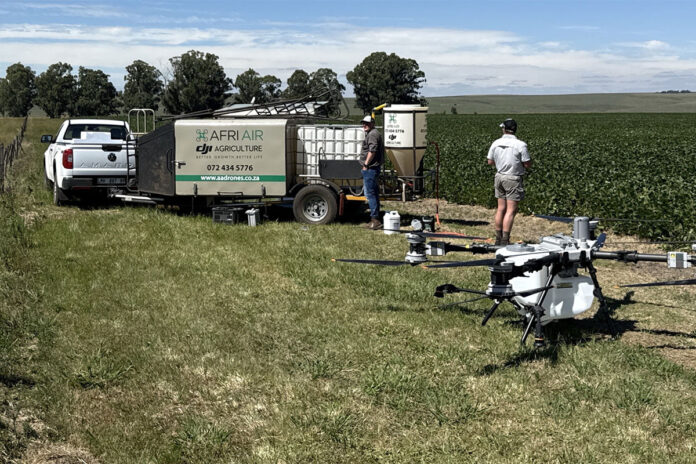
Over the past decade, drones have evolved into a valuable production tool, helping producers inspect large and often inaccessible areas and supporting precision agriculture through field mapping and crop stress detection.
Drones are also used to release beneficial insects as part of integrated pest management programmes and for the aerial application of pesticides, herbicides, fungicides and chemical ripeners.
According to Anroé Steyn, operations and sales manager of AfriAir, drone spraying is particularly useful in situations where conventional equipment struggles, such as steep or uneven terrain, or wet conditions that prevent tractors and sprayers from entering fields.
“Farmers must wait for soils to dry before moving tractors into fields to avoid compaction or getting stuck. Drones, however, can operate under these conditions, allowing a timely response to disease risks that could lead to significant production losses,” he says.
According to him, drones are increasingly used on sugar cane in KwaZulu-Natal and Mpumalanga, where tall, dense canopies and challenging terrain make ground spraying difficult.
They have also proved to be effective in orchards and vineyards, including citrus, macadamia and avocados in the Western Cape, Limpopo and Mpumalanga, where complex canopies, narrow rows and uneven terrain limit the use of large sprayers.
In field crops such as maize, potatoes, soya beans, wheat, and sunflowers, drones have also become a valuable tool for fungicide applications, late-season spraying when crops are tall, and spot spraying for weeds.

Improving spray results
As with any agricultural tool, drones need to be managed correctly to deliver optimal results. One of the most important considerations is spray drift, which can lead to off-target contamination, reduced efficacy and environmental damage.
“Spray drift is one of the most debated issues in drone spraying, but research shows the risk is different rather than simply higher or lower than with conventional methods,” says Steyn. “It all depends on droplet size, spray height, wind and swath width.”
Drones typically operate at lower heights, around 3m to 4m above the crop, compared with manned aerial applications. This reduces the distance droplets travel and can limit off-target movement. GPS-guided drone flight paths also improve accuracy and reduce overspray.
However, drones generally use finer droplets and lower spray volumes than tractor sprayers.
“These smaller droplets remain airborne for longer and are more susceptible to wind. In addition, the rotor downwash that helps push spray into the canopy can also move droplets sideways under windy conditions,” explains Steyn.
To minimise drift and improve spray effectiveness, Steyn advises operators to follow these best practices:
- spray during calm conditions, preferably early morning or late afternoon;
- avoid spraying when wind speeds exceed about 16km/h;
- use appropriate droplet sizes;
- maintain a low flight height of 3m to 4m above the crop;
- reduce flight speed in windy conditions;
- ensure correct swath overlap to avoid under- or over-application;
- consider using drift-reduction adjuvants where appropriate.
Steyn explains that these products increase the weight of the droplets, so they do not blow away as easily.
“Many international field studies show that, when properly configured, drone drift is comparable to ground sprayers and significantly lower than with manned aerial spraying,” says Steyn.
Spray coverage and application
Drone spraying with the DJI T100 uses significantly lower spray volumes than conventional equipment. This translates into lower water requirements, quicker refilling, and more hectares covered in a day than with ground sprayers in low wind conditions.
However, the higher concentrate of product uses also reduces the margins for error when mixing a product, the volumes of product used, and choosing nozzle sizes to manipulate droplet sizes.
“Mistakes will result in an over- or under- application of products, which in turn might result in the under protection of crops, product wastage, crop damages, and even the development of resistance,” says Steyn.
For best results, he advises operators to follow product label instructions to the letter, which would specify droplet size and application guidelines tested by chemical companies.
“Use the aerial application guidelines. If none exist, it means the product is unsuited for aerial applications.”
He adds that volumes are typically around 30ℓ/ha for maize, soya beans, wheat and sugar cane, and 30ℓ/ha to 60ℓ/ha in orchards, in comparison with about 100ℓ/ha to 200ℓ/ ha for tractor sprayers in field crops, and 500ℓ/ha to 2 000ℓ/ha in orchards.
In terms of nozzle sizes, insecticides typically require fine-to-medium droplets (100μm to 300μm) for better canopy penetration, while herbicides generally use coarser droplets (more than 300μm to 400μm) for good spray coverage and to reduce drift onto non-target crops.
Because margins for error are small, operator skill is critical to successful drone spraying.
“Effective drone spraying requires a sound understanding of spray calibration, droplet size selection, flight planning, and weather conditions.
As adoption increases, proper training and certification are becoming essential to ensure the safe and effective use of the technology,” he says.
Logistics and planning
Logistics and planning also affect drone spraying efficiency. According to Steyn, farmers often underestimate the level of support equipment required. A typical set-up includes the drone, batteries, chargers, a generator, water supply, chemical tanks, spare parts and safety equipment.
He points out that most inefficiencies occur on the ground, not in the air, because frequent battery changes, accurate mixing and quick refilling are essential to maintain productivity.
He estimates that three to four batteries per drone are usually required for continuous operation, along with field-based charging infrastructure. Battery heat also needs to be managed, using cooling stations or shade to prevent overheating.
“Fast-charging batteries take about eight minutes to recharge, which is about as long as a drone sprayer will be in the air,” he says.
Operators also need a steady supply of correctly mixed spray solution throughout the day.
“Ideally, there should be one person preparing pre-mixed batches and handling refilling while another manages flight control,” says Steyn.
Although drones use 70% to 85% less water than tractor sprayers, reliable water supply remains essential. Many operators use mobile water tanks of 1 000ℓ to 2 000ℓ, along with mixing tanks ranging from 300ℓ to 2 000ℓ.
Looking ahead
Agricultural spray drones are developing rapidly, with trends pointing towards larger capacity machines, greater automation and integration with precision agriculture systems.
Modern drones already feature automated flight planning, terrain-following systems and obstacle detection. Future developments are expected to include higher work rates, improved precision, and greater integration with technologies such as satellite imagery and artificial intelligence-based crop analysis.
Ultimately, spray drones are evolving from niche tools into mainstream farm equipment. However, their success will depend not only on the technology itself, but also on how effectively they are managed in the field.
Steyn emphasises that drones should be seen as part of a broader spraying toolbox, rather than a replacement for existing systems.
“Tractor sprayers, drones and manned aerial applications all have their place on a farm.
“It’s not about one replacing the other, but about using the right tool for the job,” he says.
Manned aerial spraying, in turn, is still best suited to covering vast areas quickly.
Drones, however, fill an important gap, particularly in difficult terrain, wet conditions, or where more targeted applications are needed.
As a result, these technologies are increasingly used alongside one another for maximum efficiency.
For more information, email Anroé Steyn at [email protected].