
In Zimbabwe, most tobacco is cured in brick flue-curing barns heated by firewood or coal. Farmers burn large amounts of firewood to produce the heat needed to dry the leaves. This has contributed to deforestation in many tobacco-growing areas, while the use of coal-fired barns increases carbon emissions.
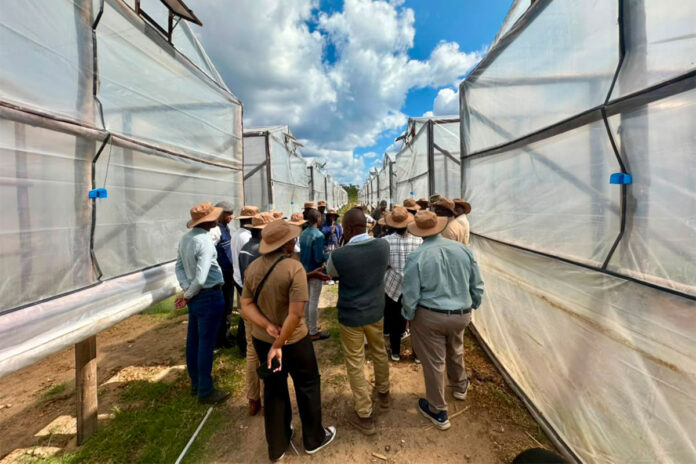
Through a partnership between tobacco contracting company Atlas Agri and the Tobacco Industry and Marketing Board (TIMB), the initiative is centred on the rollout of Marula barns, a locally developed tobacco-curing technology, across Zimbabwe’s Matabeleland region.
The plastic traps solar heat, allowing the tobacco to dry naturally while protecting it from rain and excess moisture. Like a typical flue curing barn, it has adjustable vents at the top and bottom to allow farmers to control air temperature.
The TIMB describes the barn as a major step towards sustainable tobacco production.
According to CEO Emmanuel Matsvaire, the technology eliminates the need for firewood, helping to address one of the main drivers of deforestation in tobacco-growing regions.
“The Marula barn uses trapped solar heat to cure tobacco instead of relying on firewood as a fuel source. Its enclosed design also protects the crop from rain and helps maintain stable curing conditions,” he says.
Inside the barn, design improvements have enhanced curing efficiency. Earlier three-tier structures led to inconsistent curing, with leaves on the top tier drying faster than those on the middle and bottom tiers. Now, modified designs for single- and double-tier curing produce uniformly cured tobacco.
The TIMB says further improvements will include solar-powered fans to improve heat circulation inside the barns.
Controlled environment reduces losses, cuts production costs
Previously, farmers used shade barns to develop the desired colour of tobacco leaves, while open sun racks were used to cure the lamina and midrib. Exposing the crop directly to the sun often resulted in inferior lamina texture and colour.
The open curing method also left the crop vulnerable to rain and high humidity, forcing farmers to work quickly to protect it from the elements. Prolonged exposure increased the risk of mildew, discolouration, and inconsistent quality. The Marula barn helps overcome these challenges by providing a controlled curing environment.
Agronomist Munyaradzi Musiyiwa, who heads up natural cured Virginia (NCV) tobacco production in the region for Atlas Agri, says controlling the curing environment is key to boosting quality.
“We observed that rainfall and humidity were major constraints, often resulting in mouldy tobacco and inconsistent quality. By fully enclosing the barn using transparent, UV-protected polyplastic, we created a controlled environment that captures solar heat while protecting the crop from adverse weather,” he explains.
Musiyiwa also broke down the exact steps needed to cure the crop properly.
“When loading the barn, we keep the vents closed for the first six hours to build up heat. Thereafter, we open them to release moisture and promote airflow. The most critical stage is during midrib drying, where careful vent management is essential to balance temperature increase and moisture removal.”
He adds that temperatures inside the structure can reach up to 75°C, matching those achieved with traditional curing methods while relying entirely on solar energy. This reduces operational costs and makes NCV tobacco farming a more sustainable alternative.
“The Marula barn stands at the centre of tobacco transformation. It is more than just a curing structure; it is a quality-enhancing innovation that is redefining NCV tobacco production.
“By combining sustainability with improved output, it is empowering farmers, protecting the environment, and setting a new benchmark for excellence in Zimbabwe’s tobacco industry,” he says.
Innovation beyond the barns
As use of Marula barns spreads throughout Matabeleland, tobacco production in the region is shifting its focus from volume to quality.
Alongside curing upgrades, TIMB is supporting the broader farming setup. The organisation installed solar-powered boreholes in Marula to solve local water shortages, giving farmers a dependable water source for seedling nurseries and boosting early plant survival.
The board has partnered with Lupane State University in Bulawayo to further refine the technology and is also collaborating with tobacco research centre Kutsaga and other partners to develop fan systems that improve air circulation inside the tobacco barns.
Encouraging yields and improved livelihoods
For Matabeleland farmers, the benefits of the Marula barn are already being reflected in increased production opportunities, improved crop performance, and new income prospects.
“The Marula barn has enabled people to cultivate tobacco in areas that were previously considered unsuitable for the production of the leaf. I planted a hectare, and I’m anticipating between 1 000kg and 1 200kg from this crop,” says Reed Sola, a smallholder at Wolendale Farm in Umguza.
According to Reuben Khumalo, who farms at Greenfields Farm in Marula, tobacco farming has improved livelihoods in rural areas, as it pays better than maize farming.
“It is a lucrative crop that has been changing lives, especially in the rural communities. We are planning to increase production under irrigation,” he says.
In the second round of this season’s tobacco sales, the TIMB recorded an average market price of US$2,50/kg (around R42/kg).
“We are seeing very high standards of tobacco quality coming from the region, but it’s something that we must continue to work on improving day by day,” says Matsvaire.