The compact SUV arrived just months before COVID-19 dealt its hopes of a successful lift-off a hammer blow in 2020. By the time the economy started recovering, Kia was already rolling out a new compact SUV in the form of the Sonet, which quickly established itself as the brand’s best-seller.
The second-generation Seltos finds itself in a vastly different world to its predecessor. Not only has the Chinese revolution turned the motoring landscape on its head, but the compact SUV crossover segment has also burst out of its seams.
Ideal price
Kia’s confidence in the Seltos is so high that it should almost be seen as a warning to the Chinese. Apart from it being a rock-solid product, the manufacturer got the most important thing in the war against the People’s Republic right: the price.
The Indian-built Seltos’ starting price of R389 995 is R10 000 more than before, but it is 65mm longer than its predecessor. At 4 460mm, it is just 55mm shorter than the Sportage and 350mm longer than the Sonet. Boot space has grown by 103ℓ to 536ℓ, which is 89ℓ more than the Sonet and 35ℓ less than the Sportage.
The all-new Seltos is offered in a choice of five model derivatives: the entry-level LS, the LX, the GT-Line, the GT-Line S, and the X-Line, which is offered for the first time and which has been reserved as the flagship diesel designation.
Telluride looks
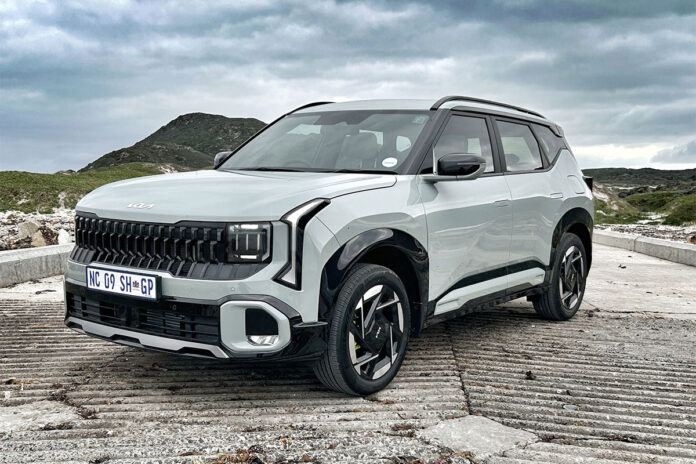
The brash Telluride-inspired front grille flanked by striking Star Map LED lighting, flush-fitting door handles, auto-folding mirrors, roof rails, and vertical LED tail lights connected by a horizontal bar are standard across the range. Carried over are the three powertrains from the first generation. These include a 1,5ℓ naturally aspirated petrol engine that produces 84kW and 144Nm of torque, a 119kW/253Nm 1,5ℓ turbocharged petrol mill, and an 85kW/250Nm 1,5ℓ blown diesel engine.
They are mated to a combination of four transmission options: a six-speed manual, a CVT, a seven-speed dual-clutch transmission (DCT), and a six-speed torque-converter automatic.
Tasman-like interior
The all-new Seltos’s classy cabin draws inspiration from the Tasman, which means it does not feature the row of buttons that toggles between the climate control and infotainment settings, as found in the Sportage and Carens.
The entry-level LS gets cloth and artificial leather seats, a 10,25” infotainment system with wireless Apple CarPlay and Android Auto, a reverse camera, rear parking sensors, and 17” alloy wheels.
The LX grade brings with it a smart key and push-button start, an electric parking brake, a 12,3” infotainment system, rear parking sensors, and dual-zone climate control.
Upgrading to the GT-Line means the addition of artificial leather seats and a steering wheel, a wireless charger, ambient lighting, a panoramic sunroof, and 18” alloys.
The S adds ventilated and powered front seats, a 12” digital cluster, and an eight-speaker Bose sound system.
Unique X-Line touches
The X-Line benefits from all the spec offered on the GT-Line S, with the addition of model-specific 18” alloy rims and unique X-Line styling, which includes interior accents and the striking Matt Graphite Grey signature paintwork.
Standard safety across the range includes six airbags, ABS, ESC, and hill-start assist.
GT-Line S and X-Line models get advanced features such as adaptive cruise control, blind-spot collision avoidance, and lane-keeping assist.It goes without saying that the turbo petrol mill and DCT configuration is sportier than the oil-burner, but the diesel mill is a peach in its own right.
What’s the verdict?
Kia has done a fantastic job with the all-new Seltos. It signals a real statement of intent to fight back at the Chinese, a gesture more heritage brands could take notice of.
Pricing
Seltos 1.5 LS MT R389 995
Seltos 1.5 LS CVT R414 995
Seltos 1.5 LX CVT R464 995
Seltos 1.5 GT-Line CVT R514 995
Seltos 1.5 CRDi GT-Line AT R544 995
Seltos 1.5 T-GDi GT-Line S DCT R614 995
Seltos 1.5 CRDi X-Line AT R614 995
Pricing includes three-year/45 000km service plan and five-year/unlimited mileage warranty.