We are embarking on a challenge of a slightly less agricultural kind; one that involves just enough risk to make it interesting and thoroughly enjoyable. It is, in essence, an adventure.
The seed for this adventure was planted at Nampo 2026, at the Volkswagen/Ducati exhibition stand, when I first spotted the Ducati Multistrada on display. I could not take my eyes off the bike. It was also where I met Mark Walters, marketing and PR manager at Ducati SA.
Following my meeting with Mark, and much to my surprise, he promised to provide me with a Ducati for a test ride. After some fancy footwork on Mark’s part, the new Ducati DesertX V2 became available, turning the dream of entering the GS Challenge on a capable off-road adventure bike into reality.
I collected the brand-new DesertX, with only 13km on the clock, and the adventure began!
Phase 1 of the adventure
The first part of the adventure was to put 800km on the bike so that it could undergo its crucial first service before tackling the final leg: the
Great African GS Challenge of 2026.
What an absolute pleasure it was getting to know the DesertX over those first 800km!
The bike I had the pleasure of riding is a second-generation Ducati DesertX, and one of the first of its kind to arrive in South Africa.
The first-generation DesertX was not a huge seller, but owners praised it so highly that Ducati decided to give the model a comprehensive makeover for 2026.

The 2026 model
The 2026 DesertX received far more than an engine transplant.
Ducati has redesigned the motorcycle around its new 890cc V2 engine, introducing a new chassis, revised suspension, altered ergonomics, and an updated electronics package.
Ducati describes the new DesertX as “the result of intensive field testing, where every off-roading experience translates into concrete evolution: more natural control, greater usability in every situation, and an even more pronounced off-road attitude, without relinquishing the pleasure and precision of road riding”.
While running in the bike, I resisted the temptation to venture off-road for fear of damaging it before its first service.
The basic model was not fitted with crash bars, and I wanted to have these installed before attempting any serious off-road riding.
While the DesertX was begging to be taken onto the dirt, I knew the GS Challenge would provide ample opportunity for off-road adventures.
The first road trip
The bike’s first proper road trip came when I attended the Bayer Leadership Academy for Agriculture in South Africa awards function.
The event marked the conclusion of a leadership development programme that had begun in April 2026, and was held at the Pecan Manor Conference and Function Venue in North West.
The ride to the venue and back to Pretoria added another 350km to the DesertX’s clock.
On the return journey, I intentionally got lost in the area around Hartbeespoort Dam. Riding along the Magalies Mountain range and through the small towns of Magaliesburg, Hekpoort, and Broederstroom gave me the opportunity to test the bike on the winding roads through the koppies.
The early spring weather provided ideal riding conditions, particularly on a bike such as the DesertX, which is as comfortable on tarmac as it is on dirt roads.
The bike handled the twisties beautifully, felt light, and looked as powerful as it is.
The new V2 delivers plenty of performance, while the revised gearing gives it a lively character on winding roads. I found the chassis stable and composed, and the 21” front wheel did not prevent the Ducati from being entertaining on paved mountain roads.
The bike immediately made me feel safe and in control. It is easy to lean into a corner and come out of it just as effortlessly, particularly when standing on the pegs.
Electronically challenged
The electronics helped considerably. The DesertX has six riding modes, namely Sport, Touring, Urban, Wet, Enduro, and Rally, with adjustable traction control, wheelie control, engine braking, and cornering ABS.
I am not particularly hands-on when it comes to electronics (I often need the kids’ help with cell phone issues), but I found navigating the different options on the screen straightforward.
It did, however, take me a while to find the total kilometres travelled, and I had some difficulty figuring out the trip counter.
A ride through the countryside
Back to my road trip. Although there is not much farming activity visible from the road at this time of year, the route through the Hartebeesthoek Valley took me along country roads, with farms on either side of the R560 and R400.
I crossed the Gauteng/North West border more than once, enjoying the new life in the veld after the first spring rain.
As I had the day to myself, I had the luxury of stopping wherever I wanted to photograph interesting sights along the way. I came across a beautiful little Cape Dutch-style house standing alone and seemingly abandoned in a field, and simply had to stop for a photograph!
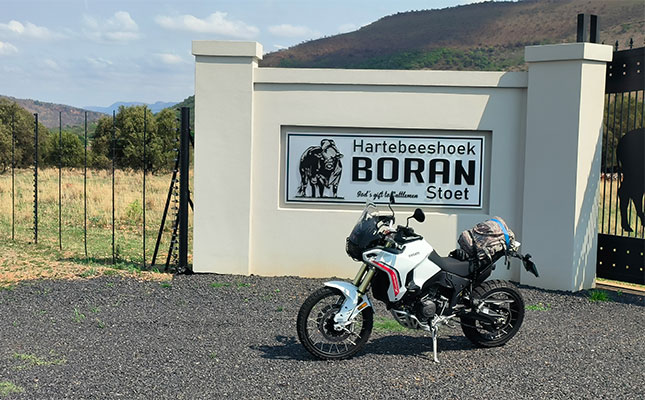
Even more interesting was the Telkom BCX Hartebeesthoek Satellite Earth Station, where I again paused to photograph the entrance to the facility.
Fortunately, a fellow rider stopped to do the same and offered to take a photograph of me next to the DesertX.
This is a major telecommunications and satellite teleport facility in the Hartebeesthoek Valley. A little further down the road are the adjacent SANSA Space Operations and scientific research sites.
The facility was commissioned in 1961 as part of NASA’s tracking network, with facilities at Hartebeesthoek supporting satellite and deep-space missions. The site included a Deep Space Station that formed part of NASA’s Deep Space Instrumentation Facility network.
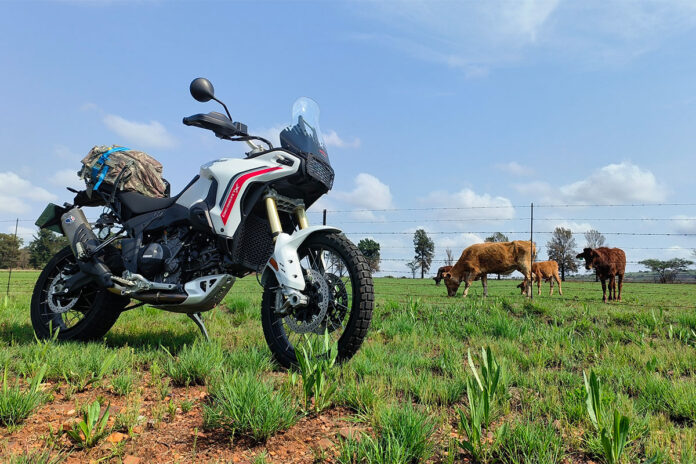
Further along, I took the DesertX through a ditch next to the road to photograph a small herd of cattle. They were trying to gain some sustenance from the fresh grass shoots.
A taste of the Winelands
Then I stumbled across a jewel I certainly wasn’t looking for: the official starting point of the North West wine route.
Yes, you read that correctly: a wine route on the Gauteng/North West border.
Being rather fond of the ‘juice of the vine’, I had to stop once again to see what was happening behind the gates of Hazon Vines Boutique Wine Estate.
Although the owners, Nicolene and Tienie Kruger, were in the Cape on ‘wine business’, I was warmly welcomed and shown around the tasting room.
I had to be uncharacteristically strong and decline an invitation to a tasting, because two wheels and alcohol do not mix well.
Nicolene later told me that the warm Highveld climate and rocky, mineral- rich soils, combined with summer rainfall, create a distinctive ‘Harties terroir’, rather than the classic Stellenbosch or Paarl profile.
Their grapes are smaller, with more concentrated flavours, and they produce Shiraz, Cabernet Sauvignon, Cabernet Franc, Chardonnay, and Malbec on the farm.
I told Nicolene that their operation deserved more attention in an article for a future issue of Farmer’s Weekly and was promptly invited to the launch of the North West Wine Route on 24 October.
The trip was beginning to remind me of the Western Cape winelands and, believe it or not, I even found a harbour.
I had to take the turn-off to Harties when I spotted a sign for the Harties Harbour. Staring out over the hyacinth-infested waters of Hartbeespoort Dam from the deck of the Zanzibar Beach Cafe, where I stopped for a quick coffee, I was convinced I heard the distinct squawk of a seagull.
Understated by design
Back to my ride, let’s take a look at the visual design of the DesertX.
Ducati describes it as follows: “The Matt Star White Silk livery enhances the DesertX’s functional design with a clean, technical look. The matte white finish highlights the bike’s robust forms and off-road character”. I would agree with that.
However, in a line-up alongside other brands of similar adventure bikes, the DesertX was not the motorcycle that drew everyone’s attention.
I watched riders appraising the lines of various adventure bikes outside the popular Kakiebos Pub and Grill on Sunday morning. Most didn’t give the Ducati a second look.
But each to their own. I appreciate the toned-down, functional design of the DesertX. However, looks are not the main reason I believe riders would stampede Ducati dealerships to get their hands on a DesertX. Looking at the bike’s capabilities and taking it for a test ride with the great guys at Ducati Johannesburg would, in my opinion, seal the deal.
That is, if you have budgeted towards the higher end of the market for a new adventure bike.
The DesertX certainly is not the cheapest buy, but I believe it gives you a lot of bike – and a lot of riding – for your rand.
More than the numbers suggest
The new design has not transformed the DesertX into a lightweight motorcycle. In fact, the claimed weight reduction is relatively modest.
I found, however, that the new bike feels lighter and easier to manage than the figures suggest. Ducati has concentrated on weight distribution, a slimmer tank, and a revised chassis rather than simply chasing a lower number on the scales.
That is an important distinction. A motorcycle can be heavy on a specification sheet yet still feel manageable when you are riding it.
For adventure riding, where the bike is constantly moving between seated and standing positions and negotiating uneven surfaces, balance can matter just as much as outright weight.
This is where the DesertX stands out. I will report in more detail on the off-road capabilities of the DesertX V2 after putting it through its paces on the trails at the Great African GS Challenge.