
Mitsubishi finds itself between a rock and a hard place as a self-confessed ‘forgotten’ brand, but it has no intention of exiting South Africa anytime soon. Even in its heyday, it was never among the highest-volume sellers, but survival depends on staying relevant, which has required some smart thinking.
As the medium crossover/SUV segment has become a price battleground due to the influx of Chinese brands, it simply isn’t sustainable for a manufacturer with a small local footprint. Mitsubishi has therefore opted for the next best thing: a segment where Chinese brands – and few others – have a presence.
Seven is heaven
The Destinator has therefore not replaced the ASX and Eclipse Cross as a like-for-like SUV in Mitsubishi’s portfolio, but rather arrives as a seven-seater. It slots in below the bigger Outlander and the more basic Xpander, a multipurpose vehicle aimed more at the commercial market.
With the Destinator starting at R489 990, its main seven-seater rivals in terms of size and pricing are the Jetour X70 Plus, the Hyundai Alcazar, and the recently introduced Kia Carens.
We recently had a week-long opportunity to test drive the Destinator in flagship R569 990 Exceed guise to see whether it can lead the brand revival Mitsubishi is hoping for.
Good looks
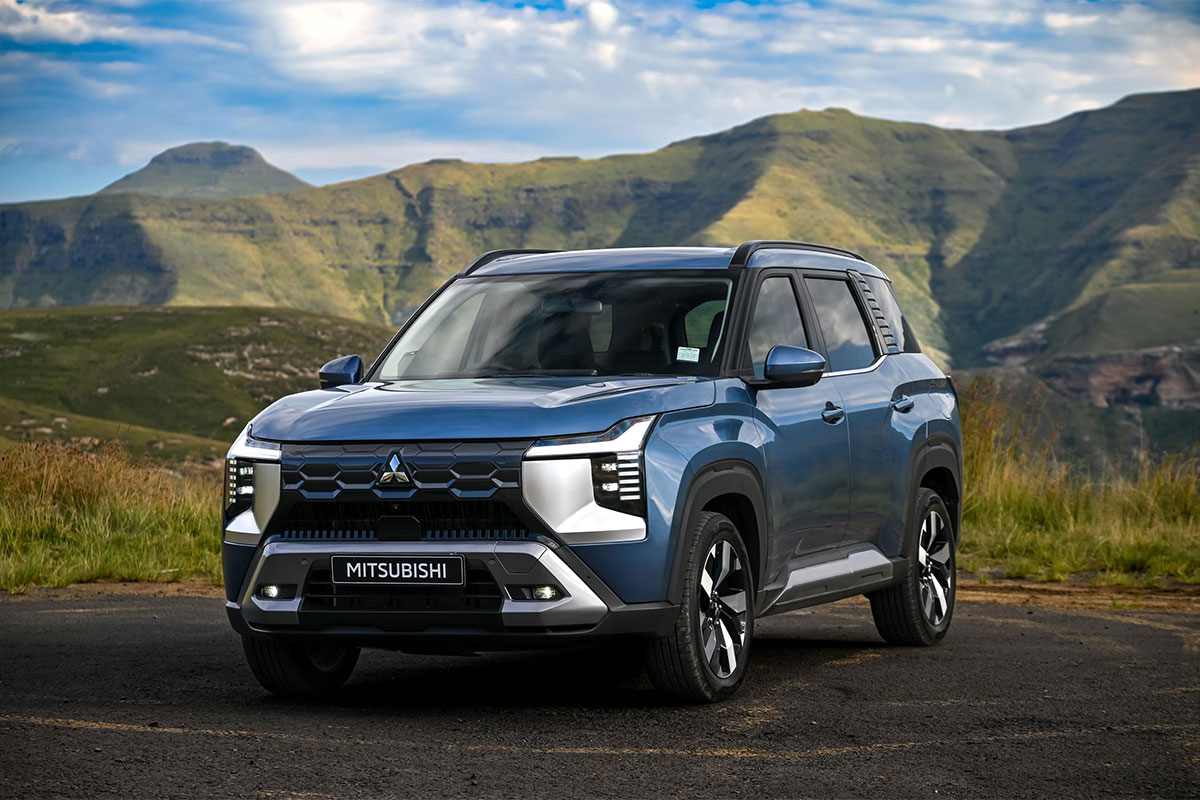
With similar styling to its Outlander Sport sibling, the Destinator features Mitsubishi’s Dynamic Shield grille and T-shaped LED headlights with silver outer surrounds, but it swaps the Outlander Sport’s body-coloured faux front and rear skid plates for silver ones. It also features 18” alloy wheels, different wheel arches, and revised cladding.
The Exceed’s black imitation leather seats are complemented by faux leather door inserts with contrast stitching, brushed aluminium touches, and plenty of piano-black finishing. The use of hard plastics here and there does spoil the plush overall look and feel of the cabin.
Taking centre stage is a 12,3” infotainment system, wired to an eight-speaker Yamaha sound system, with wireless Apple CarPlay and Android Auto.
Old-school feel
The interior feels more like a traditional car than just another faceless tech fest. While the instrument cluster is a fully digital eight-inch unit, it’s still set within a traditional binnacle. Beneath the dashboard vents are plenty of physical buttons for climate control.
Highlights on the Exceed’s spec sheet include rain-sensing wipers, a panoramic sunroof, a wireless smartphone charger, ambient lighting, and a 360° camera system. Advanced driver assistance systems include adaptive cruise control, lane change assist, and blind-spot monitoring.
There’s plenty of space in the sliding second row, while third-row legroom is best suited to smaller occupants, which is the norm in this segment. However, access to the third row is made easy by the second row tumbling forward.
When not in use, the third row folds forward manually, opening up a generous 620ℓ of boot space. With the third row in place, boot volume is reduced to around 120ℓ.
Smooth power
The thing we probably enjoyed the most was the Destinator’s 1,5ℓ turbo-petrol engine. The turbocharged four-cylinder engine sends 120kW of power and 250Nm of torque to the front wheels via a continuously variable transmission (CVT). A drive selector offers a choice of modes: normal, tarmac, gravel, wet, and mud.
The generous outputs mean the CVT is well behaved, with little of the droning usually associated with this type of transmission. Acceleration is surprisingly brisk, with very little lag off the line. The power delivery, along with the old-school feel of the cabin, results in a very pleasant drive.
Our fuel consumption of 9,8ℓ/100km was well off the claimed 7,2ℓ/100km, but with very little open-road driving, that’s likely as high as it’ll go, making it more acceptable.
What’s the verdict?
Overall, the Mitsubishi Destinator Exceed enters a small segment as a good-looking, well-specced car that’s a pleasure to drive, and it has the potential to help the brand stay relevant in a saturated market.
Vehicle fast facts
Mitsubishi Destinator 1.5T Exceed
Price: R569 990
Engine: 1,5ℓ turbo-petrol
Transmission: CVT
Power: 120kW at 5 000rpm
Torque: 250Nm at 2 500rpm to 4 000rpm
Fuel consumption (tested): 9,8ℓ/100km
Licensing mass: 1 500kg
Payload: 590kg
Towing capacity: 750kg (unbraked)