
Set to be positioned between the Magnite and an incoming model for developing markets, the Tekton is effectively Nissan’s version of the Renault Duster, albeit with a number of differences.
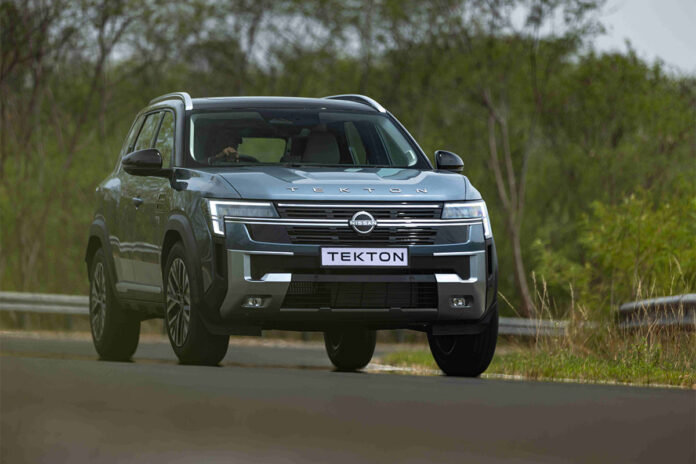
With the Tekton confirmed for export to 50 markets, mostly in the Middle East and Africa, its restyling is said to have been inspired by that of the Patrol, especially when viewed from the front.
Aside from a new Nissan-specific grille, the Tekton also gets new headlights with inverted L-shaped LEDs, an illuminated strip underneath the bonnet line connecting the light clusters, new alloy wheels up to 18”, and a redesigned front bumper.
Different to the Duster
The changes to the front fascia go further and include a new bonnet with block-letter Tekton badging, a red finish for the centre slat on the grille, and a satin-silver faux skid plate.
The Tekton’s rear-end differences from the Duster comprise a new bumper and imitation skid plate, restyled light clusters connected by an LED strip, Tekton badging at the base of the tailgate, and an optional two-tone finish.
Although based on the same CMF-B platform as not only the Indian-made Duster but also the example manufactured in Romania, the Tekton’s dimensions differ, even though its ground clearance is unchanged at 212mm. Boot space is 700ℓ with the rear up, while the claimed approach and departure angles are 27° and 35°, respectively.
Single-piecedesign
The interior has been carried over from the Duster, retaining the 10,1” infotainment display and the 10,25” instrument cluster in a ‘single-piece’ design. New, though, is a revised centre console, the same gear lever as the Magnite manual, restyled air vents on the passenger side, and more upmarket materials for automatic variants.
All models displayed at the unveiling featured a unique two-tone white-and-purple finish, complete with white stitchwork, plus purple and rose-gold accents on the doors, dashboard, and steering wheel.
The Tekton is offered in a choice of two powertrain options in India. Shared with the Duster, the 1ℓ turbocharged engine develops the same 74kW of power, but 6Nm more torque for a total of 166Nm. The sole transmission option is a six-speed manual, and the claimed fuel consumption is 5,1ℓ/100km.
Generous power
At the range’s summit, the 1,3ℓ turbo-petrol has been uprated from 118kW to 120kW, while the torque is unchanged at 280Nm.
The flagship Tekton can be specified with either a six-speed manual gearbox or a six-speed dual-clutch transmission instead of the Duster’s seven-speed.
Similar to the Duster, four-wheel drive has been ruled out, for now, over likely cost implications, despite the Tekton being pitched as a more premium offering.
For the time being, the Tekton misses out on the Duster’s self-charging hybrid powertrain, which combines a normally aspirated 1,8ℓ petrol engine with a 1,4kWh battery pack driving two electric motors for a total system output of 118kW.
When do we get it?
The Tekton has been given the green light for the local market and will, in fact, arrive in September as the replacement for the Qashqai.
Pricing is expected to start around R450 000, based on the priciest Magnite at R370 900 and the entry-level X-Trail at R687 900.
The Nissan Tekton will be produced in Chennai, alongside the Renault Kwid, Triber, Kiger, Gravite, and Duster.
The second joint venture model to debut this year after the Nissan Gravite based on the Renault Triber, the Tekton also heralds the start of what Nissan calls its ‘Dare Beyond’ product strategy.