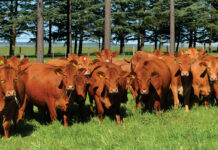

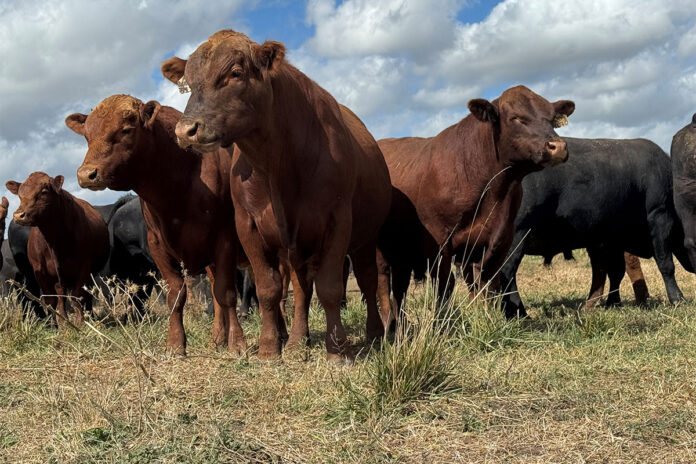
Argentina has a national herd of some 52 million cattle of which 70% are Angus or Angus crosses.
Cattle breeding is both an art and a science involving the strategic selection of breeding stock to produce offspring with desired traits.
Successful cattle breeding requires a deep understanding of market needs, genetics, animal behaviour, and reproduction values. The goal is to produce cattle that are healthy, productive, well-adapted to a specific environment, meet market demands, and add to the farm’s profitability.
Through effective pasture management and selective breeding, the Lafontaine family has been able to achieve cattle production rates well above regional averages. Over generations, their focus has been on pasture-based systems and overcoming the typical link between low birth weight and lower weaning weight in calves.

Juan Adolfo Lafontaine set out to break that curve and over many years of selectively breeding animals that would produce calves with low birth weights but have the ability to grow at a high rate, allowing them to reach a high weaning weight.
With him in the business are his son Nicolás and daughter Wichi.
Today, they are able to sell yearling breeding stock weighing 450kg, that produce calves with low birth weights, but which are weaned at 240kg in February, and then gain another 200kg in six months, when they are ready for slaughter.
Their aim is to raise Angus cattle for export: cattle to China and calves to Europe. These animals must be grass-fed and finished on grass.
During a visit by a group of South African farmers to the Los Tigres ranch, Lafontaine assured them that these animals exhibit precocity, fertility, and early physiological maturity.
Improved weaning weight
For generations, his family has been dedicated to improving livestock production in the challenging region of south-western Buenos Aires province, combining a suitable forage system with superior genetics to increase the productivity of the area’s fields, Lafontaine says.
“For 50 years we have been selecting cows that could thrive in this environment but also develop traits through selective breeding, specifically to overcome the typical opposing growth curves of animals,” he notes.
Lafontaine set out to modify this biological curve by selecting animals with low birth weights, but with a faster growth rate than the breed average during the rearing, growing, and, fattening stages. He seeks to avoid problems during calving without sacrificing the calf’s weaning weight.
Eighty percent of an animal’s growth potential is related to birth weight. Higher birth weight means faster fattening and higher finishing weight.
Normally, when a female calf gives birth to a calf with a low birth weight, the calf will be small at weaning. In other words, calves with high birth weight tend to reach higher weaning weights.“Due to this normal growth curve, bulls that produce small calves are typically used to breed heifers, while bulls that produce larger calves are used to breed bulls,” Lafontaine points out.
On the flip side of the coin, more calving problems are encountered with calves with a higher birth weight. According to Lafontaine, the selection process allows for a 50% reduction in calving problems and a 60% increase in growth when breeding 15-month-old heifers.
Lafontaine combines phenotypic selection with expected progeny differences (EPD) within the framework of the Angus breeding evaluation programme.
EPDs are tools that allow for the prediction, based on the sire and dam’s genetic history combined with that of the breeding bull, of the potential offspring.
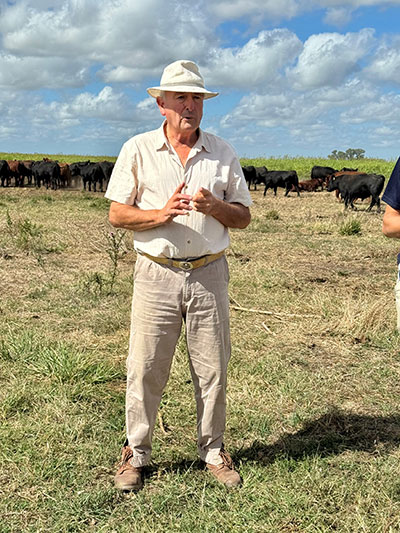
“We use animals that calve easily, and search for exceptional, high-performance sires. We keep adding to the mix until we have females with the same characteristics. Today, two-thirds of the population, almost 70%, are suitable for heifer production.
But one-third of the total, which is half of those suitable for heifer production, have normal growth, which is excellent, or even better.“The process is not easy or quick. It requires patience and careful selection,” he states.
He retains cows that produce calves with low birth weights while eliminating those that produce calves with lower growth rates.
Birth weight is one of the most difficult characteristics to measure. The Lafontaine family designed a device that eliminates the effort of weighing each calf manually. It attaches to the bed of a pickup truck and has a support with a scale.
As a result of this selection process, the average birth weight of the herd decreased over the years, while the weaning weight of the calves increased simultaneously.
“We sell yearling bulls with an average weight of 450kg and a scrotal circumference of 37,5 cm, after being weaned at 268kg.
Heifer fertility is crucial for lifetime productivity. “We look for a 93% rate in first pregnancies. We also want to get a second pregnancy after 15 months and are also looking at a 93% success rate.”
Improving genetics
The selection process also considers the final product of the steer: the carcass. The ranch is aiming to increase the rib-eye area and improve meat quality through a balanced meat-to-fat ratio.
“In selecting for these traits, there are no conflicting situations, making it easier to move forward positively,” Lafontaine explains.
The improved genetics are tested under commercial conditions to further refine their breeding research.
The feed is 95% pasture-based, with supplementation of 0,5% to 0,8% of live weight before winter to prevent diarrhoea problems on green forage.
“This low-cost system yields very good results in livestock management,” Lafontaine explains.
Lastly, he says that they measure production by looking at kilogram produced/ha. “But you can only do that if you give attention to individual animals.”