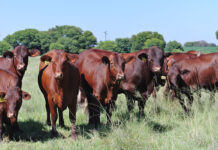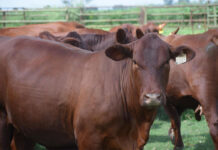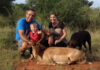

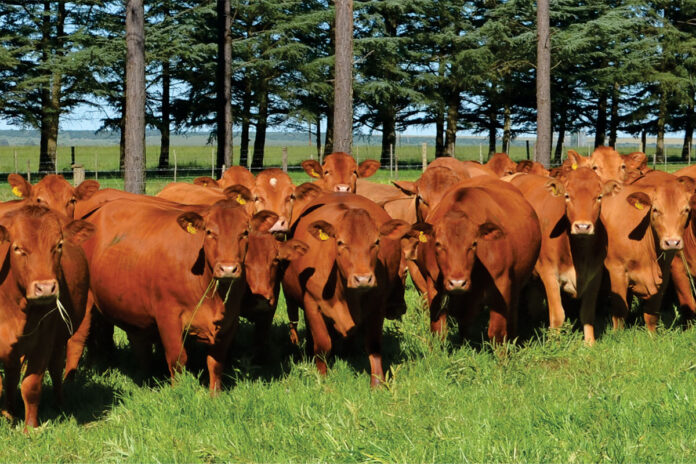
The Nooitverwag Beefmaster stud is run by Kerneels and Gerrie Janse van Rensburg on the farm De Vereeniging near Ermelo in Mpumalanga. The stud was registered by Kerneels in 1993 and was moved from Koster in North West to Ermelo in 2001.
“The move from North West’s sweetveld some 440km east to the sourveld of Mpumalanga occurred without any adverse effect on the performance of the animals, directly in contrast to the general belief that cattle cannot be moved from sweetveld to sourveld because they will find it difficult to adapt to the sourveld. The fact that our cattle adapted to this change in grazing conditions clearly underpins the adaptability of the breed as we maintained the same conception and weaner weights from the onset,” says Gerrie.

The Janse van Rensburgs’ decision to farm Beefmasters was based purely on economics. Initially, 103 cows were selected for the stud from their own commercial herd, followed by the introduction of bulls acquired from Oktavia Beefmasters, Rautmaster Beefmasters and WO Beefmasters. The selection process of the first cows took place under the auspices of the Beefmaster Breeders’ Society of South Africa (the society).
Optimum production means optimum income
“My focus was, from the very beginning, on optimum performance, and no other breed could hold a candle to the Beefmaster in this regard. The breed simply outperformed the other breeds we considered. For instance, the weaning weights in our herd increased by between 20kg and 25kg compared to weaners from other well-known breeds after the introduction of the Beefmaster genetics. Optimum performance still remains one of the most important cornerstones of the Nooitverwag stud,” Kerneels explains.
The Janse van Rensburgs’ selection criteria is focused on sound money matters, financial progress and, as Gerrie puts it, a passion for the breed and the breeding of Beefmasters. The father and son team’s love of the breed is based on its adaptability, even temperament, top growth rate, outstanding conformation and fertility. According to them, the choice of Beefmaster as a beef cattle breed makes financial sense.
Record-keeping for genetic integrity
Detailed record-keeping has formed an integral part of the Nooitverwag Stud since its inception and even before. Kerneels kept close records of performance of the breeding females in the commercial herd that preceded the stud. He used a cow recording system that was made available by the Agricultural Research Council at the time to keep track of his females.
The system provided for, among others, the recording of the number of calves born to and raised by individual animals, the gender of the calves, birth dates and weaning weights.
“The society is deeply committed to performance testing and recording. In my opinion, this is vitally important to ensure genetic integrity and the provision of the best possible animals to the market. This commitment to proven statistics played an integral role in the development of the Beefmaster as a leading beef cattle breed internationally. There is no place for thumb suck as far as performance records and consequently genetic improvement is concerned,” says Gerrie.
“It is incumbent upon us as stud breeders to provide proven genetics to commercial breeders as they constitute the stud breeding sector’s biggest market in terms of bulls. In our case, we first use between 60% and 70% of our own two-year-old bulls in our commercial herd before the bulls are put on the market at the age of three years. The Beefmaster is fast gaining ground in crossbreeding concerns, increasing the demand even more.”
Fastest-growing beef cattle breed
Beefmaster cross heifers can, for example, confidently be retained as replacements in a commercial herd. Gerrie says that the Beefmaster is not a fad of a flavour of the month breed, but a well-established breed that has already made its mark in the national beef cattle herd of South Africa. This is underscored by the fact that it has become the fastest-growing breed of all the beef breeds affiliated with SA Stud Book.
Adaptability if of high priority in the Nooitverwag herd. The Janse van Rensburgs maintain a stocking capacity of 2,4ha per MLU on the sourveld and maize stover in winter. The farming concern includes a maize and soya production component, a commercial Beefmaster herd as well as the stud. The average annual rainfall is about 750mm while winter temperatures of below freezing point are not uncommon.
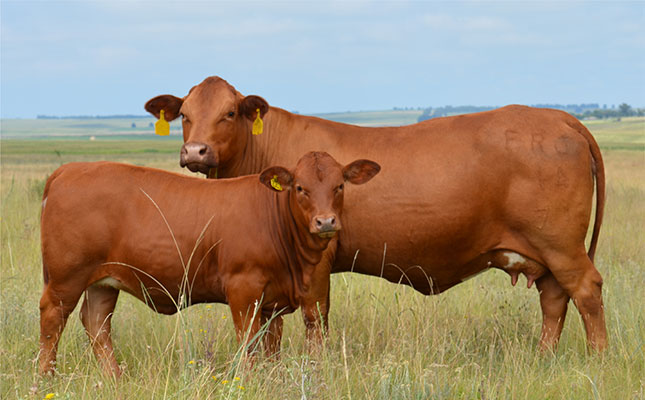
“On the Highveld we farm under truly extensive conditions, and that is why adaptability is so important. We select purposefully for animals that continue to perform optimally, despite the climatic conditions they are exposed to. As the father of the breed, Tom Lasater, put it, the basis for cattle breeding and range management is an understanding on the part of the rancher that he is working within a finely turned universe that functions better if he interferes less,” says Gerrie.
In harmony with nature
A P6 lick with 10% protein is provided in summer, given that most of the breeding animals in the herd are lactating, or in case of heifers, in the process of maturing. A winter protein lick is supplied over a period of five months. The Nooitverwag animals are treated against internal and external parasites twice a year, coupled with dipping two to three times a year.
Redwater is endemic to the area, but because of the Beefmaster’s innate resistance to disease, the disease does not pose a serious problem.
The Nooitverwag Stud maintains a single breeding season that stretches from 1 October to 2 January. The natural fodder flow is at its peak during these months and allows the animals the opportunity to make optimal use of the available natural resources.
“This allows us to farm in harmony with nature,” Gerrie points out.
The 2026 Nooitverwag production sale will take place on De Vereeniging near Ermelo on 14 July 2026.
For more information, email Gerrie Janse van Rensburg at [email protected].