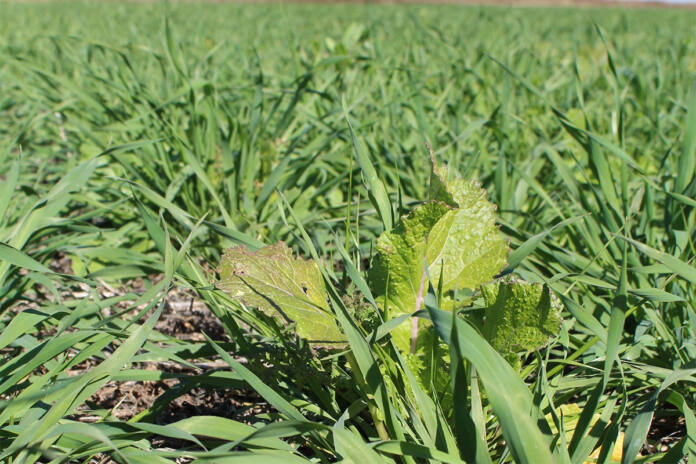
Cover crops are an important tool for improving soil health and building soil structure in maize production systems. When used as companion crops between maize rows, they cover the soil, conserve moisture, and improve water infiltration through a diverse network of roots. They also feed soil micro-organisms, enhance soil structure, and help prevent compaction.
However, selecting the right cover crop requires careful planning. With an expanding range of species available, farmers need to consider how different crops fit into their production systems and support their long-term goals.
Start with the end goal
Ivan Jansen van Rensburg, technical marketer at Barenbrug, says the growing number of cover crop options can make decision-making difficult.
“It’s easy to be confused by all the options. Farmers first need to identify the purpose of the cover crop before considering factors such as rainfall, irrigation, soil type, site-specific challenges, available equipment, and budget.
“Soil type, in particular, plays an important role in species selection. Legumes such as vetch and medicks perform well on loam and clay soils, while serradella and lupins are better suited to sandy soils.”
He cautions against assuming that greater diversity always means better results. While diversity is desirable, mixtures containing too many species can become difficult to establish and manage.
Planting equipment may struggle with differences in seed size and seeding depth requirements, while species that establish successfully may not necessarily be compatible with one another (see table).
Termination can also become challenging when some species have already produced seed while others are still actively growing.
Jansen van Rensburg says farmers should aim for a core mix of three to five species with complementary growth periods, growth habits, and nutrient acquisition strategies. Species should be selected according to the specific advantages they offer, such as nematode suppression, while also considering potential disadvantages, including allelopathic effects on the crop that follows, pest and disease carryover, or weed potential.
“The greater the plant diversity, the greater the diversity of microbes and the more robust the soil system,” he adds.
Farmers should also evaluate whether important functions are missing from a mix. For example, species with deep, strong roots may be required to break through compacted layers in the soil.
Once the objectives have been established, producers can determine the appropriate species mix, row spacing, and seeding rates before planting, observing performance and making adjustments over time.
Seeding rate also requires careful consideration. Higher rates generally improve weed suppression but may reduce biomass production because of increased competition between plants.
“You must decide what your main objective is: to produce biomass or to suppress weeds. However, a balance can also be achieved,” says Jansen van Rensburg.
Understanding soil biology and crop rotations
A successful cover crop programme depends on understanding the relationship between plants and soil microbes.
Jansen van Rensburg explains that microbes act as recyclers by decomposing organic matter, as refiners by fixing nitrogen, and as miners by transporting nutrients through the soil. The glues and gums they produce help bind soil particles together and are a visible sign of healthy soil structure.
Jamie Young, technical seed marketer at Barenbrug, compares soil microbes to those found in a cow’s rumen. “Much like rumen microbes that work to feed the cow, soil microbes work to supply nutrients to plants.”
He explains that soil microbes require a carbon-to-nitrogen (C:N) ratio of approximately 24:1 to efficiently break down plant material and release nutrients for the next crop. Plants with lower C:N ratios, such as legumes, break down more readily, while residues with higher ratios, such as maize stover, decompose more slowly.
Nitrogen plays a critical role in this process. If microbes don’t receive sufficient nitrogen from crop residues or other sources, they will draw nitrogen from the soil, reducing the amount available to crops.
By selecting cover crops that complement both existing residues and the next crop in the rotation, farmers can help microbes break down plant material more efficiently and return nutrients to the soil.
Young says cover crop selection should be viewed as an investment in the next crop in the rotation. For maize production, cover crop mixes with a lower C:N ratio are generally preferable. This means including a greater proportion of legumes and annual ryegrass.
In contrast, when a legume crop such as soya bean follows, a higher C:N ratio cover crop consisting of grains such as oats or stooling rye is more suitable.
Compacted soils are another common challenge. Species such as sugar beet, turnips, and daikon radish can help break through compacted layers with their dense root systems.
Young notes that the degradability of plant material is influenced by several factors, including plant maturity, soil microbial health, and water availability. More mature plants tend to be more fibrous, resulting in higher C:N ratios and slower decomposition.
Timing, moisture, and species selection
Even the best species selection can fall short if timing is incorrect. Young stresses that cover cropping and intercropping cannot be considered in isolation, as timing plays a major role in determining success.
Cover crops need to be introduced at the right stage of the maize growth cycle to make use of remaining soil moisture and benefit from canopy protection during establishment.
“The cover crop establishes beneath the maize canopy and remains relatively dormant while conditions are shaded. As the maize crop dries down and the canopy opens, increased sunlight stimulates rapid cover crop growth,” explains Young.
Soil moisture is equally important because it directly influences microbial activity, residue breakdown, and nutrient availability.
According to Young, successful cover cropping largely comes down to three interconnected factors: timing, moisture, and species selection.
Farmers must also balance rapid nutrient release with maintaining sufficient soil cover. While a C:N ratio of around 24:1 promotes efficient decomposition and nitrogen release, some higher-carbon residues should remain on the soil surface as mulch to protect the soil.
Where grass residues with high C:N ratios are present, applying a small amount of fertiliser nitrogen of between 8kg/ha and 10kg/ha can help microbes break down the material more efficiently and prevent nitrogen from being tied up during decomposition.
Ultimately, successful cover crop selection begins with a clear understanding of what the farmer wants to achieve. By matching species to soil conditions, crop rotations, and management objectives, and by paying careful attention to timing and soil biology, cover crops can become a valuable tool for improving soil health and supporting maize production.
For more information email Barenbrug at [email protected].