
Turning point
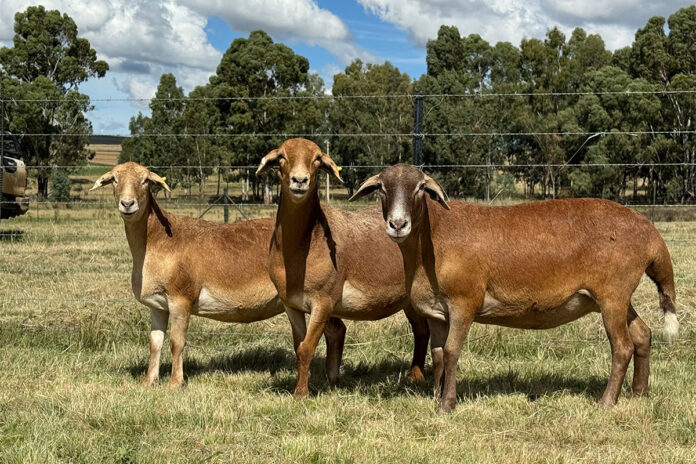
Paul and Daleen Roos’s move to Meatmasters came after a careful search for a breed better suited to the conditions on their farm. The couple farms outside Vrede in the Free State on their property, Geluksvlei, where they run PDR Boerdery, a diversified operation comprising Bonsmara cattle, Meatmaster sheep, crops, a veterinary practice, and a transport business.
Before settling on Meatmasters, they had explored several other small-stock options as part of finding the right fit for Geluksvlei, but none proved as well-suited to their conditions. Each taught them something about what would and would not work under their farming system.
The area’s wet summers, parasite pressure, and hoof-related challenges meant they needed animals that could cope with the environment with minimal intervention. They were also looking for a breed that fitted more naturally into their commercial system and could withstand the practical pressures of farming in the area.
Stock theft also influenced their decision. In their experience, animals that are easy to catch and handle are more vulnerable, particularly when thieves can move them off a farm alive. Paul explains that Meatmasters are naturally more alert and harder to handle, which adds a practical layer of protection under their conditions.
“We decided we needed something different. With a Meatmaster, someone can’t just walk in, catch it, and carry it off,” says Paul.
Finding the fit
When Paul and Daleen introduced the breed in 2021, there were no other Meatmaster studs in their immediate area, and demand was already climbing. Buying foundation animals was expensive. At stud auctions, they paid up to R16 000 for individual pregnant ewes, initially sourcing genetics from about five different flocks before identifying bloodlines that suited their conditions.
The stud’s foundation genetics trace back to the well-known Sterkfontein Meatmasters, bred by Willem van den Berg.
The stud has grown from 40 to 50 ewes to about 220 registered ewes, alongside four anchor sires and a larger commercial flock. Around 60ha to 70ha are rotated between maize and soya beans, with crop residues providing winter grazing for the sheep. The area’s annual rainfall averages 780mm to 800mm, while winter temperatures can drop to -10°C.

These conditions place a premium on animals that could remain productive without requiring constant intervention.
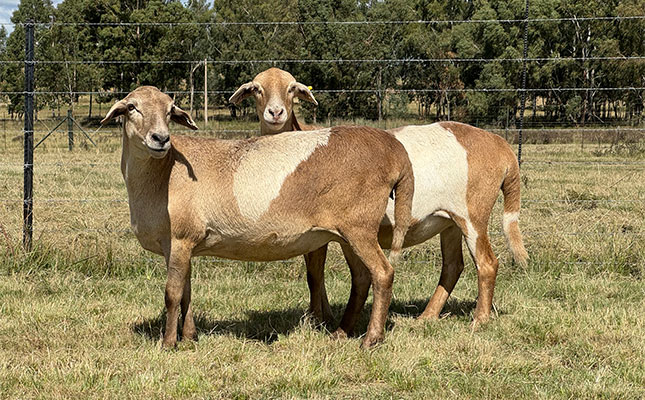
In the end, hardiness was the deciding factor. Daleen describes Meatmasters as “easy keepers”. As hair sheep, they shed naturally and require no shearing, while also coping well with wireworm and footrot.
“You spend less on a Meatmaster than on the woolled breeds,” she says.
Paul’s background in cattle also shapes the way he views the breed. He believes there is still scope to breed for muscling, capacity, conformation, and a Highveld-adapted type suited to their environment. Improving meat traits and carcass quality remains one of the aspects he enjoys most.
Breeding system
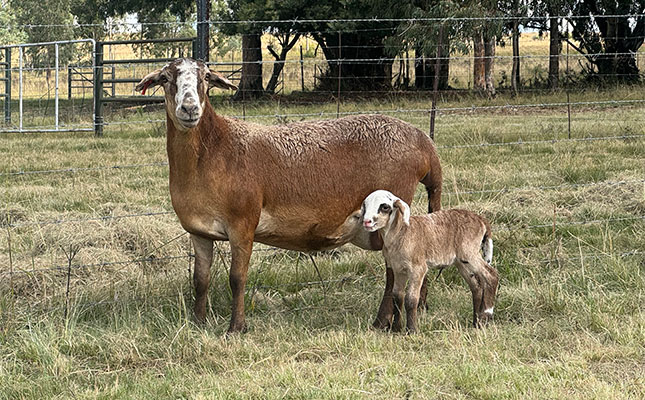
The stud follows a seasonal production system centred on autumn lambing, although breeding decisions are guided by seasonal conditions rather than fixed dates. Rams generally join the ewes around October, while replacement ewes are first exposed to a ram between 14 and 18 months of age. The exact mating period depends on the veld and seasonal conditions.
As Daleen puts it, they are “not fixed to a calendar”, but farm with the season.
Established anchor rams can cover considerably more ewes, but the couple uses young home-bred rams more conservatively, joining about 20 ewes per ram to avoid placing too much pressure on an unproven sire. Young ewe groups may also receive a slightly longer joining period when necessary.
Lambing takes place in autumn, allowing ewes and lambs to benefit from soya bean crop residues once the lands have been harvested. Weaning follows in early spring rather than the middle of winter, as the couple believes winter weaning places unnecessary stress on both ewes and lambs.
The stud does not use flushing feed before mating and does not actively pursue twin lambs.
“I would rather have one strong lamb that grows well than twins that only wean at 16kg or 20kg,” says Daleen.
Lambing percentage averages around 130%, although this varies from season to season according to the condition of the ewes at mating stage.
After weaning, lambs are grown out, and the poorest-performing 10% to 15% are culled. The remainder are evaluated for growth, type, and conformation.
The stud applies a strict zero-tolerance policy to non-productive ewes.
“If a ewe doesn’t give you a lamb, she must go. Even a young ewe that does not conceive in the first round is culled,” says Paul.
This approach comes directly from the Bonsmara side of the business. Paul points out that some commercial cattle operations only need to retain about 40% of their heifer calves as replacements, allowing them to keep only the earliest-calving and best-performing females. Early calving is viewed as an indicator of fertility, adaptability and easy-fleshing ability, and Paul and Daleen apply the same thinking to their sheep.
Neither Paul nor Daleen places much value on sentiment when it comes to making breeding decisions. Every animal must earn its place, regardless of pedigree. If a ewe fails to produce, she is culled irrespective of the purchase price or bloodline. That commercial mindset influences every breeding decision because their customers expect animals that perform under practical farming conditions rather than in the show ring.
Most breeding still takes place naturally, although they have used laparoscopic artificial insemination on selected ewes. They may consider embryo flushing and in vitro fertilisation for elite females in future, although those technologies are currently used mainly in the cattle herd.
Feeding strategy
The couple does not rely solely on carrying-capacity calculations. They monitor the veld continuously and move sheep once grazing starts running short. Smaller ewe groups are rotated according to veld conditions instead of following fixed grazing schedules.
Paul explains that they prefer to “farm with nature”. Daleen says they regularly walk through the veld themselves before deciding when groups should be moved.
There are no planted pastures on the farm. The sheep rely on natural veld, maize and soya beans residues, and supplementary bales when feed becomes scarce. Teff and grass bales are fed where necessary, together with winter protein licks to maintain rumen function as veld quality declines.
Health management
Wireworm and footrot remain the farm’s biggest health challenges because of the wet, clay-heavy soils and relatively high rainfall.
To improve wireworm resistance, Paul and Daleen sourced a ram from a breeder near Ventersdorp who had selected specifically for the trait. Paul says the ram had never been dosed for wireworm, and its offspring performed well enough for the bloodline to become an important part of the flock.
New arrivals spend about 28 days in quarantine before joining the flock. During this period, they receive key vaccinations and are monitored to reduce the risk of introducing disease. The business also has facilities for advanced reproductive work, including embryo flushing, although these are separate from the quarantine process.
The couple’s health programme targets the challenges they encounter on the farm instead of treating for every possible disease. They vaccinate against the core risks, monitor parasite burdens, and adjust treatments according to seasonal pressure.
Low input costs form an important part of their management philosophy. Their aim is to avoid a production system that depends on constant feeding, dosing, and intervention while still managing the risks that matter.
Marketing
The stud’s main purpose is to supply the commercial market while also serving fellow stud breeders to a lesser degree.
“Our target market at this stage is the commercial producer. If a commercial farmer buys a ram or a ewe from you and it does not produce, what are you going to tell him? That he must give it another chance because it comes from a good ewe line? He is not going to care where it comes from. The commercial guys are our target market. If the stud guys come, that is a bonus,” says Paul.
The couple believes commercial buyers are looking for ewes that rear strong lambs and wean them successfully off the veld without excessive supplementary feeding.
Animals are sold mainly through the regional Meatmaster club auction, with additional sales taking place directly from the farm.
Sale animals undergo a lengthy adaptation period before auction. Concentrate levels in the complete ration are increased gradually instead of being pushed aggressively, helping preserve rumen health and veld functionality.
“It is easy to make an animal fat, and it is easy to make an animal look good. The art is to make it look good without damaging the rumen and the gut. That is why we adapt them slowly, lift the feeding level gradually, and keep them on a complete ration,” says Paul.
The objective is to present well-conditioned animals without sacrificing the veld adaptability that commercial buyers value.
Sale rams are fertility-tested, while working rams undergo basic breeding-soundness examinations.
Commercial farmers are increasingly buying Meatmaster rams for crossbreeding because of the hybrid vigour the breed offers. Most buyers still focus on visual type, functionality, and mothering ability rather than detailed performance data. Paul and Daleen are cautious about comparing breeding values across very different production environments, arguing that animals must first prove themselves under veld conditions.
The next step
Paul and Daleen intend to continue investing in the best genetics they can access. Their objective is not simply to buy expensive animals. Instead, they are refining a Meatmaster that is easy-fleshing, functional, slightly shorter on the leg, better muscled, and able to maintain body reserves under their conditions.
Paul describes their preferred type as a “wet” sheep, by which he means an animal with enough body capacity and reserves to maintain condition under veld conditions. It is not about breeding a Dorper-type sheep, he says, but rather a Meatmaster that performs on Geluksvlei and meets the needs of their commercial customers.
For newcomers, they recommend starting with a smaller group of good ewes rather than a larger flock of poorer-quality animals. They also caution against buying from too many unrelated flocks because this creates unnecessary variation and makes it harder to breed a consistent type.
They also encourage prospective buyers to visit breeders before making purchases. Sheep that look impressive in an auction ring may not have been proven under veld conditions, and they prefer genetics from production systems that resemble their own.
For more information, email PDR Boerdery at [email protected].