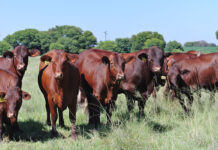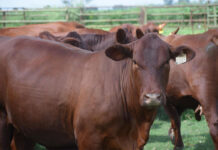

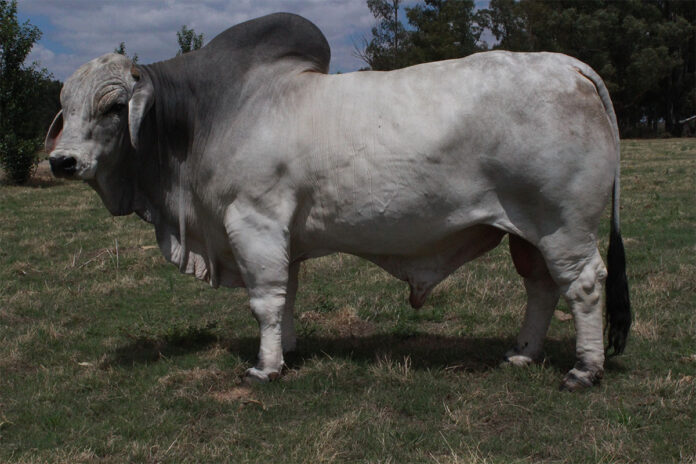
The Brahman is the foundation of the Beefmaster breed, so it is one of the cornerstones of the Beefmaster genetic base. To the Bos-Blanco Stud near Kroonstad in the Free State, improving their Brahman herd is still very high on their list of priorities.
According to Burnie Staal of Bos-Blanco Stud, this makes continued investment in the stud’s Brahman herd a priority.
“If we lost our Brahman genetics, not just Bos-Blanco, but the Brahman industry in South Africa would lose a foundation genetic pool that is irreplaceable,” he says.
Among the Brahman traits that remain particularly important to the stud are hardiness, adaptability, and the ability to perform on the veld under harsh natural conditions.
The modern Brahman
Staal says the South African Brahman has changed considerably over the past 30 years as breeders have focused increasingly on functionally efficient cattle capable of producing offspring with improved economic traits.
Temperament, production, and structural correctness are among the characteristics that have improved significantly.
Despite this, Staal says one of the most persistent misconceptions about Brahmans is that they have a poor temperament. Their intelligence, he adds, is also often underestimated. The ideal modern Brahman, in his view, is a medium-framed, beefy animal that is functionally efficient, structurally sound, and correct.
Breeding for tomorrow
While the breed is renowned for its ability to cope with hot, dry environments, Staal does not believe climate change itself is necessarily driving greater interest in Brahmans.
“There are always drier and wetter cycles. Brahmans perform better than other breeds in the drier seasons, but I do not think Brahmans are becoming more popular because of climate change specifically.”
Instead, he says economic pressures and farmers’ need to produce more profitable animals have increasingly influenced selection priorities. Economic goals and the need for farmers to produce more profitable animals have changed selection priorities.
“Economic traits are receiving more attention today than they did 20 years ago, aided by advanced technology and economically driven selection methods,” says Staal.
Building on South African genetics
Staal explains that all Brahman cattle ultimately trace back to American bloodlines, as the breed originated in the US. Bos-Blanco has carried out embryo flushes using leading US bulls, but Staal says most of its herd traces back to established South African foundation bloodlines, which themselves originated from US genetics.
He believes South African breeders have made considerable progress in breeding efficient, structurally sound, and correct Brahman cattle. There remains a place for international genetics, however. According to Staal, US genetics can provide South African Brahmans with greater genetic diversity and additional body capacity.
Technology and genetic progress
Bos-Blanco has used embryo transfer for about 40 years and continues to rely heavily on the technology, although it is applied only to the top percentage of the stud’s most predictable female lines.
“We do artificial insemination on all our females once before natural breeding,” Staal points out. “We only do embryo work on cows from predictable families that have produced a lot of herd sires and productive cow lines for Bos-Blanco.”
To date, genomics has not played a big role in Bos-Blanco’s breeding decisions.
“Up to this stage we have not given a lot of emphasis to genomics itself, although we do give a lot of emphasis to genomic-linked traits like reproduction and production traits values. The biggest challenge is management – it is very difficult to manage natural resources to get accrued trait values consistently under a lot of different challenging natural conditions, and that is something DNA cannot capture,” adds Staal.
Breeding philosophy
Bos-Blanco’s breeding philosophy centres on a medium-framed, early-maturing Brahman that is structurally correct and functionally efficient. Structural correctness and functional efficiency receive particularly strong emphasis.
Non-productivity, poor temperament, structural problems involving the legs and hooves, and poor udders are grounds for immediate culling. Temperament remains particularly important because of its historically negative association with the Brahman breed.
The female herd
The stud also places considerable emphasis on cow families. One of the most influential has been that of
BOS 93 108, whose daughters had a major impact on herd-sire production at Bos-Blanco and in the wider industry.
Bos-Blanco looks for cow families capable of producing top-end performing offspring year after year.
Fertility, milk production, growth, and predictability are among the most important maternal traits.
Staal describes an exceptional Brahman cow as one that, together with her maternal siblings, consistently produces a top-end calf every year, regardless of the bull to which she is mated.
Staal adds that the stud’s best cows can remain productive in the herd for up to 16 years, while embryo work may continue on exceptional females until they are 20 years old.

Adaptability under extensive conditions
Adaptability remains one of the Brahman’s defining strengths, particularly under harsh, extensive veld conditions.
Staal says the breed is especially valuable in crossbreeding programmes because it is genetically distinct from Bos taurus and Sanga cattle. This enables producers to exploit hybrid vigour, while retaining good growth under natural conditions.
Tick and disease resistance, hardiness, and heat tolerance add to the breed’s value under African production conditions. The Brahman’s heat tolerance and ability to travel long distances between grazing and water are also important during drought.
The Brahman’s tick resistance is particularly significant on the wider African continent, where tick-borne diseases and external parasites pose major production challenges. Staal says commercial producers sometimes underestimate just how important the Brahman’s inherited adaptability can be.
Commercial farmers do not always recognise the adaptability of Brahmans – their ability to walk long distances to find resources under extreme natural conditions and still produce efficient are an inherited trait.
Commercial relevance
Extensive commercial producers using crossbreeding systems stand to gain substantially from Brahman genetics, according to Staal, particularly through hybrid vigour. Producers who retain replacement Brahman-cross females can also secure longer-term benefits from the genetics.
Buyer priorities have nevertheless changed over the past decade, with considerably greater attention now being paid to economic traits. Reproduction, milk production in females, low birthweights, heavy weaner calves, and good feedlot growth are among the characteristics commercial buyers increasingly demand. Of these, fertility and growth command the highest premiums.
Staal says this creates an important distinction between commercial selection and the show ring.
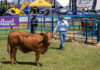
“Commercial producers place a lot of emphasis on traits like reproduction, milk production, and growth. Show judges, unless judging performance classes, generally only have access to phenotype, not genotype, so these economically important traits often go unnoticed in the ring.”
Genetics that shaped Bos-Blanco
Bos-Blanco’s herd originates from five influential US bloodlines: Sugarland Loxacrata, Sugarland Rexcrata, Sugarland Suville, MN Mayro Manso, and JMD Elefante Manso. Two bulls in particular, BOS 08 289 and
BOS 04 194, have had a major influence on the present-day herd, with each establishing its own genetic line.
Staal has no doubts as to which cow families transformed the stud: “On the female side, BOS 93 108, from the MN Mayro Manso bloodline, had a significant impact through daughters, including BOS 03 71, BOS 14 35, and BOS 07 42. These females produced several herd sires that went on to influence Bos-Blanco and the broader Brahman industry.”
“Pedigree really only matters if it produces predictable, highly performing animals. Fertility remains the most economically important trait and one of the most difficult to improve, as progress depends on both management and genetic improvement.” By contrast, Staal believes size for age is a characteristic that judges can sometimes place too much emphasis on.
Pressure and opportunity ahead
Staal expects pure Brahman breeding to face pressure over the next decade as a number of synthetic breeds already incorporate Brahman genetics into their breeding programmes.
He believes Brahman breeders will therefore need to place even greater emphasis on producing functional, structurally correct, beefy, high-quality animals capable of competing with, and complementing crossbred cattle.
Another challenge, he says, is South Africa’s beef grading system, which he believes favours the feedlot rather than the primary producer and the majority of consumers. At the same time, export markets offer considerable opportunity, which excites Staal.
“South Africa serves as an important genetic base for Brahman cattle on the African continent, creating opportunities to export locally developed genetics into a growing industry.” For young breeders considering establishing a Brahman stud, his advice is straightforward: visit several reliable, established breeders before deciding which breeding direction to follow.
Four decades of lessons
Among the cattle bred and raised at Bos-Blanco, Staal singles out BOS 07 42, and her maternal sister BOS 14 35 as exceptional females. Together, they produced several herd sires that helped secure the stud’s genetics. Together they produced several herd sires that secure Bos Blanco’s genetics.
After 40 years of breeding, the offspring of BOS 08 289 and BOS 04 194 are two bloodlines that continue to excite him.
“These two bloodlines complement each other and have excellent breeding values.”
According to Staal, BOS 08 289 is a trait leader for weaning weight, 400- and 600-day weight, milk, scrotal size, and carcass weight. He says the bull’s Rand Value Index for the Wean and Feedlot Index is three times higher than the breed average.
One of the most important lessons Staal has learnt is to place greater emphasis on established cow families when producing herd sires. “Using a bull from markedly different genetics can unpredictably shift the genetic make-up and values of an entire herd, whereas predictable cow families provide a more reliable foundation for genetic progress.
Bos-Blanco has nevertheless used a number of young, as-yet-unproven herd sires intensively. Staal says this has paid off when those animals came from predictable genetics and had excellent breeding values.
With the stud’s female herd having reached its target size, Bos-Blanco now sells a substantial amount of genetics each year.
“This includes bulls and females the stud itself would love to keep, but making those genetics available to other breeders ultimately contributes to the development of the wider Brahman industry,” says Staal.