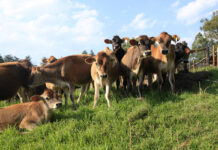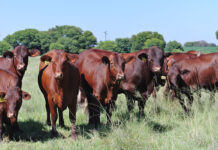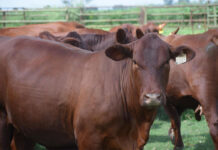

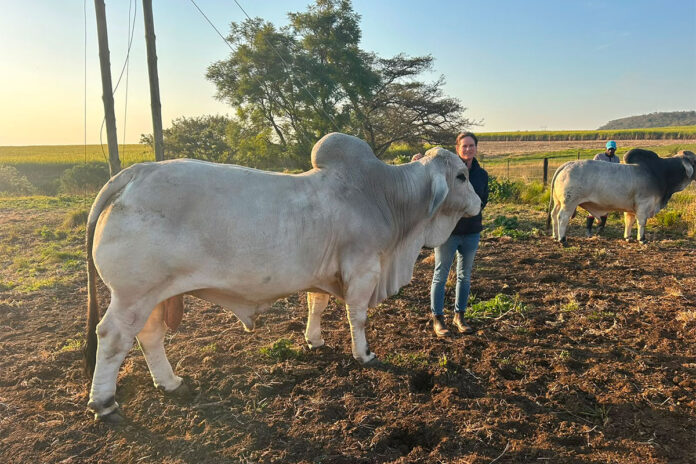
Based near Wartburg in KwaZulu-Natal, Double Bar Brahmans (DBB) comprises 171 registered breeding cows, 30 mateable heifers, and 10 breeding bulls. The stud forms part of a 1 500ha operation of owned and leased land that also carries commercial cattle, sugarcane, green maize, and a small area of maize grown for silage. Dent runs the operation with her husband, Nick, and their children, Jocelyn and Douglas.
The Double Bar name goes back three generations. Dent’s grandfather, Brian Raw, established a Brahman stud in the Msunduzi Valley near Pietermaritzburg in the mid-1970s under the Double Bar farming operation.
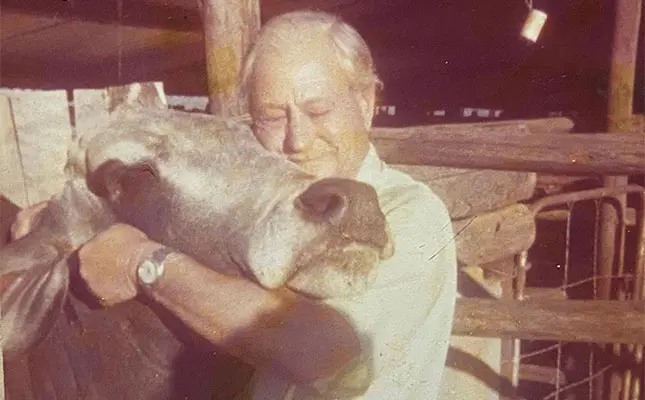
Brian had a deep love for Brahmans and although he passed away before Dent was born, this passion was clearly passed down in the genes. After his passing, the stud was taken over by her parents, Neil, and Angie Raw. They then disbanded the registered herd in the late 1980s and moved to Ngunis, retaining Brahman bulls for crossbreeding.
Dent returned to the breed in 2004. She had inherited money from her late grandmother, Phyllis Raw, while in matric, and her father suggested that she invests it in cattle and lease grazing on the family farm.
Her time at Cedara College and watching the Brahman classes at the Royal Show confirmed her love for the breed and made the Brahman the obvious choice. She bought her first 18 stud Brahmans under the guidance of the late Tony Braithwaite at the Mega Meat Sale and registered Double Bar Brahmans that same year.
By 2011, the herd had grown to 120 registered cows. Newly married and needing capital to establish sugarcane, Dent deregistered the entire herd and continued running the cattle commercially. She returned to registered breeding in 2016 with 20 cows and one bull and has concentrated on rebuilding the stud through strict selection.
Her passion for the Brahman is clear, and with Nick and the children sharing her love of the breed, the stud is growing from strength to strength.
Breeding for harsh thornveld conditions
The thornveld environment determines much of the selection at Double Bar. The cattle walk long distances between grazing, feed, and water while facing severe heartwater and other tick-borne disease pressure. Young bulls are weaned into the thornveld and remain there through most of their development, coming in only during the final two to three months before a sale.
Under these conditions, Dent prioritises adaptability, longevity, hybrid vigour, and parasite resistance. Her selection has become more focused since 2004. She began with functional cattle and clean underlines but now also looks for medium-framed, early-maturing animals with structural soundness, good bone, and plenty of beef. Temperament, however, remains the first test.
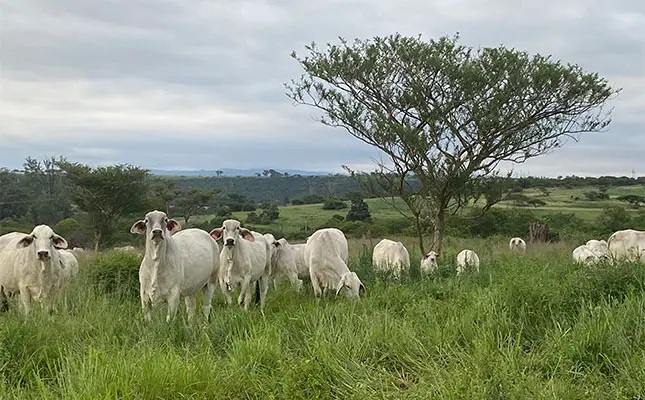
“We cull heavily on temperament. It’s one of our first culling tools throughout – weaners, cows, and bulls,” she says.
Her ideal bull is medium-framed, carries plenty of beef, shows masculinity in the forequarter, and is strong over the topline. She is strict on testicular size and is working to increase it. Maintaining a clean sheath while adding depth and capacity remains a constant balancing act.
“It is always a fine line to get the balance between capacity and a clean sheath,” Dent says.
Flexible breeding in a changing climate
Double Bar targets winter calving. Bulls generally run with the cows from November until January or February, bringing most calving into the cooler months when parasite pressure is lower. The season is not completely rigid, however, and cows that fall out of sync are mated when their condition allows.
This flexibility has become more important as winters have grown warmer and rainfall less consistent. Dent now pays closer attention to whether cows are on a rising plane of nutrition than to fixed calendar dates.
“It’s important to focus on the condition of the female and mate when the cow is on a rising plane of nutrition. Although we would like to have them all mated in a strict season, if you haven’t timed it right and the conditions haven’t been optimal, we find that we need to be attuned to the cow’s production. It is important for me to spend time with the cattle and observe them,” she says.
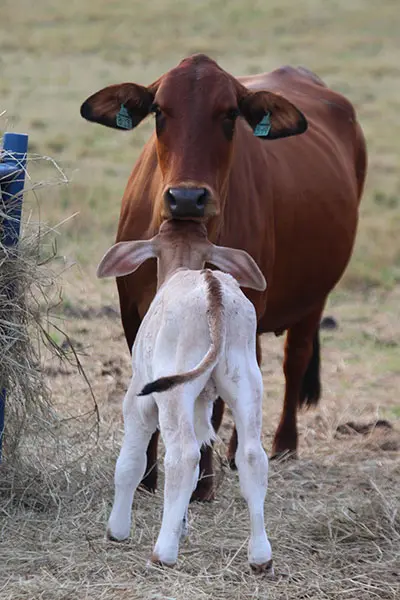
She uses one bull for every 20 cows. SenseHub collars are used as a breeding tool for both AI and natural mating to monitor their cycles before a bull is reintroduced. Every breeding bull is fertility tested before use, as tick-borne disease, heat, or injury can affect semen quality between tests.
Heifers are prepared for mating from June and are generally put to the bull around the beginning of August, depending on their condition. Selection begins with the fertility of their dams, followed by temperament and structural correctness. One cull takes place before mating and another after pregnancy diagnosis.
The more difficult stage begins after a heifer has calved. First-calvers are kept separate from mature cows for another year so that they are not bullied away from the lick, and they receive supplementary feed before the next mating.
“The biggest challenge in the Brahman is not getting her in calf the first time; it’s getting her back in calf after her first calf,” she says.
The stud’s average inter-calving period is 430 days, which Dent wants to reduce to less than 400 days. Calving problems are rare, and she reports high calving and weaning percentages. The greatest risk comes when calves are four to five months old. As they drink less milk, the immunity received from their dams declines, and they become particularly vulnerable to heartwater.
Longevity is a trait in which Double Bar takes pride. Several cows have produced 11 or 12 calves, while the oldest cow in the herd, at 19, recently produced her 15th calf. Dent places great value on cows that repeatedly rear strong calves under the farm’s conditions, particularly because introduced animals can take a year or more to adapt.
Introducing genetics without losing adaptation
Outside genetics are introduced selectively through artificial insemination and embryo transfer. Heinrich Bruwer has been a great mentor to Double Bar, and Dent has used his genetics extensively, including Grandview Brahman Stud sires GBS 16-8 and GBS 17-16 Royal Flush. She says GBS 16-8 has been one of the most influential herd sires at Double Bar to date.
In 2025, Double Bar carried out its own embryo project through In Vitro Africa, using GBS 18-24 as the donor dam and GBS 16-8 as the sire. The programme achieved an 80% conception rate, and Dent intends to continue using embryo transfer in the breeding programme.
To prevent the concentrated use of proven bloodlines from narrowing the herd too far, she uses the Brahman society’s mating predictor to check the inbreeding coefficient of proposed matings. Heifers are grouped according to their relationship to particular bulls, sometimes in as many as ten separate groups in a season.
When a bull is bought from outside a heartwater area, Dent follows a year-long, vet-developed preventative programme before exposing him fully to the farm’s conditions. She stresses that she cannot avoid bringing in genetics that will benefit her herd but that the animal must be managed carefully while it adapts.
The herd-health programme covers heartwater, redwater, gallsickness, and internal and external parasites, while annual vaccinations include those for three-day stiffsickness, lumpy skin disease, contagious abortion, and clostridial diseases.
Supavax is used against anthrax, botulism, and blackquarter, and Rift Valley fever. Vaccination has also become more important on veterinary advice. Weaners are treated for worms, with liver fluke a particular concern because of the farm’s marshy areas, streams, and natural springs. Every animal is counted and checked daily to mitigate the threats of theft and disease.
Visual appraisal backed by figures
Although it is important for Double Bar to keep production records, Dent places great emphasis on visual appraisal, pedigree, and the dam’s fertility when making selection decisions.
In the search for a herd sire, figures still matter. Here, birth weight, testicular size, and the milk EBV receive the most attention alongside the phenotypic appearance and production of the dam and sire. Phase D testing provides an additional way to compare the herd with cattle from other breeders and collect performance statistics. Double Bar has used this tool successfully and will continue to do so in the future.
Ultimately, however, the fullest test is a cow’s lifetime performance. An animal that maintains condition, reconceives, and repeatedly rears a good calf under Double Bar’s conditions earns her place.
Preparing bulls without overfeeding
Double Bar’s sale is held in July, but preparation begins in December. Bulls are first assessed for condition, structural faults, and temperament so that feed is not wasted on animals that will not make the final group.
About 30 candidates then move into a 150ha thornveld camp, with the water source in a stream at the bottom of the camp and a lick at the top. The layout keeps them walking, helps maintain their mobility, and builds muscle.
They remain there until three to four months before the sale, when feeding begins. A further cull follows, after which the Brahman society inspects the remaining bulls. The final group undergoes semen and disease testing. During the last six weeks, the bulls are brought closer to the homestead so that they can be handled and observed daily while photographs and other marketing material are prepared.
“The slower you feed and the slower you build them up, the better it is for their fertility and the more sustainable their condition will be,” says Dent.
Showing is an important part of building the stud’s profile beyond KwaZulu-Natal. Show animals require more preparation for the ring, but Dent conditions them with the same restraint as sale bulls because they must return home and breed afterwards.
“Within a province we tend to all know each other, but the only way to really get our name out there is to travel and show our cattle. Showing has encouraged us to meet so many fellow breeders around the country, making strong friendships along the way,” she said.
Nick and Priscilla’s two children, Jocelyn and Douglas, have also shown a strong passion for the breed, with both children showing their Brahmans at the National Youth Show and local shows. Jocelyn, in particular, has a keen interest, helping Priscilla with show training and record-keeping, as well as assisting the vet on his rounds. Some might say she has inherited her mother’s and great-grandfather’s heart for the breed.
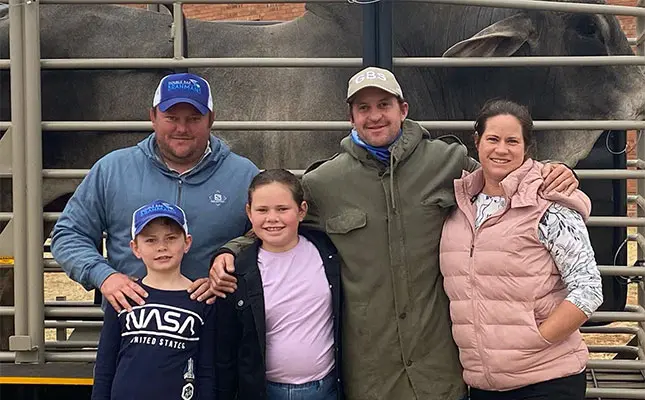
The stud is marketed through AAM Livestock agents and auctioneers, social media, word of mouth, and visits to the farm. Buyers who have never seen the cattle often prefer to visit, while repeat clients increasingly make use of videos and other forms of online appraisal.
Dent explains that buyer preferences have shifted away from very large-framed animals towards medium-framed, early-maturing cattle that are well muscled, have good capacity and mobility, and are efficient feed converters.
The stud’s most recent auction reflected that demand, with the top bull selling for R300 000 and the Double Bar bulls averaging R102 000. DBB is part of the Better Beef Sale, which takes place annually in July.
Dent aims to grow the registered herd from 171 cows to 300 while continuing to produce bulls that buyers can trust. She sees the farm’s mixed veld and severe disease pressure as an advantage in this regard: cattle that perform at Double Bar tend to adapt more readily when moved to easier conditions than cattle from easier areas adapt when brought onto the farm.
“Brahman breeding is in our blood; I can’t imagine us farming without them. Our goal is to build Double Bar Brahmans into a legacy that can be passed down and appreciated by our children and future generations to come. Our motto is ‘cattle you can rely on,’ and that is exactly what we want to produce,” she says.
For more information, contact Priscilla Dent at 082 804 6408.