
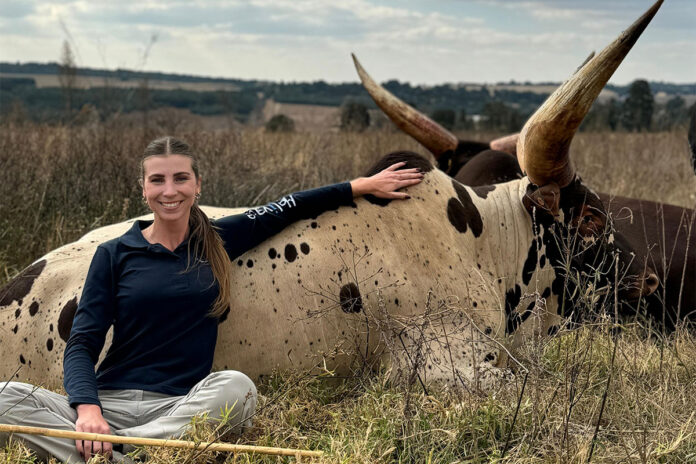
Charlize Meintjes grew up on the family farm, but says she did not initially see herself staying in agriculture. At school, she felt out of step with classmates whose parents worked in corporate jobs or ran businesses, and for a time that influenced her thinking about her future.
She left to study for a bachelor’s degree in fashion and to explore her creative side, but finished unsure of where she wanted to go next. Her father suggested she come back to the business, earn a salary in a basic role, and decide later whether farming was really for her.
She began as a sales representative in the poultry division, a job she did for about three years. What drew her back to the farm was the game operation. As a child, she had always admired the game capturing that happened while she was at school, and being able to take part in one changed the way she saw the business.
“That is not something the average person gets to see every day,” she says.
Those captures were one of the first things that made her look at the farm differently.
Meintjes wanted to create a place for herself within the business rather than simply fit into an existing role. She introduced a website, social media platforms, and new marketing material at a time when the farm had little online presence. She handled branding for the delivery trucks, packaging for poultry products, and much of the digital marketing herself, and says the response showed her how much the business benefitted from being visible, particularly in the stud industry.
From there, she took on staff, moved into management, and gradually assumed more responsibility across the farming enterprises.
Finding her own place in the business
For several years, Meintjes was involved mainly on the marketing side of the business, photographing cattle, creating content, and helping build the farm’s public profile. As she became more involved in the stud operation, she realised she would need to establish her own credibility within a competitive farming environment.
She believes that young farmers face pressure and doubt regardless of gender, but says being a young woman in a traditionally male stud industry can make that pressure more intense. Over the past few years she has focused on learning from other breeders, farmers, and veterinarians and becoming more involved in the day-to-day management of the operation.

“When I was first introduced to the farming industry, I was just the daughter who did the photos,” she says.
She credits her father and grandmother, who started the business in the late 1980s, as important mentors. Their guidance shaped her advice to other young people entering agriculture. Learn from successful farmers, she says, but also learn from people who have struggled, because both have something valuable to teach.
“Everybody can teach you something,” she says.
She also encourages young women not to be discouraged by stereotypes, and says she has built strong friendships with other female farmers as her network has grown.
As her involvement in the business has expanded, so has her responsibility for the day-to-day running of the farming enterprises.
Managing a mixed livestock operation
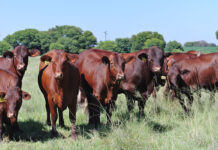
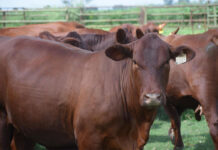
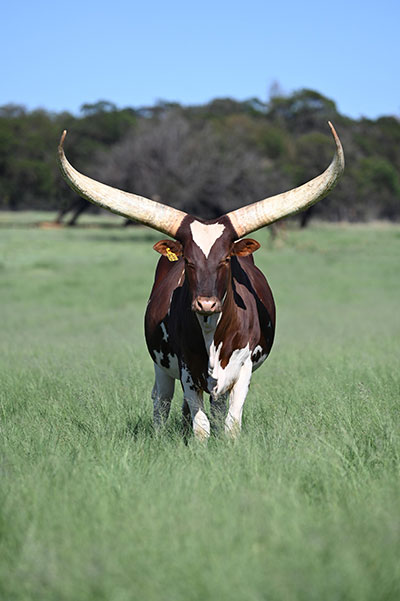
Today, Meintjes manages the Ankole, Boran, and game enterprises across Sterkfontein’s properties in Gauteng and the North West. Including recipient animals, the cattle herd totals about 1 100 head. She has been responsible for the game operation for roughly two-and-a-half years and works with species including sable, Livingstone eland, saddleback impala, and colour variants of blesbok and springbok.
The business is spread across several farms, with the main property and neighbouring cattle land covering just over 1 000ha. A second North West farm is also more than 1 000ha in size, while two additional cattle farms together add roughly another 500ha to 600ha.
Because she cannot be on every farm each day, Meintjes relies heavily on farm managers, online reporting groups, and regular communication with staff. Her first check each morning is the overnight stock report to make sure no animals have been lost and that any health problems are dealt with immediately.
Stud farming, she says, involves far more paperwork and planning than many people realise. She uses drones, regular farm visits, and frequent meetings with staff to keep track of what is happening on each property.
“You can plan as much as you like, but it is not going to go to plan,” she says.
The game enterprise requires less daily handling than the cattle, apart from the annual capture period. The cattle remain the most labour-intensive part of her job, and the Ankole herd takes a disproportionate amount of her time despite being the smallest group of animals. Because the breed is still relatively new in South Africa, she spends time training young animals at the kraal and making sure handling remains calm and consistent.
Asked which enterprise gives her the most satisfaction, she says it is difficult to choose between them, but cattle farming remains the most rewarding because of the close daily contact with the animals.
“You spend so much time with them that you learn their personalities,” she says.
Travelling between farms has also pushed her to look for more practical ways of managing her time.
Learning to fly
Meintjes is close to completing a helicopter pilot’s licence. The interest began when she was about five years old and watched a helicopter land during a mass game capture on the farm. She never intended to become a professional pilot, but the fascination stayed with her through years of travelling to auctions by helicopter and through the example of a young female pilot she admired.
Her father later offered to help her obtain a licence, and she saw it as both a practical tool and a personal challenge. Travelling between farms can consume several hours a day, particularly on poor roads in North West, and she believes a helicopter could eventually reduce travel time and assist with game counts.
Away from the farm, she enjoys training, hiking, and spending time outdoors. She says the pilot training has also given her opportunities to travel and see more of the country. The flying and travel have become part of a wider conversation about the future of the business.
Looking ahead
One achievement she highlights came at the end of 2024 when the farm bred its first saddleback impala ram with horns, measuring more than 18 inches. The ram sold strongly at auction and remains a milestone she is particularly proud of.
She is also preparing to take a more direct role in the family’s production auction programme. The sixth annual Sterkfontein sale, scheduled for April 2027, will be the first auction for which she assembles and markets her own group of animals.
The game enterprise is the area she most wants to expand, although she says the immediate challenge is securing another property, possibly in Limpopo, where a wider range of species could be kept. Government regulation remains one of the biggest obstacles, from permit restrictions on certain species to delays around foot-and-mouth vaccination programmes that have disrupted embryo work and breeding plans.
In the longer term, Meintjes expects to become more involved in the poultry side of the business, which remains the largest part of the family operation. She says she wants to understand more of the fully integrated poultry business so that she can eventually help carry it forward.
For now, however, the game enterprise remains her main focus.
“I want to breed more species,” she says, “and I think it’s going to keep growing.”