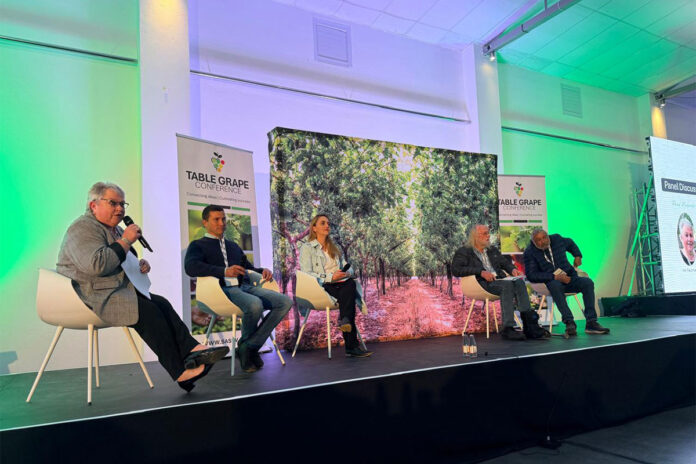
Several speakers at the event, jointly hosted by the South African Table Grape Industry (SATI) and the South African Society for Enology & Viticulture (SASEV), highlighted the risks posed by a Super El Niño and growing water deficits, as the Western Cape had just experienced one of its driest Julys on record.
Danie Kritzinger, a scientist and horticulturist at consultancy Agrimotion, said during a panel discussion on water security that extreme heat in November and December 2025 had revealed shortcomings in some table grape farms’ irrigation systems, which were inadequately designed to keep up with the vines’ water requirements.
He said another risk of water deficits, which became apparent during the 2016/17 drought in the Western Cape, was declining water quality. The secondary effect was increased soil salinity caused by the use of high-salinity irrigation water.
Kritzinger added that the drought had provided valuable lessons and that the table grape industry needed to reflect on them.
“Expect a drought every year. That’s the best way to manage your water. Start with proper soil preparation, which is the foundation of this industry. Make sure your roots are at least 80cm deep and that there are enough fine roots that can absorb water and nutrients,” he said.
Dr André Roux, a former water engineer with the Western Cape Department of Agriculture, advised growers to check their irrigation systems for leaks and address any pressure differentials in individual blocks to reduce water losses. In one case, he helped a grower reduce their water use by around 25%.
“This wasn’t a major capital cost, but more a case of paying attention to what was on the ground and rectifying the problem,” he added.
Independent soil science consultant Dr Philip Myburgh said the variation in soils across table grape areas, combined with differences between cultivars, meant growers cannot rely on a fixed recipe. Instead, they need to monitor conditions and take measurements to ensure irrigation and other production parameters are suited to specific areas of their farms.
Why agriculture still needs human intelligence
Dr Ilse Trautmann, former deputy director-general of agricultural research and regulatory services at the Western Cape Department of Agriculture and newly appointed chairperson of the SATI Research Committee, cautioned against overreliance on technology at the expense of human experience and wisdom. She drew a distinction between ‘artificial intelligence’ (AI) and ‘agricultural intelligence’.
“Agricultural intelligence is human intelligence reinforced by data science and experience. It combines science, ethics, environmental stewardship, and experience; it is contextual rather than purely computational.
“The future is not artificial intelligence replacing agricultural intelligence; it is the two augmenting one another. They need each other,” she said.
Trautmann warned that AI without agricultural intelligence “can optimise the wrong objective, maximising short-term yields while degrading soil health”, while agricultural intelligence without modern digital tools “may miss opportunities to improve production, conserve water, minimise waste, and respond to climate variability”.
Simple solutions to combat heat damage
In his presentation, Óscar Salgado, head of global technical support at AgroFresh, shared several simple yet effective solutions to protect table grapes from quality losses caused by heat during the post-harvest phase. These included improving working conditions for vineyard workers to reduce rough handling and prevent damage or bruising.
He said one of the biggest threats to post-harvest quality was vapour pressure deficit, which causes berry moisture loss and can lead to quality issues such as micro-cracking. He added that the logistics industry’s reliance on large trucks meant grapes often heated up while waiting for a truck to fill up.
Among the solutions he shared to maintain constant temperatures during transport from the vineyard to the packhouse were plastic covers over picking crates to help retain moisture in the air and prevent the berries from drying out.
Other measures included using reflective covers around crates to direct heat away from the grapes, transporting crates in trucks with white exteriors to reduce heat accumulation, and covering the trucks with wet hessian so that evaporating water cools the product during transport.
New research direction
SATI CEO Mecia Petersen gave a presentation on the association’s realignment of its research approach to address the evolving challenges facing the industry.
She said many of SATI’s current research projects were nearing completion, creating an opportunity to seek new research proposals that address growers’ needs across the entire value chain. The association was also considering how to build capacity and develop the skills the industry would need going forward.
Petersen added that SATI was forging new partnerships to undertake applied research, noting that while academic research typically takes three to five years to deliver results, growers often cannot afford to wait that long for new technologies.