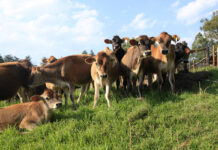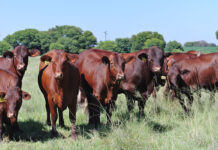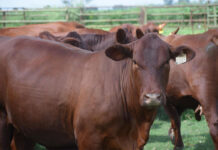

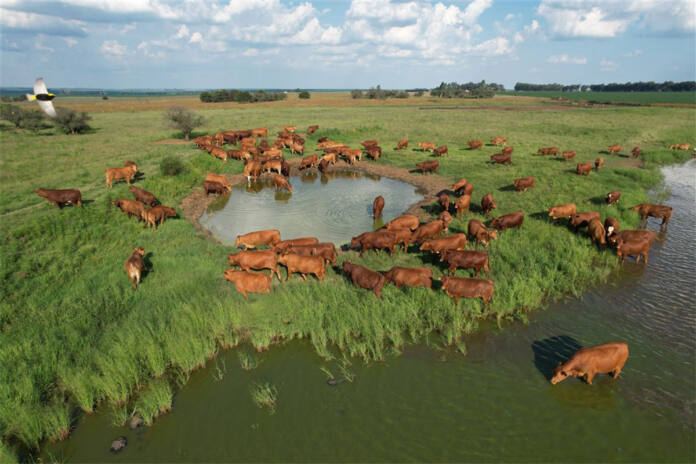
Theo Coetzee farms on Rhenosterfontein, between Koster and Ventersdorp in the North West, across roughly 4 700ha. It is a mixed operation, combining dryland grain, the Mushlendow feedlot and the Majesto Beefmaster stud.
Grain accounts for about 60% of the farm’s income, and the cattle for about 40%, excluding the feedlot. The two sides are linked in practice, with crop residues from the grain lands providing grazing for the cattle through winter. The Majesto stud herd runs at around 1 100 cows and 800 heifers at various stages.
Coetzee started farming on Rhenosterfontein in 1997, running a commercial cattle herd alongside the cropping enterprise. In 2014, he joined the Beefmaster Cattle Breeders’ Society of South Africa and registered with SA Stud Book, building the Majesto stud out of the commercial herd he already ran.
The Beefmaster is an American composite breed, developed by Tom Lasater from Brahman, Hereford, and Shorthorn cattle selected on performance rather than appearance. It reached South Africa in the 1970s and has grown into one of the country’s larger beef breeds.
Coetzee had no hesitation about which breed to build the stud around.

“The Beefmaster impressed me with its fertility, strong maternal traits, good milk production, adaptability and excellent growth. It also performs well commercially and produces profitable calves,” says Coetzee.
The operation finishes its own cattle through the Mushlendow feedlot. Rather than marketing animals directly off the veld, cull cows and calves are fed through the system, linking herd performance to feedlot growth and carcass value.
The stud developed gradually from the commercial herd. Through strict selection, the use of proven genetics, and the removal of animals that failed to meet breeding objectives, the herd became more productive and more uniform over time, according to Coetzee.
Performing under North West conditions
Of the roughly 4 700ha at Rhenosterfontein, about 1 500ha is dryland crop fields. The rest is a mix of natural veld and planted pasture. The planted pasture carries 1,8ha to 2,6ha/large stock unit (LSU), while the natural veld runs at 6ha to 8ha/LSU.
The veld is a mix of sour and sweet grazing, and the planted pastures are made up of Rhodes grass and Smuts finger grass. In winter, the cattle also have crop residues from the grain lands to fall back on.
These are the conditions under which the breeding herd is selected. Breeding females run on the veld and are expected to maintain condition, rebreed consistently and raise a calf with limited supplementation. Those requirements have shaped the type of cattle Coetzee selects for and are among the reasons he chose the Beefmaster.
Breeding strategy
Majesto uses artificial insemination and embryo transfer alongside natural mating. The two reproductive technologies give Coetzee quicker access to top genetics and allow the traits of his best animals to be spread more widely through the herd, accelerating genetic gain.
He works on two fronts at once, bringing in new blood to widen the gene pool and add traits while linebreeding lines that have already proven themselves. The new genetics help keep inbreeding in check, while linebreeding helps fix desirable traits within the herd.
The bloodlines that have shaped Majesto most over the past decade are those that improved fertility, growth, conformation and adaptability, with a handful of standout bulls and cow families bringing greater uniformity to the herd. When he selects donor cows for the embryo programme, Coetzee works from years of records rather than a single good season.
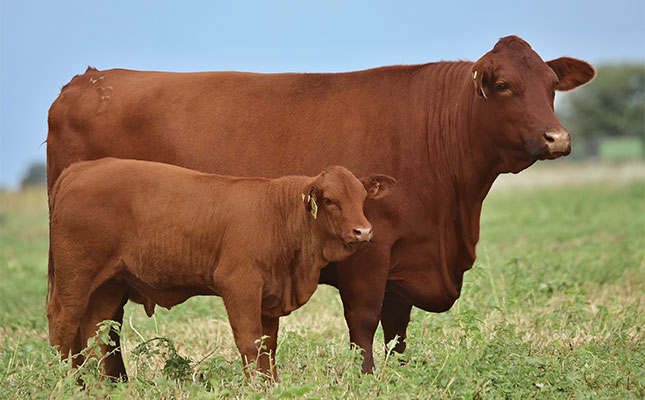
“I choose cows that excel in fertility, weaning weight, conformation, temperament and performance data over several years, that is, above-average calves even if they are by different bulls,” says Coetzee.
The emphasis on long-term performance is reflected throughout the herd’s production system and breeding management.
Production cycle and figures
Intercalving period and weaning percentage receive the most attention in the herd because they have a direct influence on productivity. The 205-day weaning weight also provides a reliable indication of a calf’s growth and a cow’s maternal ability.
The herd calves in two seasons. The summer herd is mated from December to the end of February and calves from September to November, while the winter herd is mated from June to August and calves from April to June.
Heifers go to the bull from 15 months and calve for the first time at 24 to 28 months, with closer supervision during that first calving. After weaning, every young bull goes through a 100-day Phase D growth test on the farm, with average daily gains of between 1,85kg and 1,97kg. Calves are weaned at 210 days at an average weight of 272kg.
The intercalving period has come down over the past few years, although the current season has presented a significant setback.
“The intercalving period is now 388 days. We aim to get it as close to 365 days as possible through strict selection and good management. This year, however, we had a major setback with the foot-and-mouth outbreak in the middle of our breeding season,” says Coetzee.
The herd weaned at 84,3% in the past season, and the disruption is expected to carry into the next.
“Our calving percentage is currently 88,3%. The 2027 season will be an exceptional challenge, because we can already see that conceptions are not going to be where we want them,” says Coetzee.
The season was further complicated by the foot-and-mouth disease outbreak during the breeding period. For an operation that relies on tightly controlled breeding seasons, the disruption is expected to affect conception rates and calving performance into the following season.
The Beefmaster’s hardiness keeps the health programme relatively light. Cows are treated once a year for internal parasites in autumn, around the end of April into May, with dung samples analysed beforehand to determine whether treatment is necessary. In a dry season, treatment may not be required at all.
Selecting for function over fashion
Coetzee’s selection philosophy starts with the cow.
“An exceptional cow is highly fertile, weans a heavy calf every year, has good maternal traits, produces enough milk, and stays productive in the herd for a long time,” says Coetzee.
Longevity matters because cows that remain productive for longer produce more calves over their lifetime and reduce replacement costs.
Conformation also carries considerable weight because it influences both performance and durability. Poor feet, legs or udders, or any structural fault that affects productivity, will count against an animal regardless of pedigree.
The culling behind this approach is strict. Cows that fail to conceive are removed, and calves with low weaning indices go to the feedlot, with their dams culled behind them. Because cows and calves run in a single group from the start of the season through to weaning, every animal is assessed under the same feeding conditions.
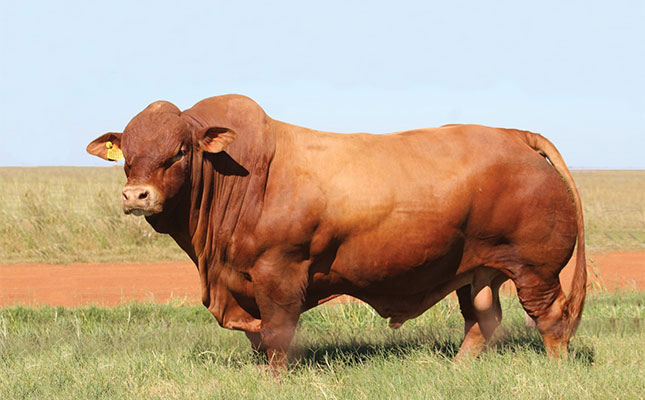
His bulls are held to the same standard.
“A bull must be fertile, have good conformation, show strong growth, sire above-average calves and pass the desired breed traits on to his progeny,” adds Coetzee.
Those selection principles ultimately influence the type of animals Majesto offers to the market and the genetics it chooses to invest in.
The auction market
Coetzee has watched the commercial buyer become more demanding over the past decade. “Buyers are increasingly focused on animals that deliver commercially through fertility, growth and efficiency,” he says.
What they ask for most, he adds, is fertility, weaning weight, good temperament, adaptability, feed conversion and low maintenance.
Coetzee also became a notable buyer at the top end of the Beefmaster market. In 2024, he and Paul van Vuuren of V8 Beefmasters jointly bought the pregnant cow BOS 18-8751, a so-called three-in-one lot of a cow with a calf at foot and back in calf, for R600 000, a national record for a Beefmaster female at the time.
It was purchased from Bos Blanco Beefmasters at the national sale in Parys. For Coetzee, the purchase provided access to proven female lines and genetics that can strengthen the herd over the long term.
Further strengthening the herd, Majesto Beefmasters purchased a half share in the bull Top Gun in partnership with V8 Beefmasters. Combined with an intensive embryo programme implemented over the past two years, this investment has accelerated the introduction of proven genetics and increased the value and quality of both herds.
What defines the stud
The current focus at Majesto is on reproduction, weaning performance, feed efficiency and maternal ability.
Coetzee believes one of the breed’s biggest challenges will be maintaining genetic diversity while continuing to improve production traits. He sees significant opportunities for Beefmasters in commercial beef systems where cattle are expected to perform under a wide range of environmental conditions.
His advice to young commercial producers considering the stud industry reflects the approach he followed himself: start with good genetics, set clear objectives, keep accurate records, be patient, and select on performance rather than appearance alone.
“It is about strict selection for functional and profitable animals, combined with consistent management and clear breeding objectives,” he concludes.
For more information, email Theo Coetzee at [email protected].