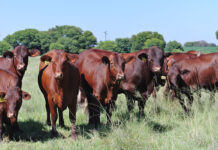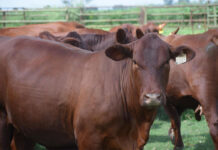

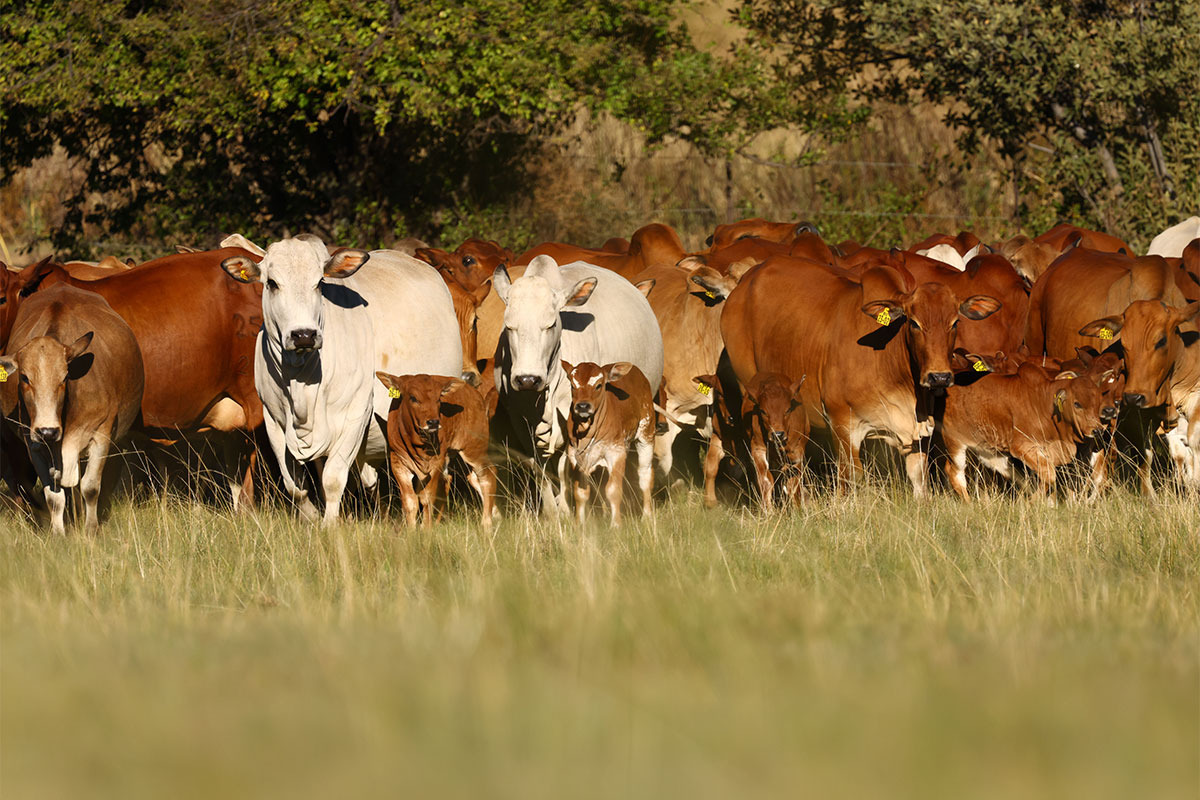
Boshoff believes that an F1 Boran cow is the perfect animal for a commercial producer to farm with.
“The hardiness that a Boran brings to any herd is something money can’t buy. The Boran’s hybrid vigour and prepotency makes it the obvious choice for crossbreeding with virtually all the beef cattle breeds in the country. For our commercial cattle herd, we use Boran bulls on Sussex cows. The Boran/Sussex F1 cows are then bred back to a Sussex bull and back to a Boran bull. This results in a highly fertile, well-adapted and robust, easy-calving cow with ample milk that can drop and raise a calf at 50% of her body weight annually. The crossbred weaners excel in the feedlot,” he explains.

The Boshoff farming business consists of crop production, the Boran stud and a Sussex bull breeding concern. Boshoff was introduced to the Boran breed in 2010 and bought his first five cows and a bull in 2011. From there, he started building the herd and bought the best genetics and animals possible. Eventually, he ended up with about 850 animals on the books.
Herd instinct and hardiness
“The herd instinct of the Boran is of utmost importance for us as we farm along the Lesotho border. The strong herd character makes it very difficult for stock thieves. They stick together under all conditions and it is extremely difficult to scatter a herd,” he explains.
The breed’s hardiness, non-selective feeding habits and adaptation makes it excellently suited to all production conditions in South Africa. The Bosiu herd manages very well on the sourveld and extreme cold of the eastern Free State winters, where temperatures of as low as -8°C are not uncommon. The cattle are kept on the veld in summer and on maize stover in winter. Young animals are kept on planted pastures.
Coat colour adaptability and tick resistance
Because of the Boran’s outstanding adaptability, they are remarkably resistant to ticks and are dipped minimally. They require less than average supplementation. A phosphate lick is supplied in summer with Voermol Premix 450 or a lick in winter.
“The breed’s adaptability is underscored by the fact that the animals have the ability to adapt their coat colours according to the weather. For example, our light skinned animals tend to darken somewhat in winter to increase the uptake of thermal energy. The same goes for animals in very hot areas further north where darker skins become lighter coloured in order to manage extreme heat effectively,” says Boshoff.
The Bosiu females are medium framed, fertile with good capacity, and functionally effective with very good udders. The bulls have broad, masculine heads, strong necks and broad chests. The bulls are well muscled, broad over the back and have with good length and depth with strong legs.
Two breeding seasons
Boshoff maintains two breeding seasons. In winter the bulls are kept with the cows in June and July, while the summer breeding season stretches from November to January. Heifers are put to the bulls at between 20 and 24 months old.
“We usually do artificial insemination (AI) in our winter breeding season to improve the genetic base of the herd. This allows us to use bulls whose semen is not readily available. About 25% of the herd is AIed. We like a birthweight of around 27kg to 32kg, weaner weight of 50% of the mother’s weight and an intercalving period of less than 400 days,” Boshoff explains.
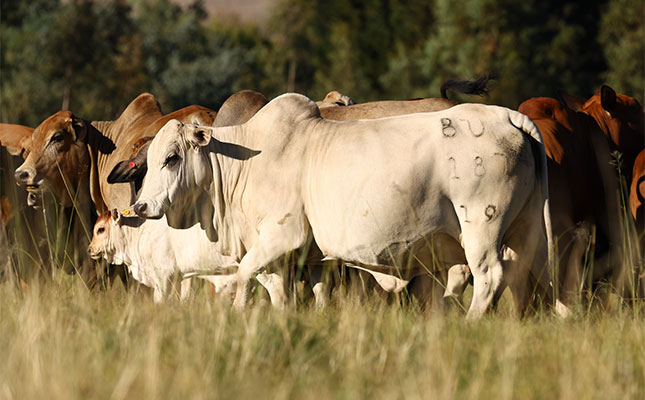
Bosiu Borans are marketed via the stud’s annual production auction, with about 40 cows and 20 bulls up for sale. The stud also participates in various other auctions such as the Sale of the Bonts, the White Gold and the Boran National Heifer and National Sale. Bulls are also sold out of hand.
Top economic breed
According to Boshoff, the Boran has a bright future in South Africa. It is an economic breed that ensures top production per hectare with relatively low input costs.
“Climate change is a given, and the Boran is the top choice to mitigate the effects thereof. The breed has genetically developed over millennia under the most taxing of conditions.
“Over and above its genetic value, the Boran’s super nice temperament makes it a pleasure to farm with,” says Boshoff. “We treat our cattle as part of the family.”
For more information email Johna Boshoff at [email protected].