
In an era where data-driven decision-making is increasingly promoted across agriculture, the Bonsmara breed stands as a reminder that South African beef producers have been practising disciplined measurement for decades.
Long before digital dashboards and genetic indices became commonplace, Bonsmara breeders were already required to measure, record, and submit performance data as a condition of belonging to the breed.
This culture of compulsory performance testing has not only shaped the Bonsmara’s genetic direction, but has also underpinned its reputation as one of the most reliable and commercially relevant beef breeds in the country.
Philosophy rooted in function, not fashion
The foundation of mandatory performance testing in Bonsmara lies in the work of Prof Jan Bonsma, whose research challenged the dominance of visual appraisal in cattle breeding.
Bonsma argued that animals should be selected for their ability to function efficiently within a specific environment, rather than for cosmetic traits or exaggerated conformation.
This thinking was revolutionary at the time. It shifted breeding objectives away from appearance and towards fertility, adaptability, growth efficiency, and longevity – traits that directly influence profitability at farm level.
According to animal scientist Japie van der Westhuizen, this philosophy was deliberately embedded into the Bonsmara breed structure.
“From the start, Bonsmara breeders accepted that if you want reliable genetic progress, measurement has to be compulsory,” explains Van der Westhuizen.
“Optional recording does not create accountability. Compulsory recording does.”
As a result, the Bonsmara developed not just as a breed, but a system: one in which individual herds contribute data to a collective genetic resource.
Why compulsory testing matters at breed level
South Africa has more than 400 registered Bonsmara breeders operating across a wide range of production environments. Without a standardised testing framework, meaningful comparison between herds would be impossible. Mandatory performance testing creates a common language. Every breeder measures the same traits, at the same stages of an animal’s life, under standardised protocols. This allows animals from different regions and management systems to be evaluated fairly.
“That consistency is the Bonsmara’s real strength,” says Van der Westhuizen. “It allows the breed to make collective genetic progress rather than isolated, unverified improvement.”
This framework is supported by SA Stud Book, with all performance and pedigree data captured, verified and analysed through the Logix system. The result is a transparent, independently managed database that underpins genetic evaluations and buyer confidence.
Managing risk before it starts
The first compulsory measurement in a Bonsmara animal’s life is birthweight. While often overlooked outside stud breeding circles, this measurement carries significant economic implications.
High birthweights are associated with calving difficulties, increased labour input, higher veterinary costs, and greater risk of cow and calf losses. Recording birthweight allows breeders to balance selection for growth with the practical realities of calving ease.

Advocate Hanri Ehlers, herd manager at Ehlerskroon Bonsmaras, says compulsory birthweight recording forces discipline.
“You can’t chase growth blindly,” she explains. “If you do, the data will expose the consequences very quickly. Birthweight keeps selection grounded in functional efficiency.”
The economic checkpoint
Weaning weight is arguably the most influential single measurement in beef production. It represents the point at which income is often realised in commercial systems and reflects both calf performance and maternal efficiency.
In the Bonsmara system, weaning weights are compulsory for animals to qualify as breeding stock. This ensures that only cattle with proven performance under real conditions enter the stud population.
Increasingly, breeders are also recording cow weight at weaning. This additional measurement allows for the identification of cows that produce heavier calves without excessive maintenance requirements.
“Efficiency is about output relative to input,” says Ehlers. “A cow that weans a good calf every year without needing extra feed is gold in a commercial system.”
Fertility is a non-negotiable trait for bonsmara breeders
Across all beef systems, fertility remains the single most important driver of profitability. A cow that fails to conceive or calves irregularly cannot be compensated for by growth or carcass traits.
For this reason, Bonsmara breeders are required to record mating dates, calving dates, calving intervals and age at first calving. These records feed directly into genetic evaluations for female fertility.
“Fertility data tells the truth,” says Van der Westhuizen. “It removes emotion and opinion from selection decisions.”
Ehlers agrees. “If a cow doesn’t calve regularly and unassisted, she leaves the herd. The data makes that decision objective, not personal.”
Post-weaning growth and adaptation
Post-weaning weights, typically recorded at 12 or 18 months, provide insight into an animal’s inherent growth ability once maternal influence has been removed.
These measurements help distinguish animals that are genetically efficient from those that benefitted mainly from superior maternal support.
They also provide valuable information on adaptability. Animals that maintain growth under variable environmental conditions are better suited to South African production realities.
Longevity and reasons for culling
One of the most powerful – and often underestimated – aspects of Bonsmara performance testing is the recording of culling dates and reasons for culling.
Few traits influence long-term profitability as strongly as productive herd life. By documenting why animals leave the herd, breeders gain insight into structural weaknesses, fertility failures, and adaptability issues.
“Longevity doesn’t happen by accident,” says Ehlers. “You only breed it if you measure it.”
These records feed into genetic evaluations for functional efficiency and form the basis of composite indices such as Cow Value, which reflect expected profitability at herd level.
Making sense of data: BLUP and EBVs
Raw data alone has limited value unless it is interpreted correctly. The Bonsmara breed uses best linear unbiased prediction (BLUP) analysis to adjust performance data for non-genetic factors such as climate, nutrition and management.
The output of this analysis is the estimated breeding value (EBV), which predicts the genetic merit an animal is expected to pass on to its offspring.
“EBVs are about future performance, not past appearance,” explains Van der Westhuizen. “They allow breeders to select animals that will improve the next generation.”
For Ehlerskroon, EBVs have become a cornerstone of selection decisions, particularly when buying or selling animals beyond their immediate environment.
Modern tools building on a solid foundation
Technologies such as ultrasound scanning and genomic testing are increasingly being integrated into the Bonsmara system. Ultrasound allows for the objective measurement of carcass traits without slaughtering animals, while genomics improves the accuracy of breeding values in young stock.
Crucially, these technologies enhance (rather than replace) the existing performance framework.
“Genomics only works because we already have decades of performance data,” notes Van der Westhuizen. “Without that foundation, it would be meaningless.”
Ehlerskroon Bonsmaras: performance testing in practice
With a breeding history spanning more than 54 years, Ehlerskroon Bonsmaras offers a practical example of how mandatory performance testing shapes a herd over time.
Under Ehlers’s management, the stud has maintained a strong focus on functionality, fertility, and adaptability under South African conditions.
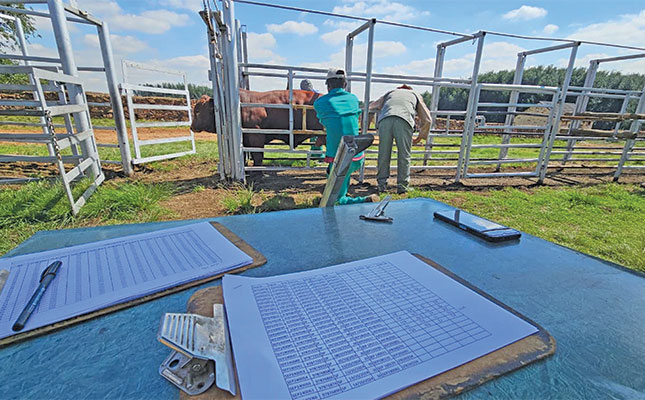
“Performance testing keeps you honest,” she says. “It tells you whether your breeding decisions are actually working and shows you where you are succeeding and where you need to improve.”
That disciplined approach has delivered measurable results. Ehlerskroon Bonsmaras received a double gold award at the Logix Beef Cattle regional awards, and was named a regional winner in the Logix Beef Cattle Herd of the Year competition; a well-earned recognition based entirely on verified performance data and genetic progress.
System built on accountability
According to Van der Westhuizen, the strength of the Bonsmara lies not only in its popularity, but in the integrity of its systems.
“Mandatory performance testing protects the breed’s credibility,” he says. “It ensures that genetic claims are backed by evidence, not opinion. It protects the credibility of the breed and gives commercial producers confidence that the genetics they buy will perform.”
For Ehlers, however, that accountability is non-negotiable. “Measuring what matters is the only way to build a herd (and for that matter a breed) that is productive, resilient, and sustainable,” she says.
By enforcing disciplined measurement and data-driven selection, Bonsmara breeders have created a system where function outweighs form, and where performance, not promise, defines genetic value.
Ehlerskroon Bonsmaras is situated in Mpumalanga. The entrance to the stud is located on the R555, north-east of Delmas.
For more information email [email protected], or visit ehlerskroon.co.za.