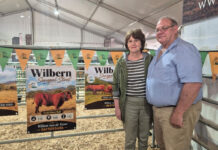
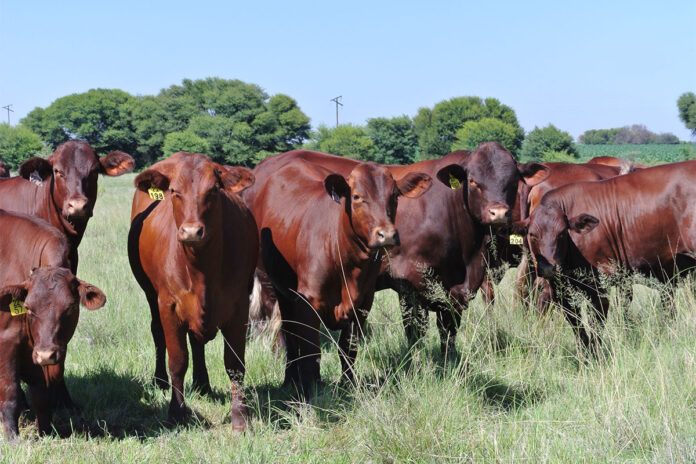
Abri Lock grew up travelling to Santa Gertrudis shows and auctions across South Africa and Namibia, watching his father, Koos, exhibit and judge cattle. Some of his strongest memories are quieter ones: driving through the veld with his father and learning to manage the cattle in their natural environment.
That upbringing placed him within a family breeding programme that began when his grandparents, Apie and Annie Lock, started farming Santa Gertrudis cattle in 1973. Yet when he launched Red Rock Santas in 2016, he chose not to inherit an established stud identity.

“I wanted the challenge of starting from scratch and building a stud under my own name. I wanted to make my own breeding decisions, develop my own cow families and, over time, see whether I could establish a herd that could compete and earn its place within the breed on its own merits,” says Lock.
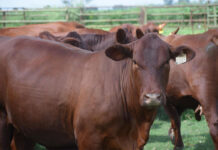
Red Rock now forms part of a combined family operation with Koos Lock’s Locklore Santa Gertrudis and JADUP Santas, owned by Lock’s cousin, Jozeph du Plessis. The three studs are run together on Locklore farm near Schweizer-Reneke in North West, where the family manages about 600 breeding cows extensively.
“It is an immense privilege to still be farming with Santa Gertrudis cattle alongside my father and my cousin. The fact that our family has been farming Santa Gertrudis cattle for the past 53 years is a testimony to the quality, adaptability, and value of the breed,” says Lock.
A stud in its own right
Koos Lock and Du Plessis have farmed in partnership across all branches of the business since 1997. Although the three studs retain separate registrations, histories, and cow families, they follow the same day-to-day management principles. The females share the same veld conditions, and bulls bred in any of the herds can be used across the operation.
This arrangement gives the breeders access to a larger genetic pool without erasing the identity of the individual studs. Lock says they take pride in what each stud produces, but rivalry does not influence breeding decisions.
“If Locklore or JADUP breeds an exceptional bull that can improve Red Rock, I want to use him, and the same applies the other way around. “Ultimately, the goal is to improve all three herds and, in doing so, contribute positively to the Santa Gertrudis breed as a whole,” he says.
Red Rock’s distinction lies in Lock’s selection decisions and the cow families he is developing. The three studs nevertheless share the aim of producing functional cattle for commercial conditions.
“I place a lot of emphasis on balance. I don’t believe in selecting for one trait at the expense of everything else. Fertility, structural soundness, temperament, growth, adaptability, and the ability to perform from the veld all have to come together in one functional animal,” he says.
Selection starts with fertility
One of the first lessons Lock learnt from his father was that cattle breeding offers no shortcuts. Progress requires patience, consistency, and decisions based on the herd’s long-term needs rather than short-lived trends.
“He taught me to breed cattle that work for you, not cattle that you have to work for. An animal can look impressive, but at the end of the day it still needs to be fertile, functional, adaptable, and able to perform under our conditions. Good cows, in particular, form the foundation of any successful breeding programme, ” says Lock.
Fertility therefore carries the most weight in selection. Growth, conformation and genetic merit cannot compensate for an animal that fails to reproduce efficiently.
Replacement heifers must show femininity, sound feet and legs, adequate capacity and depth, and the ability to maintain condition on the veld. Lock prefers easy-fleshing, medium-framed females with calm temperament and the potential to remain productive for many years.
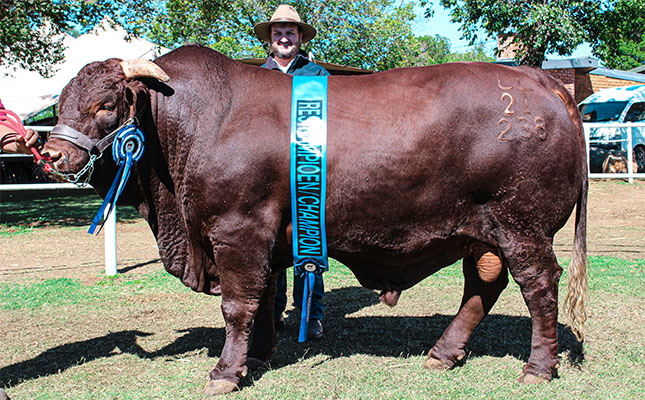
Two structural traits are non-negotiable: sufficient length from the hip to the pin bones, and adequate pelvic capacity. He avoids females that are short through the pelvis or have a narrow pelvic opening because these traits increase the risk of calving difficulty.
Breeding bulls face the same functional test. Lock assesses their feet, legs, mobility, masculinity, muscling, capacity, balance, testicular development, and sheath structure. A bull must offer growth without becoming excessively large.
“A bull’s job is to walk, cover cows, and produce calves that will add value to the next generation, so structural soundness is non-negotiable. When somebody buys a bull from us, our name goes with that animal. I want to be confident that he is capable of going out and doing the job he was bred to do,” says Lock.
Moderation for the veld
Lock says today’s Santa Gertrudis should not be judged by the large-framed type many producers remember from previous decades. The breed society and individual breeders have moved towards a more moderate animal while retaining the breed’s growth, muscling, and adaptability.
Red Rock aims for medium to moderately large-framed cattle. The objective is not to make the Santa a small breed but to find a mature size suited to extensive production. A moderate cow generally costs less to maintain than an excessively large one, particularly when grazing is under pressure.
“We still want masculine bulls with good growth, length and muscling, but they must remain athletic and functional rather than simply being selected for size. It is about finding the optimum size for our environment: an animal with enough performance to produce kilograms of beef while remaining fertile, efficient, and adaptable under South African veld conditions,” Lock says.
Natural sweetveld forms the grazing base. Variable rainfall can produce good summer conditions followed by prolonged dry periods in which both forage quantity and quality decline. Cows must walk and graze for themselves, maintain condition, conceive consistently, calve with little assistance, and raise a good calf each year.
The same commercial test applies to show cattle. Red Rock will not retain or breed from an animal solely because it’s presentable in the ring.
“A champion bull still has to go out and produce good calves, and a champion female still has to conceive, calve, and raise a good calf every year. If they cannot do that, the show-ring title means very little from a breeding point of view,” says Lock.
Proof in the cow herd
Individual females provide the clearest measure of this breeding objective. Lock bought the pregnant heifer JC 15 32 from the late Johann de Wet in 2017. She has since become one of Red Rock’s foundation cows, producing nine calves at an average intercalving period of 361 days.
Five of her calves have been sold at the family’s annual production auctions. Their weaning weights have ranged from 234kg to 318kg.
“That combination of fertility, consistency, and calf performance is exactly what I want from a productive stud cow,” Lock says.
LL 17 133 provides another example, having produced eight calves at an average intercalving period of 356 days. Lock values cows that prove themselves repeatedly rather than producing a single exceptional calf.
Among the sires, LL 17 231 has influenced all three studs. The bull performed well in the show ring and backed this up on the veld and through his progeny. At nine years of age, he remains in use across the herds.
Santarific Camo, a bought-in bull, has also made a remarkable contribution. Lock describes him as medium-framed and structurally correct, with the ability to breed exceptional females and bulls. Several of his sons and daughters are due to be offered at the family’s production sale on 15 October 2026.
Three studs, one genetic pool
Mating decisions start with the strengths and weaknesses of each female, not the prefix under which she is registered. The breeders choose the bull most likely to complement her from the sires and bloodlines available across all three studs.
Pedigrees are checked to avoid matings between animals that are too closely related. New genetics are introduced through carefully selected outside bulls when a bloodline can address a particular need.
Estimated breeding values, performance records, pedigrees, and visual appraisal provide complementary evidence; none is decisive in isolation.
“The numbers must support what we see in the animal, and the animal must support what we see in the numbers. I would not select an animal purely because it looks good, just as I would not select one purely because it has impressive figures on paper. The complete picture is what matters,” says Lock.
Continuous breeding needs disciplined records
Bulls remain with genetically similar cow groups throughout the year and are rotated every three months. The system suits the operation’s scale and extensive conditions, allows sires to serve females across the three studs, and helps the breeders manage bloodlines as bulls move between groups.
Continuous mating allows cows to conceive when their body condition and the environment are favourable, rather than forcing the entire herd into a short breeding season. In 2023, the combined herd recorded an average intercalving period of 411 days and a weaning percentage of about 85%.
The approach depends on disciplined identification and record-keeping. Each calf’s dam, birth date, and other relevant information are recorded at birth. Bull movements indicate the possible sire, while DNA parentage testing is used when confirmation is needed. All three studs also participate in BGP2 genomic testing.
“In a continuous breeding system, accurate records are non-negotiable,” says Lock.
Calving histories and intercalving periods help the breeders identify cows that are not reproducing efficiently. Females are considered for culling if they repeatedly fail to conceive, have an unacceptable intercalving period, fail to raise a calf, develop structural problems or consistently produce calves below the herd standard.
Selection must be supported by management. Veld management, strategic supplementation, herd health, and vaccination help cows retain enough condition to reconceive and raise calves. Supplementation is used when necessary during drought or poor grazing periods, while keeping the system commercially realistic.
The Santa cow in commercial herds
Lock considers adaptability as the Santa cow’s most valuable quality under South African conditions because it supports fertility and sustained calf production despite changes in grazing and weather.
“A cow needs to handle changing veld conditions while still raising a good calf. An animal that can adapt to her environment has a much better chance of remaining a productive mother year after year,” he says.
He regards the Santa Gertrudis as a useful maternal line because it combines fertility, milk production, mothering ability, hardiness, and the capacity to maintain condition under extensive conditions. Crossbreeding can carry these qualities into hardy replacement females.
Many commercial clients in the area run Bonsmara cows, a cross that Lock says has produced particularly good results. One Bonsmara breeder bought three Santa Gertrudis bulls after seeing the calves and later added pure Santa Gertrudis heifers to his herd.
“The progeny combine good growth, adaptability, and hardiness, while producing functional females that can be retained as replacements,” says Lock.
Commercial buyers also send photographs of progeny produced by Red Rock bulls, allowing the breeders to see how their genetics perform in other herds and environments. Repeat bull purchases remain an important test of whether the cattle create value beyond the stud.
Lock says Santa calves are generally strong and active at birth, while the cows’ milk production and mothering ability support growth to weaning.
“At the end of the day, producers are paid for kilograms of beef, and Santa cattle are able to produce those kilograms efficiently,” he says.
Technology supports stockmanship
Performance records, estimated breeding values, DNA, and parentage information allow breeders to assess cattle beyond visible type, and identify strengths and weaknesses earlier. Lock says these tools sharpen mating decisions but do not replace visual appraisal or knowledge of cow families.
Climate variability reinforces the programme’s emphasis on cattle that maintain condition and reproduce without excessive inputs. Lock says the related challenge is to change outdated perceptions of the breed.
“Today we are breeding more moderate, functional, and efficient cattle without losing the growth and adaptability the Santa is known for. People who haven’t worked with modern Santa cattle are often surprised by how versatile and commercially practical the breed has become,” he says.
Continued growth will depend on heeding commercial producers’ advice and supplying cattle that improve fertility, adaptability, and the cost-efficient production of beef. Lock believes results in commercial herds will build demand more effectively than promotion alone.
His goal is to develop Red Rock into a respected name with recognisable cow families and genetics, adding a distinct contribution to the work begun by his grandparents and continued by his father.
“If, one day, the next generation can look back at what I contributed with the same pride that I have when I look at what my grandparents and father achieved, I will consider that a success,” he says.
For more information, email Abri Lock at [email protected] or call 082 570 6325.