
From a young age, Andre Kauerauf was interested in sustainability, living off-grid, and being self-sufficient. When he and his wife Kait moved to the family farm on the outskirts of Nottingham Road, KwaZulu-Natal, in 2015, they had the opportunity to do just that.
The property already had a bed and breakfast from which they could generate an income, but to make full use of the 200ha and earn a living from it, the land needed to be farmed.
“I also wanted to produce clean, nutrient-dense food for our family, which is hard to find in a conventional food system. I started reading a lot about regenerative farming, which focuses on creating a healthy ecosystem by optimising soil and grass health. For us, it’s about creating healthy food for people, too,” Kauerauf relates.
He explains that clean food is grown using little to no pesticides and no routine antibiotics or growth promoters.

While still juggling full-time jobs in town at the time, Kauerauf as a wireless Internet provider and his wife as a teacher, the couple bought a few chickens and planted vegetables. By 2017, vegetable production had increased enough to start supplying a nearby wedding venue.
However, Kauerauf was drawn to livestock production, and since the hilly farm was more suited to raising animals than growing vegetables, livestock has become the farm’s core focus.
As a small start-up, funds to expand production were modest. “At the end of 2017, we bought the first batch of broiler chicks. When these were sold, we used the income to expand into layer hens, then added a few pigs, goats, and then cattle in 2021.
“The farm is structured so that it is modular, and any division can be scaled up or down in increments, as needed. This reduces the capital outlay, as large units don’t need to be erected overnight to get production going,” explains Kauerauf.
Managing grazing for soil and herd health
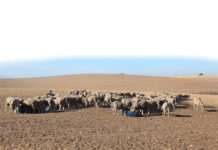
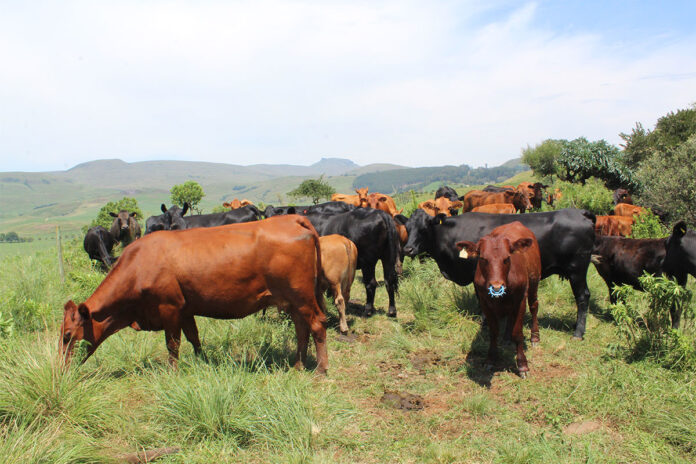
Bramleigh Farm has 50 Angus cattle, which are raised entirely on veld. As Kauerauf aims to double the size of the herd, he retains around 80% of the heifers that are born. Bull calves and bought-in weaners are grown out and sent to slaughter when they are at least two-and-a-half years old.
The farm’s rough, steep terrain and ample indigenous bush mean that grazing is only feasible on around 120ha of the 200ha. While the goal is to eventually move the cattle once every day between grazing camps to maximise vegetative growth in the grass, they are currently moved every two to three days.
“The terrain is quite challenging, and at this stage, we don’t have enough water infrastructure or fencing to set up high-density grazing camps across the whole farm, so only about 50% of the camps are grazed at high density.
“Our carrying capacity is around 75 to 80 head of cattle on the 120ha, but as our veld improves, we should be able to push it to 100 head,” says Kauerauf.
The veld is mostly mistbelt sourveld, consisting of turpentine and red grass. Cattle are moved based on the nutritional value of the grass in the camp and its growth stage.
“From October to April, we rush the cattle around the farm to keep the grass in a vegetative state and prevent it from going to seed. Once it goes to seed, the nutrient density, especially protein, crashes.
“After the grass is grazed, it lies dormant for a day or two before it starts growing again. If it is continuously grazed after that, the veld can become overgrazed, so we have to move the cattle within six days of them being in a camp. But if the camp is left alone for too long, the grass goes to seed, so the cattle need to return again soon.
“If we can prevent the grass from going to seed in autumn, then it goes dormant with the first frost, and the nutrients are essentially banked, making it available to the cattle in winter. Our terrain is too rocky to cut and bale the grass, so we need to keep the nutrients in the field,” explains Kauerauf.
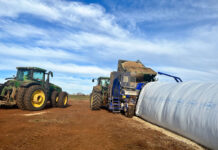
In winter, the cattle receive a protein supplement and, where needed, additional hay bales are brought in towards the end of winter.
Paying attention to rumen fill is important in deciding when to move cattle between camps. Kauerauf says that if the animals’ stomachs aren’t protruding on the left side by the afternoon, they didn’t have enough food and they need to be moved.
“You can’t regain growth that was lost, so it’s important to pay close attention to how much food is available. We would rather move them sooner than risk losing a day’s production.”
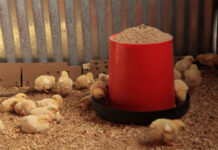
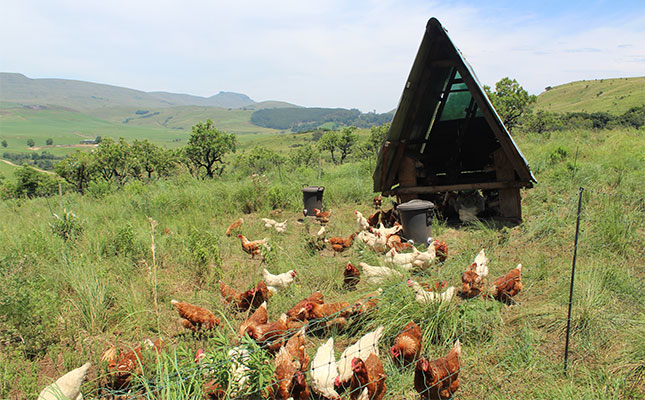
Keeping chickens in mobile coops has been advantageous to the cattle, too. Three coops are moved around on a 7ha stretch of land. Because of the added fertilisation from the chicken manure, the grass grows significantly faster than in other fields, making more food available for the cattle.
These camps are especially useful in summer when tick pressure is high, as the chickens eat ticks that fall off the cattle and any larvae that are present in the field. This reduces the overall tick population and the frequency that the cattle need to be dipped.
Added benefits through diversification
Since Bramleigh markets its meat directly to consumers, cattle are slaughtered based on demand. This results in around two per month but can increase to four.
The herd is kept together, with the bull running with the heifers, cows, and steers. Kauerauf says the cows have naturally synchronised and calf between the end of September and the end of October. The heifers generally conceive when they are around two years old.
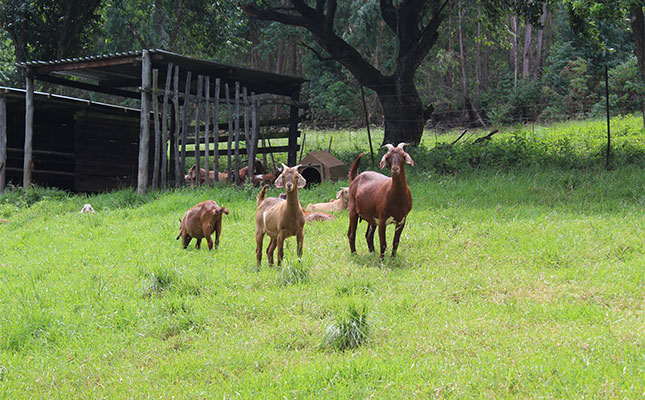
Some 40 Saanen–Kalahari Red cross goats are kept on the farm, with the herd evenly spread between males and females. Seven of the ewes are milked and the milk sold fresh, while the rest of the herd is reared for the live market, bar the one breeding ram.
Kauerauf notes that the Saanen–Kalahari Red cross means the goats have good milk production but are also a good size for the live market.
Demand for the goat’s milk is high, and all 220ℓ produced each month in the summer are sold. In winter, milk production halves.
The goats are also raised on pasture but are given an all-purpose livestock ration in the evenings to boost milk production. Kauerauf says that although the goats could be milked twice a day, this would not only increase the labour but also place unwanted strain on the ewes and their kids.
The goats have their own camps, although cattle need to be brought in twice during the summer to keep the grass short.
“Goats are fairly light on the land, and they can’t keep up with the grass growth in summer. The added benefit of bringing in the cattle is that they provide a larger load of manure and urine, which are good for the soil, as is the extra hoof action they bring.
“Having both species graze the land has its benefits, since goats will graze grass from top to bottom, so there is good vertical utilisation of the grass,” he says.
Kauerauf aims to increase the organic carbon levels in the soil through grazing management.
“If the carbon levels are increasing, you know you’re succeeding in putting in more than you’re taking out. We test the soil regularly and have managed to increase the carbon by 0,5% over the last six years just through proper livestock management.
“Visually, we can also see that we are making progress, as the veld looks more vibrant, and grass coverage has increased in areas where the soil was once bare.”
The chickens were the first to arrive on the farm, and they are still the biggest income generator. However, the focus has shifted from broilers to layers, as obtaining day-old broiler chicks has been challenging.
“The suppliers prioritise orders from large farms. If you aren’t taking 2 000 chicks at a time, you get bumped to the back of the queue. We now focus on layers, producing around 700 eggs per day in summer and slightly less in winter. We achieve a 70% lay rate over the year, which I’m happy with,” says Kauerauf.
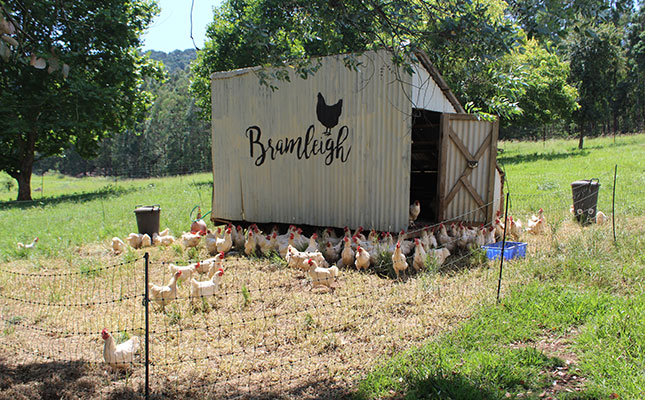
The chickens live on pasture in mobile coops, which are moved frequently. The fields in which the birds reside were initially overgrown with bramble. Not wanting to use herbicides, Kauerauf brought in pigs to clear the fields.
“The pigs dig out the bramble roots and in the process completely destroy the bushes. They are far more effective than herbicides, which you would need to apply multiple times before the bramble dies.
“Once those fields were cleared, we let the pigs graze every other nook and cranny on the farm that needed clearing. We eventually ran out of space for them, especially since cattle production was ramping up at the time, so we have since phased them out.”
The chickens’ diet consists of foraged food, which includes insects and planted pasture that contains chicory and clover. Layer pellets are also provided to ensure optimal nutrition.
“We have Hy-Line Brown chickens that are bred for performance, so they have a high feed requirement. They forage quite aggressively, which takes energy, so the fact that they forage for food doesn’t mean you can feed them less.
“So although we don’t save costs by placing them on pasture, we do have healthier chickens that produce more nutritious eggs, since the chickens have a diverse, more natural diet.”
Building value through direct sales
Marketing and selling the farm’s produce directly to consumers is essential for the couple to obtain sustainable prices for their products.
“We retain a larger portion of our revenue and have the opportunity to build relationships with our customers, understanding their needs and tweaking production where possible,” says Kauerauf.
He notes that the farm’s produce is sold at prices similar to those in supermarkets.
“We can’t charge what the produce is worth, as consumers have a price ceiling based on [retailers’] prices, but we can make a living off the prices we receive.”
Initially, much time had to be taken to educate consumers on the value of Bramleigh’s produce. However, Kauerauf says that since the COVID-19 pandemic, consumers have become very focused on healthy eating.
“There is also a lot of awareness of greenwashing, and consumers are careful of what they buy.
“The initial swing towards veganism as a route to a healthier diet seems to have swung in the opposite direction, as consumers realised that meat replacements are very processed and not all that healthy. Meat is now back on the table, but it’s ‘clean’ meat that adheres to high welfare standards.”
Direct marketing is time-consuming, as deliveries are done three times per week.
“Ideally I’d like to spend half the time I do on marketing, as it takes up 60% of my week, but at the scale we operate, outsourcing marketing is not possible,” explains Kauerauf.
“But having a diversity of products does help, since there is more to place into an order. In addition to the meat, milk, and eggs, we also do sourdough bread, and make soaps and balms using the beef tallow.”
Diversifying the farm’s income is an ongoing pursuit, which Kauerauf believes should only be limited by their creativity.
“We’ve come up with a list of about 25 avenues we can take, from fairly simple and easy options like honey and berry production, to the more ambitious like opening a farm shop and supplying ready-made farm-fresh meals.”
He adds that agritourism is growing in popularity, as more and more people want to experience farm life.
“They want to help with the egg collection and see the goats being milked. Those who get an opportunity to taste our produce often become regular customers. So the plan is to expand the accommodation on the farm.”
Finding balance in a complex system
As the farm evolves, so too does Kauerauf’s understanding of what it takes to make a regenerative system work in practice. The lessons learnt are less about rigid rules and more about mindset, adaptability, and a willingness to rethink assumptions, particularly when balancing ecological ideals with the realities of running a viable farming business.
“Regenerative farming means you need to be a generalist because there must be diversification. You also need to let go of perfectionism. Renowned US regenerative agriculture farmer Joel Salatin says, ‘Good enough is perfect’, which takes some of the pressure off.
“When you start the regenerative farming journey, and you’ve read all the books and watched the fancy YouTube videos, you create a perfect idea of what you want your farm to look like. But it’s unrealistic, as things never work out perfectly in nature. It takes some letting go of those ideals to get to a point where you realise that good enough is perfect, as long as you’re improving from one year to the next.”
A piece of advice from Salatin that Kauerauf has discarded is the principle of only buying equipment that has multiple purposes and can be utilised for most of the year.
“This caused a lot of stress initially. We got to a point where we were standing still and burning out because we didn’t buy the equipment we needed to make things easier, as it would stand idle for a large part of the year.
“We realised that if we were constantly struggling, the business wouldn’t make it anyway. Now we’re a bit more sensible and invest in what we need to get through the season,” he explains.
Paring back ambition has been important to achieve a healthy work-life balance. Kauerauf quips that he wished he realised that not everything needed to be done on a commercial scale when he first started farming.
“In the beginning, we were so focused on maximising our return on investment and wanted to go as big as we possibly could. But we got burnt out. It was a big relief when we realised that we could just enjoy some of the divisions, without commercialising the business.”
YouTube videos and books on regenerative farming abound, but Kauerauf stresses that knowledge only becomes valuable once it’s applied.
“You can read everything there is, but the real learning starts when you implement it. That’s when the theory begins to make sense.”
This process of learning by doing has also shifted his perspective on conventional agriculture.
“There is a tendency to dismiss it as factory farming, but when you start farming yourself, you realise there are reasons behind those systems. It’s not wrong; I just didn’t understand it before.”
Looking ahead, Kauerauf remains focused on refining rather than expanding.
“It’s a lot harder than I thought it would be, but over time I’ve started to enjoy the daily problem-solving. I take a long-term view and appreciate that the decisions I make now only show results a year or two down the line.”
Ultimately, the Kaueraufs’ goal is not to build a mega-farm but a resilient, sustainable family enterprise. By keeping the operation aligned with what the land can support, and what they can manage, they’re building a system that prioritises longevity, both for the business and for the next generation.
For more information, email Andre Kauerauf at [email protected].